
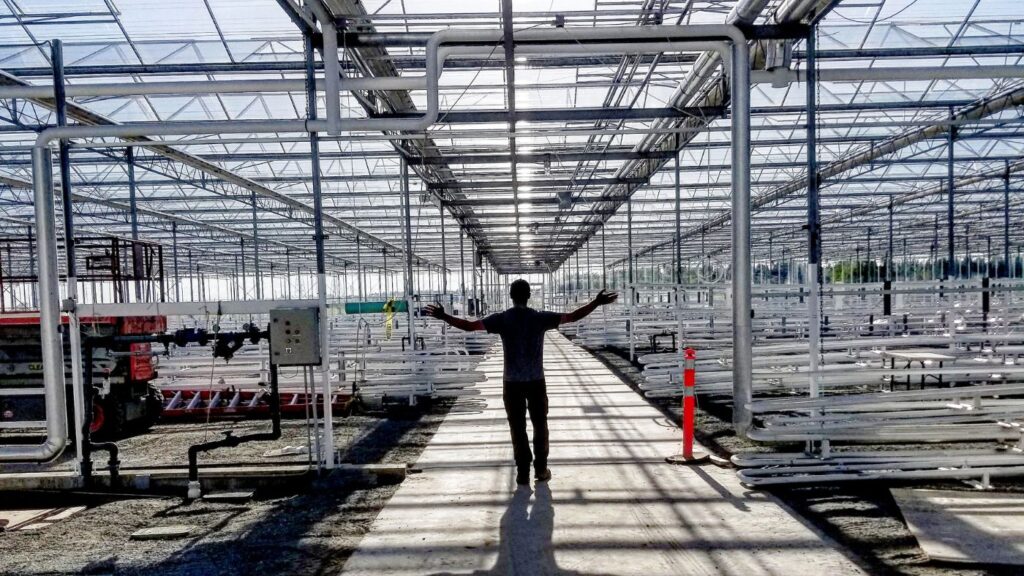
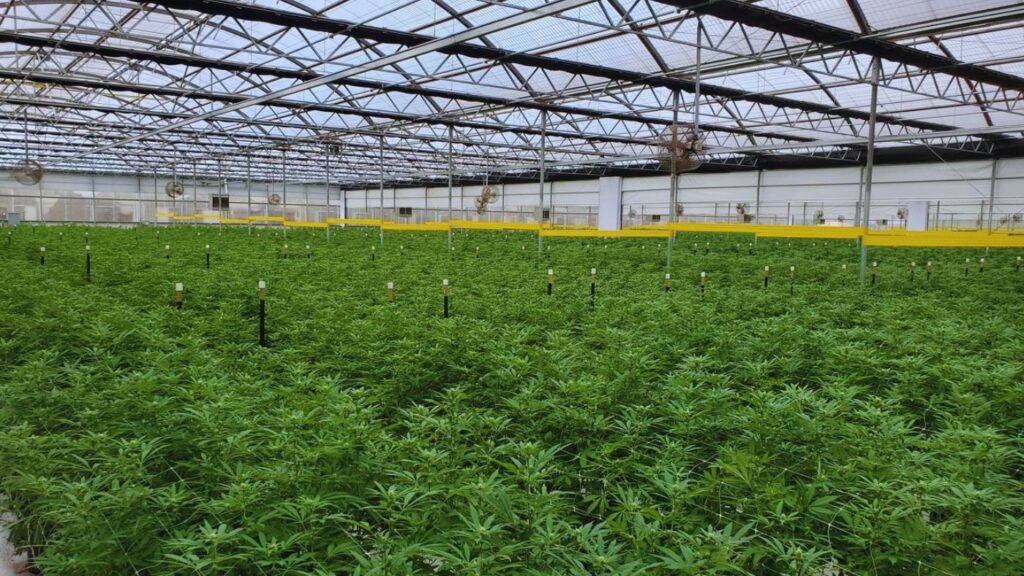
Under new state law, cannabis cultivators are banned from building new greenhouses unless they are built in the footprint of old ones, which are “getting a second life,” according to a greenhouse manager.
California’s Salinas Valley is referred to as the “salad bowl of the nation,” best described in iconic pages when John Steinbeck, American author and son of the Monterey County community, put pen to paper in most of his classic writings.
It’s here in this region of sprawling fields about 100 miles south of San Francisco where Japanese immigrants found their American dream after World War II in the cut flowers business, evident even today.
“A lot of these houses are Japanese-style houses,” said Alicia, a cannabis properties realtor.
With California’s law legalizing marijuana poised to go into effect next year, Salinas enters a new chapter in its agricultural history. It could become the cannabis capital of the state.
Alicia agreed to show us around the valley on the condition we don’t share her last name. She specializes in the new green that’s growing here, pointing out farms she says are now cannabis farms.
“Look. Barbed wires, cameras,” she said.
Alicia works to sell, buy or manage what used to be properties housing the booming flower market, properties that have since fallen apart due to various free trade agreements over the years.
She says ever since California legalized marijuana, there’s new life breathing into the valley and sucking dry the idea of continuing with the cut flowers business, when owners can sell their properties for millions.
“It wouldn’t make sense to grow flowers, you know, at $5 million,” she said.
Under new California law, cannabis cultivators are banned from building new greenhouses, unless they are built in the footprint of old ones. So any “green” house in the state has the potential to evolve into a “grow” house.
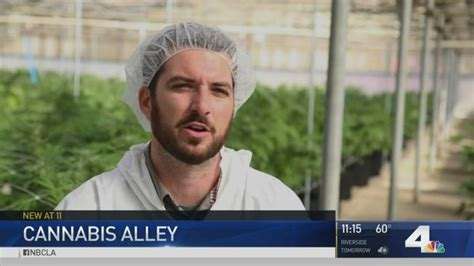
“California cannabis is its own brand, no different than California wine or anything else,” Michael Williamson, the director of operations at Harborside, a leading cannabis grower and distributor in Northern California.
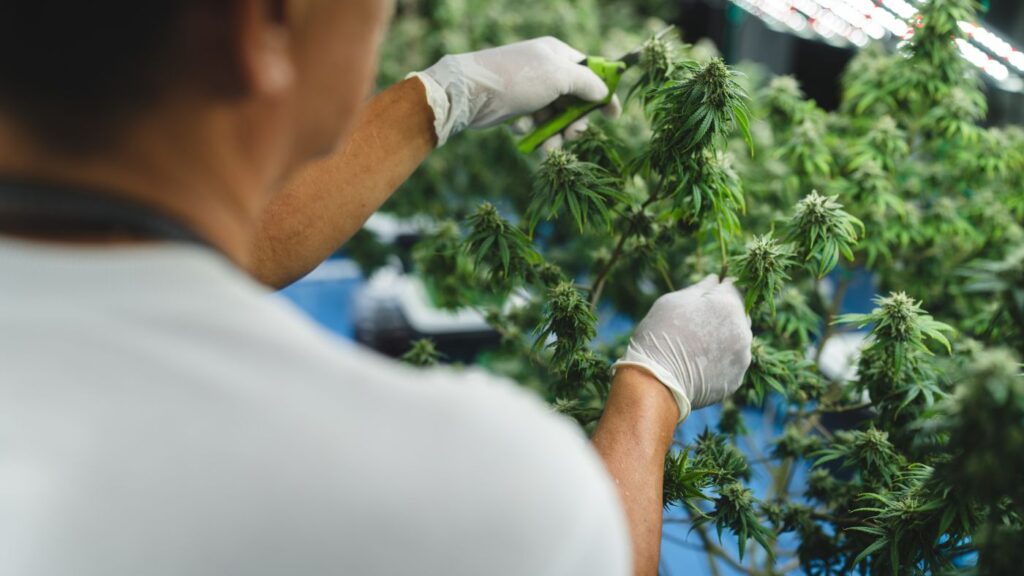
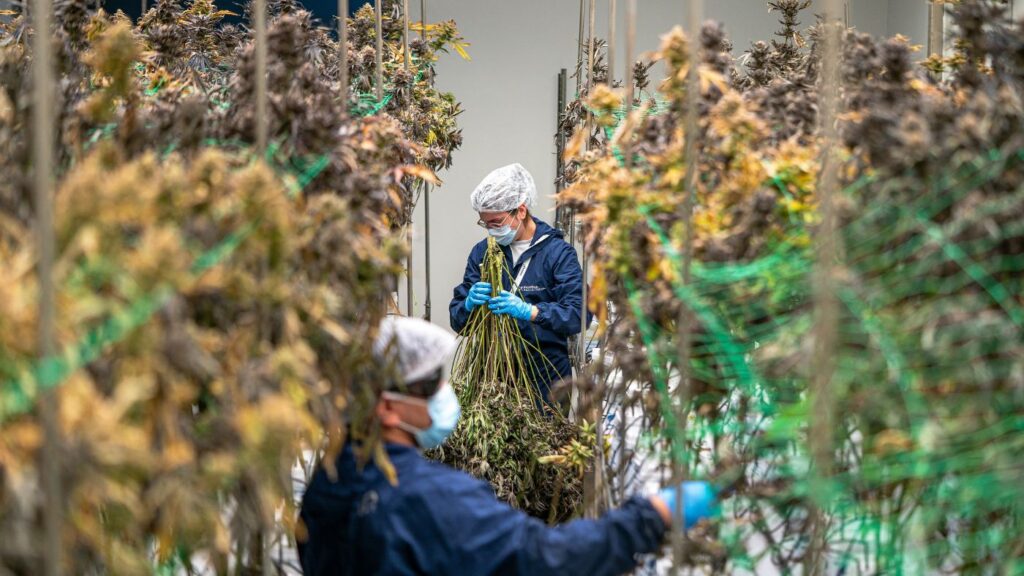
He says his hairnet, white jumpsuit and gloves are a way to keep the product pure and free from human interaction.
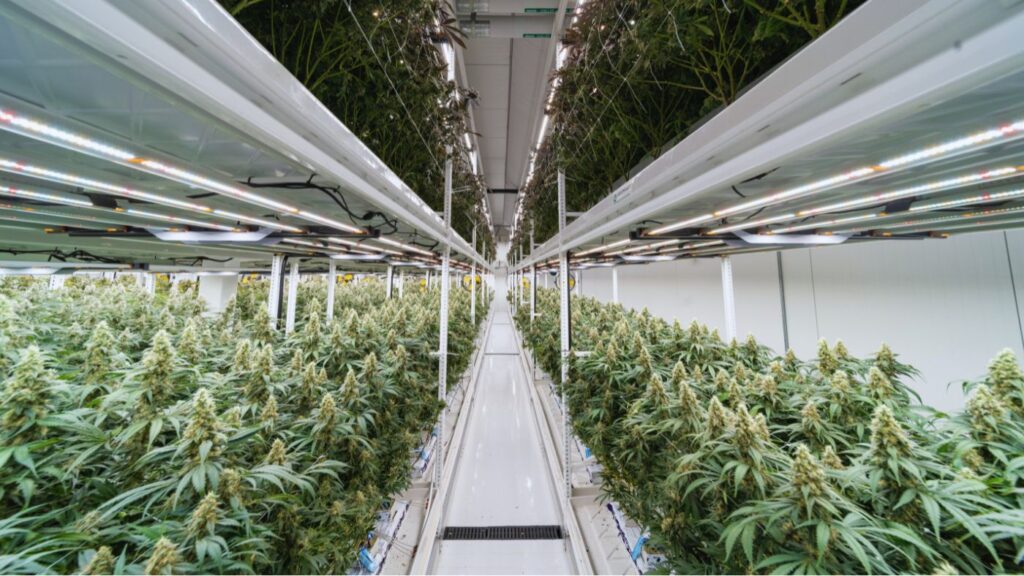
“When you look at our product and our plants, it’s really not that different than a lot of the cut flowers market,” he said. “Which makes this valley kind of the potential to be the Sonoma Valley of cannabis.”
Williamson wouldn’t say how much Harborside makes on its product, adding that for now, it’s grown solely for medical purposes.
He said the company is eyeing Los Angeles for what’s to come.
“Our moral compass is always the same,” he said. “We want to create a safe, consistent and hopefully potent cannabis.”
Growers in Monterey County say they take pride in more than just their product, but also what the industry is doing for the local workforce: the general contractors, green house manufacturers, security companies, fence installers, security camera installers and providers.
“We feel that cannabis could be a $1 billion crop within the next 24 months in Monterey County,” said Mike Bitar, the cofounder of Grupo Flor, a company that’s been actively seeking out empty greenhouses to manage. “These greenhouses are getting a second life. Right now there are no empty greenhouses in Monterey County. They’ve all either been leased up or purchased in the last six months.”
The numbers are already massive.
According to Arcview market research, a company specializing in the marijuana market, California accounted for 31 percent of the legal cannabis market in the U.S. last year. Locally that’s only for medical use. Compare that with Colorado at 19 percent and Washington at 11 percent, where marijuana is legal for recreational use.
“This industry has grown by leaps and bounds,” said Daniel Yi, a spokesman for Medmen, a cannabis management and investment firm based in Los Angeles. The company has a cultivation site in Sun Valley and also runs a dispensary in West Hollywood.
“LA plays a huge role in terms of what we’ve learned over 20 years of regulation, what we’ve learned in techniques and cultivation. We have a lot of experience and a lot of demand,” he said.
Yi says research is showing as states legalize marijuana for recreational use, more and more users are opting against the flowery buds for smoking and turning to products that come from extracting the oils from pot plants.
“There are edibles, there are extracts, there are vape pens,” he said.
And with much of the state’s demand coming from LA, it leaves the smaller towns up north with dreams of what that could do for them.
“It’ll be a pretty phenomenal crop going to LA, I’m sure, because their numbers are big,” said Salinas Mayor Joe Gunter, adding his city is actively working to become a model for others in how to regulate the industry.
“We have to embrace it because it’s coming.”
For many, though, it’s been here for decades.
“Our industry has been testing cannabis, has been labeling cannabis and has been concerned to consumer safety long before the California legislature woke to this monster,” said Salinas attorney Gavin Kogan who made cannabis law a specialty.
But there’s one thing that’s keeping cannabis from growing greener across the country: the stigma of the drug the feds still say is illegal.
“We’re chipping away at it,” Yi said.
Michael is now the Cheif Operating Officer of Catalyst BC and has consulted on numerious cannabis cultivation facilities.
Source: NBC Los Angeles By John Cádiz Klemack
Additional Resources
Consulting Services For Cannabis, Hemp, Psilocybin, and Natural Medicine
- Consulting Services Overview
- Business Strategy
- Financial Planning
- Cannabis, Hemp, Psilocybin, & Natural Medicine Licensing and Applications
- Facility Design
- StartUp Support
- Genetic Development
- Business Turnaround
- Operational Optimization
- Vertical Farming
- Controlled Environmental Agriculture (CEA)
- State and Country Services Directory
- Blog
- Home
Testimonials and Public Relations
Latest Articles
- How Much Does It Cost to Open a Dispensary in 2026?
 The allure of jumping into the legalized cannabis industry often paints a picture of quick riches and burgeoning demand, yet the reality of establishing a licensed cannabis dispensary is far more nuanced, capital-intensive, and fraught with unique financial challenges. For aspiring entrepreneurs and seasoned investors alike, understanding the true dispensary startup costs is the absolute bedrock of success.
 - Virginia Cannabis Facility Design & Build-Out for the 2027 Market
 This guide covers the major considerations involved in planning and building a Virginia cannabis facility, with a focus on retail and cultivation operations and additional considerations relevant to processors and microbusinesses. It is written from the build side of the business, because that is where many otherwise-strong applicants stumble: they underestimate utility needs, local approvals, security infrastructure, commissioning, and the time required to convert a site into an inspection-ready operation.
 - Virginia Dual-Use Cannabis Conversion (2027): The $10M Medical-to-Adult-Use Pathway
 For Virginia’s existing medical cannabis operators, the 2026 retail framework created a distinct and high-stakes transition: pharmaceutical processors may apply for verification to exercise dual-use privileges and serve both registered medical patients and adult-use customers. The pathway covers the processor and its permitted cannabis dispensing facilities, and it carries a one-time $10 million fee, a required medical cannabis program preservation plan, an impact-licensee business accelerator commitment, and a firm May 1, 2027 payment or installment-plan deadline.
 - Virginia Impact Cannabis License (2027): Social Equity & the Equity Business Loan Fund
 Virginia’s adult-use cannabis framework creates a meaningful pathway for applicants from communities and backgrounds affected by cannabis prohibition and enforcement. The law does not create a separate, stand-alone impact license. Instead, it creates an impact-licensee designation that qualifying applicants may pursue alongside an underlying marijuana establishment license, such as retail, cultivation, processing, microbusiness, transportation, delivery, or testing.
 - Virginia Cannabis Microbusiness License (2027): Eligibility & the Two-Location Model
 This guide explains the initial eligibility pathways for the licenses the CCA may issue by May 1, 2027, the difference between a microbusiness license and an impact designation, the indoor and outdoor cultivation limits, the precise rules governing two locations, and the financial, security, and operational readiness standards applicants should prepare to demonstrate. Several implementation details – including fees and the specific combination of privileges the CCA will authorize – still depend on forthcoming regulations.
 - Virginia Cannabis Cultivation License (2027): The Tiered System Explained
 For operators whose strength is growing cannabis, Virginia’s emerging adult-use market presents a significant opportunity – and a cultivation license is the gateway to it. The June 2026 framework authorizes the Virginia Cannabis Control Authority (CCA) to begin accepting license applications on or after February 1, 2027 and issuing licenses on or after May 1, 2027. It also establishes five cultivation tiers with maximum canopies ranging from 5,000 to 35,000 square feet.
Explore Our Articles
cannabis applications Cannabis Bar Cannabis Business Optimization cannabis careers Cannabis Compliance Cannabis Consumption Cannabis Consumption Bar Cannabis Inventory Management Systems Cannabis Investors cannabis jobs Cannabis Legalization cannabis licensing Cannabis Lounge cannabis marketing Cannabis Operational Procedures cannabis outreach Cannabis Regulations Cannabis Security Cannabis Software Cannabis Startup Cannabis Supply Chain Cannabis Technology Colorado controlled environment agriculture Cultivation cultivation facility Dispensary Design facility design Financial Planning HVAC HVACD Iowa Kansas Legal Update Legislation Medical Cannabis Minnesota Natural Medicine Nebraska New York Odor Control Oregon Psilocybin Psychedelics Recreational Cannabis
Free Ebook – Start Your Own Legal Cannabis Business