Alabama Cannabis Consultants for AMCC Buy-Ins, Renewals and Yield
Alabama cannabis consulting starts with whether you can apply: the Alabama Medical Cannabis Commission (AMCC) is accepting requests only for state testing laboratory applications, through December 31, 2026. We help investors buy into licensed companies and help licensees renew and raise yield; our records show 58+ licenses secured.
A Decade of Harvesting Success - Trusted by Cannabis Operators Worldwide
Three AMCC Dates Before Year-End
Updated: 10/8/2026. Alabama’s program is medical only. The Darren Wesley “Ato” Hall Compassion Act of 2021 (Code of Ala. § 20-2A-1 and following) caps licenses at 12 cultivators, 4 processors, 4 dispensaries and 5 integrated facilities; secure transporters and testing labs have no cap. Physicians may recommend forms such as tablets, capsules, tinctures, oils, creams and inhalers, but not raw plant material, smoking, vaping or food products. The AMCC’s August 27, 2026 release said a Talladega store opening August 28 would be the state’s second dispensary (AMCC release).
The dates ahead are a meeting, a renewal deadline and an application cutoff, not a round for the capped licenses. The Commission meets October 29, 2026; its October 8 meeting was canceled (AMCC meetings page). Most cultivator, processor and transporter licenses were issued December 29, 2025 for one year, and a renewal may be filed no more than 60 days before expiry, so from October 30. Requests for a testing-lab application close December 31.
Meet Catalyst BC's Founders
-
Leif Olsen
Chief Executive Officer
-
Michael Williamson
Chief Operating Officer
-
Ian Miller
Executive Chair
Our partners bring multi-faceted expertise across business strategy, licensing, facility development, finance, and commercial operations. That breadth is complemented by subject matter experts across the wider Catalyst BC team, allowing us to bring the right combination of experience to each client and project. The result is bespoke, collaborative support shaped around your business, priorities, and goals - with the right expertise brought to the table when it matters most.
Where an Alabama Cannabis Consultant Fits in an AMCC File
During an application, the AMCC’s rules bar applicants and anyone acting on their behalf from contacting commissioners or staff about the file except through written channels such as its Applicant Questions portal (Ala. Admin. Code r. 538-X-3-.04). An Alabama cannabis consultant cannot lobby for you; the work is the written file, the deficiency responses and, if the Commission asks, the presentation.
Buying Into Alabama Cannabis Without a New License
If you are new to cannabis and bring capital, five rules decide who can own and on what terms. First, an applicant must show that a majority of its ownership belongs to people with at least 15 continuous years of Alabama residence before the application date (Code of Ala. § 20-2A-55(a)(10)). Second, a person or company with an interest in one licensee may hold no interest in any other licensee (r. 538-X-4-.16(3)). Third, an option to buy in counts as ownership, and warrants and convertible debentures are generally treated as already exercised (r. 538-X-4-.16(9)). Fourth, no one may lease, pledge or borrow against a license (§ 20-2A-68). Fifth, every owner, director and person with an economic interest submits to state and national background checks, and an applicant is ineligible if an owner, director, board member or controlling holder was convicted of, or released from prison for, a felony in the past 10 years (§§ 20-2A-55(b) and 20-2A-56(b)(1)).
With no offering open in the capped categories, the route into an operating Alabama business today is an approved stake in a licensee (see ownership). The testing lab is the open door, but a lab’s applicant and every investor in it may hold no interest in a licensed cultivator, secure transporter, processor or dispensary (§ 20-2A-66(e)).
Lenders can still secure a deal. A licensee’s facilities may be put in trust or mortgaged to secure debt without the Commission’s consent, but the lender needs approval before enforcing in a way that would transfer the license, move ownership to a non-qualifying entity or otherwise break the rules (r. 538-X-4-.16(11)). The AMCC added a missing “not” to that provision, which as published would have required consent, before certifying the rule on April 9, 2026 (AMCC minutes, April 9, 2026), and the amended rule took effect June 14, 2026. We plan investor returns as distributions on an approved stake, not as a claim on the license.
Our work for Alabama investors: diligence on a licensee and its ownership chain through cannabis business strategy; the capital plan and cash runway through cannabis financial planning; ownership-change and testing-lab filings through cannabis license application support; and site and local-approval work through cannabis startup support.
Already Licensed in Alabama: One Lab, Container Rules and No Canopy Tier
The Act and the AMCC’s rules set no canopy tier, a size band licensed by square feet of plant canopy. What they do set: all cannabis must grow in an enclosed facility, never outdoors or directly in the ground, each plant or batch in its own receptacle of soil or growing media, and only from cultivars the Commission approved before you acquired plant material. At least quarterly, at your cost, a state lab must sample your cannabis for pesticides (r. 538-X-5-.05).
Moving a facility needs the Commission’s prior approval, with photographs of the new site, proof of your right to occupy it and verification of local-law compliance (r. 538-X-4-.08). A temporary departure from your filed plans can get a waiver of up to six months, renewable once. On January 26, 2026 the Commission approved two layout modifications, one a phased dispensary build-out with a smaller first phase, and three relocations (AMCC minutes, January 26, 2026).
A failed sample fails its whole batch, and within seven days you must accept and destroy it, retest, challenge or remediate; a batch that fails a microbial screen may still become a CO2 or solvent-based extract, which must then pass every required test (r. 538-X-10-.08). A retest or challenge requires three samples taken at the start, two of them quarantined at your facility. If a retest passes, a tiebreak test at another lab decides the result, and a challenge sends parallel samples to two more labs; both happen only “if available,” and the AMCC’s lab list shows one current license, Green Health Laboratories, in a term running to July 15, 2027 (testing laboratory summary). Where no other lab can test, the rule leaves a licensee “no choice but to accept the result of the failed test and destroy or attempt remediation of the batch.”
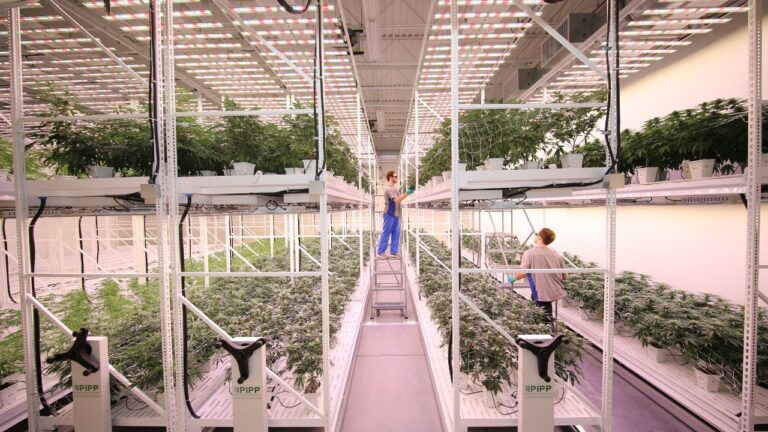
For Alabama rooms we work on Alabama cannabis facility design and HVACD (heating, ventilation, air conditioning and dehumidification), controlled environment agriculture targets that clear microbial limits, cannabis vertical farming layouts that add yield inside an enclosed facility, operational optimization and, when margins slip, a cannabis turnaround diagnostic. Our Chief Operating Officer and co-founder Michael Williamson has 25,000+ hours in cultivation and dispensary operations and co-founded Greenhaus Industries, which patented stackable trays for multi-tier growing.
Our Alabama record: Homestead Health (Jasper Development Group, Inc.), one of the four AMCC-licensed processors, has been our client since 2021, and our records list Alabama client work from 2021 to present. Leif Olsen, our Chief Executive Officer and a co-founder, leads our licensing work. Ian Miller, our Executive Chair and a co-founder, led a vertically integrated licensee elsewhere whose license-activation inspections were flawless, the kind of pre-opening inspection every Alabama facility must pass. We have no Alabama office; we deliver work on-site and remotely, and the same team runs Catalyst BC’s national cannabis consulting practice.
A word against our own interest: the AMCC posts its forms and full rules free, and its own rule says renewal “is not meant to be onerous.” To talk through an Alabama file, contact us or call (USA) 303-305-3787.

Investing in Alabama cannabis
- Cannabis Business Strategy ConsultingDiligence on an AMCC licensee
- Cannabis Financial Planning & ModelingReturns without pledging the license
- Cannabis Licensing & Application SupportOwnership changes and lab filings
- Cannabis Startup SupportLocal approval and site setup
Already licensed in Alabama
- Cannabis Facility Design & HVAC / HVACD EngineeringDehumidification for clean batches
- Cannabis Controlled Environment Agriculture (CEA)Climate that clears microbial limits
- Cannabis Vertical Farming ConsultingMore yield in an enclosed facility
- Cannabis Operational OptimizationBatch yield, labor and cost
- Cannabis Business Turnaround & Operational RecoveryRecovery before a renewal or sale
Compliant Harvests
Square Feet of Cultivation, Production, and Retail Facilities Designed
Licenses Secured
What the AMCC Is Accepting in October 2026
Applications in the capped categories open only when the Commission posts an offering announcement on its website, about 15 to 45 days before the request window opens, with the forms and a timetable (r. 538-X-3-.04(8)). The one offering open on October 8, 2026 is for state testing laboratories, announced June 12, 2026; requests for an application close December 31, 2026 (2026 testing laboratory offering). Nine of the 12 cultivator licenses the Act allows have been issued, two of them listed in the July 23 summary as expiring September 5, 2026, but no cultivator offering has been announced, and the Commission may issue fewer licenses than a cap allows (r. 538-X-3-.03(2)).

AMCC filings open and closed on October 8, 2026
| Filing | Status | Detail |
|---|---|---|
| State testing laboratory license | Open | Requests through December 31, 2026; no cap |
| Cultivator license | No offering | 9 issued of 12 allowed; 2 listed to expire Sept. 5, 2026 |
| Processor license | No offering | 4 issued of 4 allowed |
| Dispensary license | No offering | 3 issued; the fourth awarded, issuance stayed |
| Integrated facility license | No offering | 5 awarded, issuance stayed; hearing noticed for July 27, 2026 |
| Secure transporter license | No offering | 3 issued; no cap |
| Ownership change | Open to licensees | Treated as an application; published on the AMCC website |
| Facility relocation | Open to licensees | Prior approval required |
Statuses from the AMCC’s applicant and licensee summaries (updated January 2 to July 23, 2026), its business page and the 2026 lab offering, read October 7, 2026; every source is listed at the bottom of this page.
The 2026 testing-lab offering, step by step
| Step | Deadline |
|---|---|
| Application form | Sent within 3 days of a complete request |
| Application and exhibits | Due 30 days after the form is sent |
| Deficiency notice | Within 7 days of a timely application |
| Corrections | 10 days after the notice, or 17 with an extraordinary-circumstances extension |
| Public comment | 30 days, starting the day after the application is deemed submitted |
| Pass/fail show-cause response | 10 business days after the notice |
| Award or denial | Within 60 days of being deemed submitted |
| License fee or hearing request | 14 days after the award or denial |
2026 State Testing Laboratory License Offering announcement; the Commission may adjust these timetables.
Renewal clock for licenses issued December 29, 2025
| Point | Rule |
|---|---|
| License term | One year from issuance |
| Earliest renewal filing | October 30, 2026 (60 days before expiry) |
| Renewal due | By December 29, 2026 |
| Late renewal | Up to 60 days after expiry, with the application fee, renewal fee and a per-day penalty of 10 times the daily license fee |
| Operating while late | Allowed during the 60 days only if the license is renewed by the end of that period |
| Not filed by day 60 | License revoked, a penalty for each day operated, and the former licensee must reapply and compete |
| Filed but not renewed by day 60 | Operations stop until the license is renewed |
Code of Ala. § 20-2A-56(g) and (h); r. 538-X-4-.09, .10 and .12; issue dates from the AMCC’s cultivator, processor and transporter summaries.
Investors who cannot wait for an offering should read ownership next.
Six AMCC License Categories and the Caps the Act Sets
Alabama medical cannabis laws sit in two places: the Act at Code of Ala. Title 20, Chapter 2A, and the AMCC’s rules at Ala. Admin. Code chapter 538-X (AMCC law and rules page). The Act licenses integrated facilities plus five independent categories: cultivator, processor, dispensary, secure transporter and state testing laboratory (§ 20-2A-50). No person or entity may apply for more than one category at a time (r. 538-X-3-.03).
What each AMCC license allows
| License | What it allows | Cap |
|---|---|---|
| Integrated facility | Cultivates, processes, dispenses to registered patients and caregivers, moves product between its own facilities and sells to dispensaries | 5 licenses; 5 sites each to start |
| Cultivator | Grows and sells cannabis to processors; sells to dispensaries if a processor processes for it | 12 |
| Processor | Buys from cultivators, makes, packages and labels products, sells to dispensaries | 4 |
| Dispensary | Buys from processors, integrated facilities and contract-processing cultivators; sells only to registered patients and caregivers | 4 licenses; 3 sites each to start |
| Secure transporter | Stores and transports for licensees for a fee; never delivers to patients | None |
| State testing laboratory | Possesses and tests cannabis from licensed facilities | None |
Code of Ala. §§ 20-2A-62 to 20-2A-67 and the AMCC’s cannabis businesses page.
Ownership and financial requirements by category
| Category | Requirement |
|---|---|
| Integrated facility and cultivator | Majority ownership with at least 15 years of cumulative commercial horticulture or agronomic production experience |
| Integrated facility | Commitment for a $2,000,000 performance bond, $250,000 in liquid assets and funds to operate for two years |
| Every license | The Act directs the rules to require at least $2,000,000 of liability and casualty insurance; the application asks for an A-rated insurer’s plan |
| State testing laboratory | No interest in a licensed cultivator, secure transporter, processor or dispensary; ISO/IEC 17025 accreditation |
| Minority share | At least one-fifth of integrated facility licenses and one-fourth of all others go to entities at least 51% owned and run by minority-group members |
Code of Ala. §§ 20-2A-51(b), 20-2A-53(a)(2), 20-2A-55(a)(11), 20-2A-66 and 20-2A-67(d).
Of the six categories, only the testing lab is open now. A lab must hold ISO/IEC 17025 accreditation covering cannabinoids, pesticides, toxins, metals and microbiological bacteria, keep a lab space the public cannot enter and employ at least one person with an advanced degree in a medical or laboratory science (§ 20-2A-66).
AMCC Fees, Bonds and the 10x Late-Renewal Penalty
Every application carries a nonrefundable $2,500 fee, and if the background investigation costs more, the applicant pays the difference (§ 20-2A-55(f)). An awarded applicant pays the annual license fee within 14 days, before the license issues, and pays it again at each renewal, which is filed with an application fee (§ 20-2A-56(f); r. 538-X-3-.16 and r. 538-X-4-.10).
Annual, late-renewal and transfer fees by license
| License | Annual license fee | Untimely renewal fee | License transfer fee |
|---|---|---|---|
| Integrated facility | $50,000 | $52,500 | $50,000 |
| Cultivator | $40,000 | $42,500 | $40,000 |
| Processor | $40,000 | $42,500 | $40,000 |
| Dispensary | $40,000 | $42,500 | $40,000 |
| Secure transporter | $30,000 | $32,500 | $30,000 |
| State testing laboratory | $30,000 | $32,500 | $30,000 |
AMCC Schedule of Fees, Penalties & Fines, revised December 12, 2024. Each untimely renewal fee adds a per-day penalty equal to 10 times the daily cost of the license fee. The schedule does not say whether the transfer fee applies to an ownership change.
Application, correction and background-check fees
| Item | Fee |
|---|---|
| License application | $2,500 |
| Amended application (either type) | $2,500 |
| Corrections after a deficiency notice | $1,250 |
| Corrections with extraordinary circumstances | $2,500 |
| License transfer or ownership-change application | $2,500 |
| Criminal background check | $80 per person |
AMCC fee schedule; Code of Ala. § 20-2A-58(b); r. 538-X-4-.16(5).
Fines the Commission can impose
| Who | Maximum civil fine per violation |
|---|---|
| Individual | $5,000 |
| Licensee | $25,000 or the licensee’s daily gross receipts, whichever is greater |
Code of Ala. § 20-2A-57(b); a fine does not bar criminal prosecution.
Budget accordingly: a testing lab applicant today pays $32,500 to receive its license, the $2,500 application plus the $30,000 license fee, and an investor’s ownership-change request starts at $2,500. When a capped category reopens, a processor, cultivator or dispensary will pay $42,500 and an integrated facility $52,500, with its $2,000,000 bond in place at issuance (our arithmetic from the fee schedule and § 20-2A-67(e)). Our cannabis startup costs breakdown covers the rest of the budget.
Correction to published guidance (October 8, 2026): a published Alabama licensing guide we read on October 7, 2026 says the state Department of Agriculture and Industries governs cultivation licenses. That is out of date. Under Code of Ala. § 20-2A-50(b), as amended in 2024, the Commission licenses, regulates and enforces medical cannabis, with the Department cooperating, and the Commission itself awarded cultivator licenses in December 2023 and August 2024.
How the AMCC Scores, Ranks and Awards a License
When an offering opens, licensing is a contest. The Commission’s primary consideration is the merits of each application, including solvency, stability, suitability, capability, projected efficiency and experience, measured against its baseline and against the other applicants (r. 538-X-3-.11). It also weighs demand, how fully and how soon you will use the license, steps to cut patient costs and the spread of licenses; near-ties at the cutoff may go to a lottery.
A filed application is not yet “submitted.” Deficiencies are corrected first, then a 30-day public comment period runs, and the Commission must decide within 60 days of submission (§ 20-2A-56(a) and (d)). Applications and exhibits are generally public records, and the AMCC may revise the redactions you request (AMCC applicant page).
How to open a dispensary in Alabama once a license is yours
These steps apply to an awarded licensee or an approved buyer (r. 538-X-8-.04 and § 20-2A-64).
- Confirm the city or county has authorized dispensing sites by ordinance or resolution.
- Secure a site at least 1,000 feet, property line to property line, from any school, day care or child care facility, not in a building shared with a certifying physician or another licensee, with parking reserved for patients.
- Place each of your up to three dispensing sites in a different county.
- Have every dispenser trained and certified by the Commission, and set up the registry checks for each patient’s card, recommended product and 60-day purchase limit.
- Pass the pre-commencement inspection with no critical violations and every minor infraction corrected before your first sale.
In the 2026 lab offering, an applicant flagged on a pass/fail eligibility item gets 10 business days to show cause before rejection, so we check eligibility proofs and the ownership schedule first. That is where our cannabis licensing and application team and startup support begin.
Buying Into an Alabama Licensee: The 5% and 50% Ownership Lines
No license, interest in a license or ownership interest in a licensed entity may be sold, transferred or otherwise disposed of, directly or indirectly, without the Commission’s approval, and an unapproved transfer is grounds for suspension or revocation (§ 20-2A-58).
Under the rule as amended effective June 14, 2026, ownership changes fall into three tiers, with a separate notice route for a change caused by a death (r. 538-X-4-.16(4) and (10)). A de minimis change, under 5% of the licensee counting the same buyer’s deals over 36 months, needs no prior approval if it gives no right to pick or remove a partner, manager, officer, director or board member beyond proportional voting rights, does not end minority control of a minority-issued license and breaks no other rule (r. 538-X-1-.04(13)). A non-controlling change below 50% may be approved on a showing that it breaks no law or rule. A change in a controlling interest, more than 50%, may be approved only after a public hearing on the buyer’s suitability.
Every approval request is treated as an application with a $2,500 fee, is published on the AMCC website and sent to the other licensees in the category, and an interested party has 20 days to move to intervene and may ask for a hearing before an administrative law judge (r. 538-X-4-.16(5) and (7)). In February 2026, before the amended rule took effect, the Commission tabled two requests, one adding nine owners holding 0.81% in total, because neither arrived with an application and fee (AMCC minutes, February 12, 2026).
The new owners must meet every ownership qualification in Alabama law and the rules, and no change may push minority-owned licenses below the share the Act requires (r. 538-X-4-.16(6)). Indirect stakes are measured by multiplying the percentages down the ownership chain, with any link above 50% counted in full; in the rule’s own example, 10% of a company that owns 60% of a company that owns 25% of a licensee is a 2.5% interest. Stakes held by a spouse, children, grandchildren or parents are attributed to the individual; and trust and estate interests count as the beneficiaries’ (r. 538-X-4-.16(8) and (9)).
The AMCC’s licensee summaries list each licensee’s owners, percentages and license dates, where our diligence on a stake begins.
Alabama Dispensing-Site Approvals, County Limits and Security
A dispensary may open a dispensing site only where the city, by ordinance, or the county commission for unincorporated areas, by resolution, has authorized dispensing sites; the local body must notify the Commission within seven days of adopting the ordinance or resolution, and cities may still zone dispensing sites (§ 20-2A-51(c)). On October 7, 2026 the AMCC listed ordinances or resolutions received from 64 jurisdictions, 9 of them counties, and said it offers no opinion on whether any complies with state law.
An Alabama dispensary license covers up to three dispensing sites and an integrated facility license up to five, each in a different county from the licensee’s other sites, with more allowed only if the Commission later finds patient demand justifies it (§§ 20-2A-64(f) and 20-2A-67(f)).
Cultivator facilities need a monitored security alarm, video surveillance of everyone entering and leaving, and keypad or card entry; dispensing sites need continuous cameras on each entrance and 60 days of recordings (§§ 20-2A-62(d) and 20-2A-64(d)). Before you sign a lease, confirm the local authorization and the building’s security layout; our cannabis facility design work starts with that screen.
AMCC Inspections, Product Rules and the 9% Medical Cannabis Tax
Before any facility opens it must pass a pre-commencement inspection with no critical violations; after a second failure the licensee must petition for a third try, and failing that one means revocation (r. 538-X-4-.02). After opening, expect at least one announced inspection a year with 14 days’ notice, plus unannounced visits. Noted infractions must be fixed within 30 days, and a critical violation can shut a facility down at once. Injuries, losses and material breaches of your filed procedures must be self-reported within 24 hours (r. 538-X-4-.08(4)).
Products face their own limits. Processors must make medical-grade products under Good Manufacturing Practices, with no additives other than pharmaceutical-grade excipients and no product resembling candy or a cartoon character (§ 20-2A-63), and testing must show less than 0.5 percent variability among batches of the same product (§ 20-2A-66(b)).
What Alabama collects on each sale
A 9% tax applies to the gross proceeds of retail medical cannabis sales, collected and remitted under the state sales tax article, in addition to all other taxes (§ 20-2A-80(a)). Every person doing business under the Act also owes an annual medical cannabis privilege tax on its Alabama net worth, computed at the business privilege tax rate, with the first return due two and a half months after licensing (§ 20-2A-80(b); Department of Revenue).
Before You Buy a Stake or File an AMCC Renewal
Investors get an ownership-change review before they commit: the residency-majority and one-interest tests across your ownership, the approval tier your deal falls in and a financing structure that leaves the license unencumbered. Licensees get a renewal and testing review: your December 29 renewal file, your batch-failure history against the one-lab retest limits and HVACD sized against your microbial results. Send your license type and deal or production figures, and we will tell you plainly if another firm suits you better.
Alabama Medical Cannabis License Questions for Investors and Licensees
Is the Alabama Medical Cannabis Commission accepting license applications now?
Only for state testing laboratories, with requests for an application accepted through December 31, 2026. No offering is open for cultivator, processor, dispensary, integrated facility or transporter licenses, though licensees may file ownership-change and relocation requests.
Can an investor buy part of an Alabama medical cannabis licensee?
Yes, with the Commission’s approval. A change under 5% that gives no management rights, keeps any minority control and breaks no other rule needs no prior approval; a non-controlling change below 50% needs approval; and a controlling change above 50% needs a public hearing. Each approval request carries a $2,500 application fee and is published on the AMCC website.
Do owners of an Alabama cannabis license have to live in Alabama?
Not all of them, but a majority of the ownership must belong to people who had lived in Alabama for at least 15 continuous years before the application date. Integrated facility and cultivator applicants must also show majority ownership with at least 15 years of commercial horticulture or agronomic experience.
What does an Alabama medical cannabis license cost?
Every application carries a $2,500 nonrefundable fee. Annual license fees are $50,000 for an integrated facility, $40,000 for a cultivator, processor or dispensary, and $30,000 for a secure transporter or testing lab. A late renewal costs $52,500, $42,500 or $32,500 by license type, plus a per-day penalty of 10 times the daily license fee.
Can I own part of more than one Alabama licensee?
No. A person or company with an interest in one licensee may not hold any interest in another licensee or in an entity that owns one. Options count as ownership, and testing-lab owners may hold no interest in a cultivator, processor, dispensary or transporter.
Is there a canopy limit for Alabama cultivators?
There is no canopy tier. Cultivation must take place in an enclosed facility, never outdoors or directly in the ground, with each plant or batch in its own receptacle of soil or growing media, only Commission-approved cultivars and pesticide testing at least quarterly.
What happens when an Alabama batch fails a lab test?
The whole batch fails. Within seven days the licensee must accept and destroy it, retest, challenge or remediate, and a batch that fails a microbial screen may become a CO2 or solvent-based extract that must then pass every required test. Tiebreaks and challenges depend on another licensed lab being available.
What taxes apply to Alabama medical cannabis sales?
A 9% tax applies to the gross proceeds of retail medical cannabis sales, on top of other taxes. Every person doing business under the Act also pays an annual medical cannabis privilege tax based on its Alabama net worth.
Cultivation and Facility Work Behind Our Alabama Advice
These projects show the grow-room, extraction and facility work we bring to Alabama licensees; each one’s results are in our case studies.

Hexo Corp.
Gatineau, Quebec, Canada

Bostica
Lynn, MA, United States

Leafline Labs
Cottage Grove, MN, United States

View All Projects
View all Catalyst BC Projects
Reading for Alabama Investors and Licensees

How Much Does It Cost to Open a Cannabis Dispensary in 2026
The allure of jumping into the legalized cannabis industry often paints a picture of quick riches and burgeoning demand, yet the reality of establishing a

Cannabis Startup Costs: From Licensing to Profitability
Starting a legal cannabis business isn’t just about getting a license—it’s about building a profitable, compliant, and sustainable operation in one of the world’s most

Demystifying HVACD Systems for Cannabis Grow Facilities
Cannabis grow rooms require precisely controlled environments, making Heating, Ventilation, Air Conditioning, and Dehumidification (HVACD) systems essential for success. As plants progress through their growth
Alabama Sources: Code of Ala. Title 20, Chapter 2A, Ala. Admin. Code 538-X and AMCC Records
Provenance. Figures checked against the Act, rule and fee-schedule text by Catalyst BC on October 7 and 8, 2026. The Act was read in the AMCC’s compiled statute (updated November 2024) and the rules in the chapter PDFs the AMCC posted in June 2026. License counts, the lab count and the budget figures are our own arithmetic from AMCC records; company figures come from Catalyst BC’s own records. Where this page and the official text differ, the official text governs.
Statute and rules
- Darren Wesley “Ato” Hall Compassion Act, Code of Ala. § 20-2A-1 et seq. (AMCC compilation, updated November 2024)
- Ala. Admin. Code ch. 538-X-1, General Provisions (definitions, fees)
- Ala. Admin. Code ch. 538-X-3, Applications and Licensing
- Ala. Admin. Code ch. 538-X-4, Licensee Requirements (inspections, renewals, ownership changes)
- Ala. Admin. Code ch. 538-X-5, Cultivators
- Ala. Admin. Code ch. 538-X-8, Dispensaries
- Ala. Admin. Code ch. 538-X-10, State Testing Laboratories
Alabama Medical Cannabis Commission pages and records
- Cannabis businesses page (license types, local resolutions and ordinances)
- 2026 State Testing Laboratory License Offering, requirements and timeline
- Schedule of Fees, Penalties & Fines (revised December 12, 2024)
- Applicant and licensee summary information
- Processor applicant and licensee summary (updated January 2, 2026)
- Cultivator applicant and licensee summary (updated July 23, 2026)
- Dispensary applicant and licensee summary (updated July 16, 2026)
- Integrated facility applicant and licensee summary (updated June 30, 2026)
- Secure transporter applicant and licensee summary (updated January 2, 2026)
- State testing laboratory applicant and licensee summary (updated July 16, 2026)
- Meetings, notices and minutes
- Commission minutes, January 26, 2026 (facility modifications and relocations)
- Commission minutes, February 12, 2026 (ownership-change requests tabled)
- Commission minutes, April 9, 2026 (rule changes certified)
- Notice of public investigative hearing, integrated facility (July 9, 2026)
- Talladega dispensary opening release (August 27, 2026)
- License awards release (December 1, 2023)
- Additional cultivator awards release (August 8, 2024)
Alabama Department of Revenue
Contact Us
Enough about us. We want to hear more about you, your project, and your vision! Get in touch with a real live person today. Don’t worry, we don’t have a long, confusing phone menu, and your email isn’t going to the abyss, we promise. At Catalyst, we provide the service and support we’d want to experience ourselves!