Washington Cannabis Consultants for LCB Buyers and Growers
Washington cannabis consulting starts with a closed door: the Liquor and Cannabis Board (LCB) takes new producer, processor and retail applications only through its social equity program. Other investors buy into existing licenses; growers face retail sales down 20.6% from fiscal 2021 to 2025. Our records: 58+ licenses secured nationwide.
A Decade of Harvesting Success - Trusted by Cannabis Operators Worldwide
Washington Cannabis Dates to Plan Around
Updated: 10/11/2026. Washington State licenses cannabis producers, processors and retailers under Initiative 502, which voters approved in 2012 and which tasked the Liquor and Cannabis Board, then called the Liquor Control Board, with building the licensing system. Senate Bill 5052, passed in 2015, merged the unregulated medical market into it, and since July 1, 2016 only LCB-licensed businesses may sell cannabis (LCB cannabis history; LCB medical cannabis page). The governing law is chapter 69.50 RCW, and the board’s rules sit in Title 314 WAC (LCB licensing resources). The Legislature created the social equity program in 2020 and in 2023 extended it to some producer and processor licenses (LCB social equity page).
Three dates frame the next six years. The Legislature’s next regular session convenes January 11, 2027, the second Monday of January under RCW 44.04.010 (our date arithmetic). License fees and the five-license retail limit sit in statute, so changing them takes a change to the statute, as the 2026 fee bill did. Separately, current law ends the medical excise-tax exemption on June 30, 2029, and social equity licensing and its annual fee waiver on July 1, 2032.
Meet Catalyst BC's Founders
-
Leif Olsen
Chief Executive Officer
-
Michael Williamson
Chief Operating Officer
-
Ian Miller
Executive Chair
Our partners bring multi-faceted expertise across business strategy, licensing, facility development, finance, and commercial operations. That breadth is complemented by subject matter experts across the wider Catalyst BC team, allowing us to bring the right combination of experience to each client and project. The result is bespoke, collaborative support shaped around your business, priorities, and goals - with the right expertise brought to the table when it matters most.
How a Washington Cannabis Consultant Works Beside the LCB
The LCB licenses, inspects and enforces; it does not plan your business. Its own consultation program excludes business advice on operations, marketing, distribution, financing, profitability or viability (WAC 314-55-013). A Washington cannabis consultant works on the owner’s side of that line: diligence before a purchase, the ownership-change filings, and the facility, testing and traceability work an inspector checks.
How Investors Get Into Washington Cannabis Without a New License
True parties of interest are, broadly, the owners, anyone with a right to revenue or profit, and anyone who controls the business. Each must meet the six-month Washington residency rule, and an applying entity must be formed in Washington (LCB licensing FAQ). Money from elsewhere can still come in: a financier who is not a true party of interest needs no Washington residency but must live in the United States, the LCB says the funds must come from within the United States, and the financier may not take ownership, control or a share of revenue or profit without qualifying on the license. The board runs a financial and criminal background investigation on every financier (WAC 314-55-035(7)).
The April 28, 2026 federal order moved marijuana subject to a state medical marijuana license to Schedule III and notes that state licensees will no longer be subject to Section 280E, the federal rule that bars ordinary business deductions; other marijuana stays in Schedule I (Federal Register, April 28, 2026). In our view it is unsettled whether a Washington retail license with a medical endorsement counts as a state medical marijuana license under the order, so ask tax counsel before changing a return.
Our work for Washington investors: target diligence and ownership structure through cannabis business strategy; a Washington cannabis business plan with license fees, the 37% excise tax and a Section 280E scenario through cannabis financial planning; the assumption (a new entity taking over a license) or ownership-change file, or a Washington cannabis license application when a window opens, through cannabis license application support; and build-out to final inspection through cannabis startup support.
Already Licensed by the LCB: Lower Sales and Fixed Canopy Tiers
Retail sales reported to the LCB fell from $1.497 billion in fiscal 2021 to $1.188 billion in fiscal 2025, a drop of 20.6% (our arithmetic from LCB county sales reports) (LCB FY2025 sales and excise tax by county). A producer also cannot grow past its tier: the LCB says a producer may expand canopy only within its tier’s allowance and may not change or move tiers (LCB change applications page).
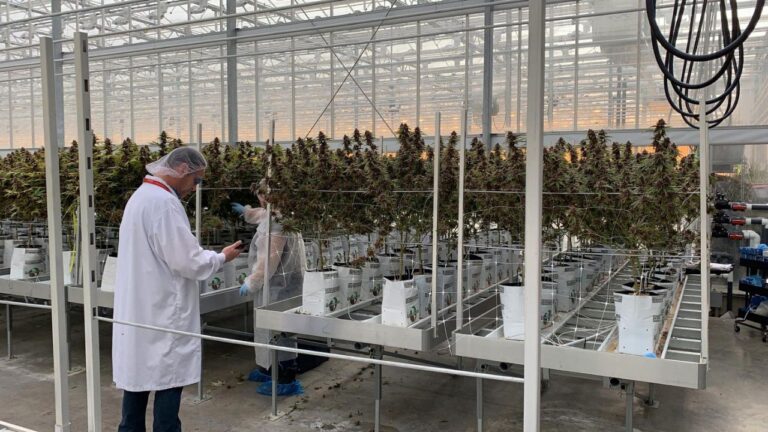
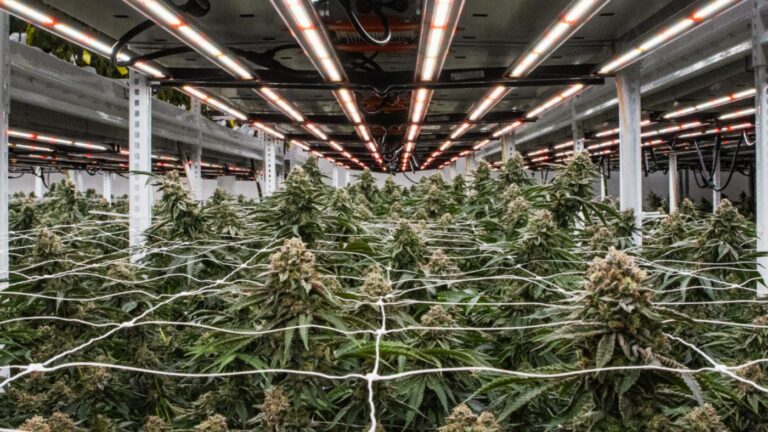
Michael Williamson, our Chief Operating Officer and a co-founder, has designed and consulted on over 7 million sq. ft. of indoor, greenhouse and outdoor cultivation facilities and has over 3,000 compliant harvests (company-reported). For Washington rooms we offer Washington cannabis facility design with HVAC, dehumidification and odor control, controlled environment agriculture for first-time test passes, cannabis vertical farming to grow more within a fixed canopy, operational optimization of harvest scheduling, labor and traceability records and, when margins slip, a cannabis turnaround review.
Our Washington record: we have no Washington client work to date. What we bring is the founders’ operating record elsewhere and the rule-by-rule reading on this page.
Our team: Leif Olsen, our Chief Executive Officer and a co-founder, is a cannabis application and licensing specialist with 18+ years as an owner, operator and advisor (company-reported). Ian Miller, our Executive Chair and a co-founder, was founder and CEO of the Solace Companies, a wholesale vertically integrated cannabis licensee, and raised $22 million in private equity for a greenfield cultivation and processing operation (company-reported).
Where we work: we have no Washington office; we deliver work on-site and remotely, and the same team runs Catalyst BC’s national cannabis consulting practice.
A word against our own interest: a licensee may ask the LCB for one advice and consultation visit a year, and conditions found during it are not disciplined unless they relate directly to public health and safety (WAC 314-55-013). For a narrow inspection question, start there. To talk through a Washington file, contact us or call (USA) 303-305-3787.

Investing in Washington cannabis
- Cannabis Business Strategy ConsultingDiligence on targets and owners
- Cannabis Financial Planning & ModelingFees, excise tax, 280E
- Cannabis Licensing & Application SupportAssumption and ownership filings
- Cannabis Startup SupportBuild-out to final inspection
Already licensed in Washington
- Cannabis Facility Design & HVAC / HVACD EngineeringHVAC, dehumidification, odor
- Cannabis Controlled Environment Agriculture (CEA)Rooms that pass testing
- Cannabis Vertical Farming ConsultingMore yield in a fixed canopy
- Cannabis Operational OptimizationHarvests, labor, traceability
- Cannabis Business Turnaround & Operational RecoveryRecovery when margins slip
Compliant Harvests
Square Feet of Cultivation, Production, and Retail Facilities Designed
Licenses Secured
Who Can Apply for a Washington Cannabis License Today?
Almost no one, for the three main licenses. The LCB is not accepting new producer, processor or retailer applications except under its social equity program (LCB cannabis licensing page), and that program’s registration window is closed (LCB social equity page). The LCB does accept new transportation and research license applications, cooperative registrations and change applications for existing licenses (LCB licensing FAQ).
Until July 1, 2032, the social equity program may issue or reissue forfeited, revoked or canceled licenses and retail licenses never issued under the pre-2020 statewide limit, including up to 100 processor licenses and, from January 1, 2025, up to 10 producer licenses issued with a processor license; it may also issue up to 52 more retail licenses (RCW 69.50.335(1)). An applicant needs at least 51% ownership and control by individuals who each meet two of four tests: five years in a disproportionately impacted area between 1980 and 2010, a cannabis arrest or conviction of their own or a family member’s, household income below the state median, or certification as socially and economically disadvantaged (RCW 69.50.335(6)(b)).
The most recent retail registration window ran from June 2 to July 1, 2025, and 69 registrants had been selected by October 20, 2025 (LCB cannabis history).
For a buyer, that leaves the existing pool. The LCB’s October 6, 2026 list shows 456 active cannabis retailer licenses and, on a separate sheet, 11 active social equity retailers (our count; the LCB warns its lists may contain errors from a data transfer issue) (LCB license list).
NJ-CRC routes and their status on October 1, 2026
| Application | Status | Note |
|---|---|---|
| New producer, processor or retailer | Social equity program only | Registration window closed |
| New transportation or research license | Accepted | $250 application fee plus a $1,300 license fee |
| Cooperative registration | Accepted | No fee |
| Change to an existing license | Accepted | Assumption, ownership change, location change, funding |
LCB cannabis licensing page and FAQ; LCB license fee sheet (LIQ 1387). Every source is listed at the bottom of this page.
Social equity licenses: limits, scoring and transfer locks
| Rule | Detail |
|---|---|
| Licenses the board may issue | Forfeited, revoked or canceled licenses and retail licenses never issued under the pre-2020 cap, including up to 100 processor and up to 10 producer licenses issued with a processor license; in addition, up to 52 retail licenses |
| Selection | A third-party contractor scores registrants on a 300-point rubric; ties go to a double-blind lottery |
| Location | A registrant selected under the 2023 law may place the first location, one time only, in any city, town or county that allows the activity |
| Transfer | No transfer or assumption in the first year; from the first to the fifth year, only to social equity-qualified buyers |
| Annual fee | Waived through July 1, 2032 |
| Licenses issued | 16 across fiscal 2024 to fiscal 2027 to date (our sum of the LCB’s yearly counts) |
RCW 69.50.335; WAC 314-55-570(5), (6) and (8); LCB social equity page.
Who counts as a true party of interest
| Entity | True parties of interest |
|---|---|
| Sole proprietorship | The sole proprietor |
| Limited liability company | All members and all managers |
| Privately held corporation | All officers and directors, and all stockholders |
| Partnerships | All partners; in limited partnerships, all general and limited partners |
| Multilevel ownership structure | All persons and entities that make up the ownership structure |
| Nonprofit corporation | All individuals and entities with membership rights |
| Any business | Anyone with a right to revenue, gross profit or net profit, or who exercises control |
| Not included | A fixed-rent landlord (common ownership or waived rent can draw scrutiny), a person paid sales commissions of no more than 10% under a written agreement, a broker paid a commission on the sale, a flat or hourly consultant, a branding or staffing contractor while the licensee keeps control, a financial institution, and an option holder who has paid the licensee nothing |
WAC 314-55-035(1) and (4); the rule’s list of exclusions is nonexclusive.
Buyers: see buying a license.
LCB License Types, Canopy Tiers and the Retail Ownership Wall
A producer grows and sells at wholesale to processors and other producers; a processor makes and packages products for processors and retailers; a retailer sells to adults 21 and over, with limited exceptions for medical patients (LCB license types page). No licensed producer or processor may hold a direct or indirect financial interest in a licensed retailer (RCW 69.50.328), and an entity and its principals may hold interests in no more than three producer licenses (WAC 314-55-075(5)) and no more than three processor licenses (WAC 314-55-077(3)).
Retail ownership is capped at five licenses held in the aggregate by a licensee and everyone with a financial or other ownership interest in it; since January 1, 2026, management and similar agreements may not confer a financial interest across more than five retail licenses either (RCW 69.50.325(3)(b)).
Washington license types and canopy tiers
| License | What it allows | License fee |
|---|---|---|
| Producer, Tier 1 | Canopy of less than 4,000 sq. ft. | $1,781 |
| Producer, Tier 2 | Canopy of 4,000 up to 10,000 sq. ft. | $1,781 |
| Producer, Tier 3 | Canopy of 10,000 up to 30,000 sq. ft. | $1,781 |
| Processor | Process, package and label products for processors and retailers | $1,781 |
| Retailer | Sell to adults 21+; with a medical endorsement, also to qualifying patients and designated providers | $1,781 |
| Transportation or research | Carry product between licensees, or research under RCW 69.50.372 | $1,300 |
WAC 314-55-075(6); RCW 69.50.325 (annual fees for producer, processor and retailer); RCW 69.50.375; LCB license fee sheet (LIQ 1387).
Washington cannabis milestones, 1998 to 2026
| Year | Event |
|---|---|
| 1998 | Initiative 692 permits medical use only |
| 2012 | Voters approve Initiative 502 (adult use) |
| 2015 | Senate Bill 5052 merges the unregulated medical market with the recreational market |
| 2020 | House Bill 2870 creates the social equity program |
| 2025 | Retail social equity registration window, June 2 to July 1 |
| 2026 | Retail management-agreement limit (January 1); license fee increase (July 1, per the LCB) |
LCB cannabis history and social equity pages; RCW 69.50.325 notes; LCB cannabis licensing page.
Two rules apply in a license’s early years: retail forfeiture and producer tier reduction. The statute directs the board to require forfeiture of a retail license that is not fully open within 24 months of issuance, unless circumstances beyond the licensee’s control warrant more time; no retail license may be forfeited in its first nine months, and none where a local ban, moratorium, or zoning, business-licensing, land-use or other regulatory measure kept it from opening (RCW 69.50.325(3)(c)). And if a producer has not used 50% of its planned canopy by the end of its first year of operation, the LCB may reduce its tier (WAC 314-55-075(7)).
Inventory caps also limit working capital: a producer may hold six months of its annual harvest indoors, or one and one-quarter of a year’s harvest for outdoor or greenhouse grows (WAC 314-55-075(9)), and a retailer up to four months of its average inventory (WAC 314-55-079(10)).
Correction to published guidance (October 11, 2026): a consulting firm’s Washington page, last modified May 7, 2026, lists Tier 1 as up to 2,000 sq. ft. of canopy. The current rule sets Tier 1 at less than 4,000 square feet (WAC 314-55-075(6)(a)).
What the LCB Charges Since the 2026 Fee Increase
Engrossed House Bill 2681 raised the annual issuance and renewal fee for producer, processor and retailer licenses from $1,381 to $1,781 (chapter 262, Laws of 2026); the act took effect June 11, 2026, and the LCB says the increased fees took effect July 1, 2026. A medical endorsement costs nothing to add (LCB license fee sheet).
Ownership changes are billed separately: $75 to change LLC members or corporate officers and stockholders, $75 to accept additional funds from a new or previously approved financier, and a new application for changes in a sole proprietorship or partnership (WAC 314-55-120). An operating licensee that is neither a social equity applicant nor a social equity license holder, and is not being assumed, acquired or closed, may file a social equity plan for a one-time refund of one annual renewal fee per entity (RCW 69.50.331(12); WAC 314-55-570(10)).
LCB license fees after July 1, 2026
| License | Application fee | License fee |
|---|---|---|
| Producer | $250 | $1,781 |
| Processor | $250 | $1,781 |
| Retailer | $250 | $1,781 |
| Transportation | $250 | $1,300 |
| Research | $250 | $1,300, plus scientific review fees |
| Medical endorsement | No fee | No fee |
RCW 69.50.325 (annual fees for producer, processor and retailer); LCB license fee sheet (LIQ 1387, June 2026).
Change application fees
| Change | Fee | Filed with |
|---|---|---|
| Assumption by a new entity | $250 per privilege, plus prorated license fees | Department of Revenue Business Licensing Services |
| Change of governing people or ownership percentage | $75 | Business Licensing Services |
| Change of location | $75 | Business Licensing Services |
| Additional funding | $75 | LCB |
| Alteration, including canopy expansion within a tier | No fee | LCB |
LCB license fee sheet (LIQ 1387); LCB change applications page.
Washington retail sales and excise tax, fiscal 2021 to 2025
| Fiscal year | Retail sales | Excise tax |
|---|---|---|
| 2021 | $1,497,078,869 | $553,944,173 |
| 2022 | $1,376,399,664 | $509,354,815 |
| 2023 | $1,257,812,688 | $465,399,616 |
| 2024 | $1,229,695,710 | $454,897,783 |
| 2025 | $1,188,173,194 | $439,783,952 |
LCB sales and excise tax by county, FY2018–FY2024 (retail sales only) and FY2025; totals rounded to the dollar. Fiscal years run July to June.
Budget accordingly: a producer and processor at one location now pays $3,562 a year in LCB license fees, $800 more than before the increase (our arithmetic from RCW 69.50.325). That is before insurance, which must include commercial general liability and product liability coverage with limits of at least $1,000,000 (LCB application page), and before local permits and taxes.
Buying a Washington License: Assumption, Member Changes and Approval
Licensees must get board approval before any ownership change (WAC 314-55-120(1)). A buyer takes a business over in one of two ways. In an assumption, a new entity takes over an existing license at its current location; in a change of governing people, members or ownership percentages change inside the licensed entity (LCB license fee sheet). Either way the LCB inquires into the source of funds used to acquire the business and verifies every true party of interest (WAC 314-55-020(1)(b)).
How to open a dispensary in Washington through an LCB-approved purchase: five steps
These steps follow WAC 314-55-020, 314-55-035 and 314-55-120 and the LCB’s application pages for a buyer of an existing retail license.
- Screen the target’s license status on the LCB’s retailer list and confirm the buyer group stays within five retail licenses and holds no producer or processor interest.
- Form the buying entity in Washington and confirm each true party of interest has lived in Washington for six months.
- File the assumption or change application through Business Licensing Services, with the addendum the LCB requires for every Business Licensing Services application.
- Answer the licensing specialist’s requests, including criminal history forms, fingerprints and proof of funds, and pay the billed fees.
- Make no ownership change until the LCB’s approval letter arrives.
Plan the site with the deal. A retail licensee may relocate only within the jurisdiction its license was originally allotted to (LCB licensing FAQ). The LCB lists indicators of hidden ownership and a questionable source of funds among its reasons for denial (LCB application page), and in our view hidden ownership and unclear funding are where Washington purchases stall.
True Parties of Interest, Financiers and Brand Royalties
The background check sets lookbacks: one or more class A or B felonies within 10 years, two or more class C felonies within seven years, or three or more misdemeanors or gross misdemeanors within three years trigger a threshold review, as does active supervision; the review weighs rehabilitation, and a record does not automatically bar approval (WAC 314-55-040). A spouse who receives no profits and exercises no control need not be on the license, but a spouse who provides funds must qualify as a financier (LCB licensing FAQ).
Brand owners have a route that needs no license. A licensee may license a trademark, trade secret or technology under an agreement disclosed to the board; a royalty based on sales may not exceed 10% of the licensee’s gross sales of that product, and a licensor in compliance need not qualify for a cannabis license (RCW 69.50.395). Two limits apply: no producer or processor may enter an intellectual property agreement with a retailer (WAC 314-55-035(6)), and a retail agreement that shares branding across more than five retail licenses confers a barred financial interest under RCW 69.50.325(3)(b).
After licensure, every new source of funds must be disclosed before it is invested, except reinvested revenue, proceeds of a revolving loan the board approved within the previous three years (unless its source or approved amount has changed), and funds from an approved true party of interest or financier, which may be used once the application is filed (WAC 314-55-035(5)).
Washington Site Rules: 1,000-Foot Buffers and Local Cuts to 100 Feet
The board may not license premises within 1,000 feet of an elementary or secondary school, playground, recreation center or facility, child care center, public park, public transit center, library or game arcade open to people under 21. A city or county may cut that distance by ordinance to as little as 100 feet, except for schools and playgrounds (RCW 69.50.331(8)). The LCB measures the shortest straight line from property line to property line (WAC 314-55-050(2)).
Local government has a voice. A city, county, tribe or port authority has 20 days after the LCB’s notice to recommend approval or object, and the board may extend that time at that authority’s request (WAC 314-55-020(3); RCW 69.50.331(7)(b)); a city or county may bar producers and processors from areas zoned primarily for residential use, or for rural use with a minimum lot size of five acres or smaller; and a timely objection based on a preexisting outlet-density ordinance stops a new retail license at premises not currently licensed (RCW 69.50.331(9) and (11)).
The building matters too. The LCB will not approve a location that limits law enforcement access (a personal residence, for example), sits on federal land, or sits within a tribe’s reservation without its express written consent; a retail store may not sit within another business except a research licensee, though separately walled licensees with their own entrances may share a building (LCB location requirements page; WAC 314-55-015(7)). Outdoor production needs a sight-obscuring wall or fence at least eight feet high (WAC 314-55-075(1)(b)), and producers and processors are subject to air quality requirements, including air permits and registration, set by regional clean air agencies and the Washington State Department of Ecology based on county (LCB air quality page).
Traceability, LCB-Certified Testing and Washington’s 37% Excise Tax
Every plant, lot, batch, sample and waste stream must be tracked from seed to sale in a system the LCB specifies (WAC 314-55-083(4)), now the LCB’s in-house Cannabis Central Reporting System (CCRS) (LCB CCRS page). Licensees must use LCB-certified labs accredited by the Washington State Department of Agriculture. Required tests depend on the product (flower, for example, is tested for water activity, cannabinoids, foreign matter, microbials, mycotoxins and pesticides), and flower or a batch may not be sold until it passes them, except transfers for extraction or between locations under one unified business identifier (UBI) number (WAC 314-55-102). The LCB’s August 4, 2026 lab list shows four active certified labs (our count) (LCB lab list).
A failed lot can sometimes be saved. With board approval a failed lot may be made into extract; separately, producers and processors may remediate it, but pesticide failures may not be remediated, and heavy metal or pesticide failures that require immediate destruction cannot be extracted (WAC 314-55-102(6)). A Washington cannabis compliance consulting review checks traceability records, sampling and failed-lot history before an inspector does.
A 37% excise tax applies to each retail sale on top of sales tax, collected from the buyer; until June 30, 2029 it does not apply to sales of compliant products by an endorsed retailer to cardholding patients and designated providers (adults 21 or older who are a minor patient’s parent or guardian or whom a patient names in writing, per RCW 69.51A.010) (RCW 69.50.535). Under Department of Revenue guidance, endorsed retailers also owe business and occupation tax under the retailing classification and collect retail sales tax, with sales-tax exemptions for some sales to recognition-card holders and for sales of high-CBD compliant products to all consumers (Department of Revenue). An endorsed retailer must keep a medical consultant on staff (WAC 314-55-080(3)), and the LCB asks for that consultant’s Department of Health certificate (LCB medical cannabis page). The LCB’s October 6, 2026 list of medically endorsed stores has 327 entries, 322 active and 5 pending (our count) (LCB endorsed store list).
Two Engagements We Offer Washington Buyers and Licensees
Investors get a purchase review before they sign: the target’s license status, every true party of interest and financier the LCB will vet, the five-license retail limit, the source of funds, and a Washington cannabis business plan with fees, the excise tax and a Section 280E scenario for your tax adviser. Licensees get a canopy margin audit: failed-lot history by cause, room-by-room HVAC and dehumidification loads, harvests per year within your tier, cost per pound and a check of your traceability records. Send your license number and your deal or production figures, and we will tell you plainly if another firm suits you better.
Washington Cannabis Questions From Buyers and LCB Licensees
Is any Washington cannabis license application window open in 2026?
Not for a producer, processor or retail license unless you apply through the social equity program, and its registration window is closed. The LCB does accept transportation and research license applications and changes to existing licenses.
Can an out-of-state investor own part of a Washington cannabis business?
Not as an owner. Every true party of interest must meet the six-month Washington residency rule. An out-of-state investor who lives in the United States may provide funds from within the United States as an approved financier, but without ownership, control or a share of revenue or profit.
How do I buy an existing Washington cannabis license?
File an assumption or change of governing people through Business Licensing Services. The LCB vets every true party of interest and the source of funds, and changes may not be made until its approval letter arrives.
What ownership limits apply to Washington cannabis licenses?
Up to five retail licenses, counting everyone with a financial or ownership interest, or up to three producer and three processor licenses. No one may hold interests on both the retail side and the producer or processor side.
What are Washington’s annual cannabis license fees since the 2026 increase?
The annual fee is $1,781 for a producer, processor or retailer license since the 2026 increase, plus a $250 application fee. Social equity licenses pay no annual fee through July 1, 2032.
How large can a Washington cannabis grow be?
Tier 1 is less than 4,000 square feet of canopy, Tier 2 is 4,000 up to 10,000, and Tier 3 is 10,000 up to 30,000. A producer may expand within its tier but may not change tiers.
What are the options after a failed Washington quality control test?
With board approval a failed lot may be used for extraction; separately, the producer or processor may remediate it. Either way it must pass testing before sale. Pesticide failures may not be remediated, and heavy metal or pesticide failures that require immediate destruction cannot be extracted.
How do the 37% excise tax and sales tax stack on a Washington purchase?
The 37% excise tax is charged on each retail sale in addition to sales tax, and it is not part of the price on which sales tax is figured. Until June 30, 2029, endorsed retailers do not collect the excise tax on compliant products sold to patients and designated providers with recognition cards.
Out-of-State Facility Projects Behind Our Washington Approach
None of these projects is in Washington. The first three tiles each open a cultivation or facility project in another market, and the fourth opens our full projects page.

Hexo Corp.
Gatineau, Quebec, Canada

Bostica
Lynn, MA, United States

Leafline Labs
Cottage Grove, MN, United States

View All Projects
View all Catalyst BC Projects
Further Reading on Startup Costs and Grow Efficiency

Dialing In Your Vertical Cannabis Operations: The Hidden Levers of Efficiency, Yield, and ROI
Dial in your vertical cannabis operations for maximum efficiency, yield, and profitability. By focusing on mechanical systems, plant spacing, airflow strategies, and ergonomic workflows, operators

Cannabis Startup Costs: From Licensing to Profitability
Starting a legal cannabis business isn’t just about getting a license—it’s about building a profitable, compliant, and sustainable operation in one of the world’s most

Demystifying HVACD Systems for Cannabis Grow Facilities
Cannabis grow rooms require precisely controlled environments, making Heating, Ventilation, Air Conditioning, and Dehumidification (HVACD) systems essential for success. As plants progress through their growth
Washington Sources: RCW 69.50, WAC 314-55 and LCB Records
Provenance. Figures checked against statute, rule and agency text by Catalyst BC on October 11, 2026. RCW chapter 69.50 sections, RCW 44.04.010 and WAC chapter 314-55 were read on the Washington Legislature’s site, with the 2025 and 2026 session laws on its bill files site. LCB pages, the license fee sheet and the LCB’s retailer, sales and laboratory lists were read on the LCB site; the business tax note comes from the Department of Revenue, and the federal order from the Federal Register. The sales change, the social equity license total and the fee total are our own arithmetic. Company figures come from Catalyst BC’s own records. Where this page and the official text differ, the official text governs.
Washington statutes, rules and session laws
- RCW 69.50.325, license types, fees and the retail limit
- RCW 69.50.328, no producer or processor interest in a retailer
- RCW 69.50.331, licensing qualifications, buffers and local objections
- RCW 69.50.335, social equity program
- RCW 69.50.372, research license
- RCW 69.50.375, medical cannabis endorsement
- RCW 69.50.395, intellectual property agreements
- RCW 69.50.535, cannabis excise tax
- RCW 69.51A.010, medical cannabis definitions (designated provider)
- RCW 44.04.010, regular sessions of the Legislature
- WAC 314-55-013, voluntary consultation and education program
- WAC 314-55-015, general license requirements
- WAC 314-55-020, qualifications and application process
- WAC 314-55-035, true parties of interest and financiers
- WAC 314-55-040, criminal history review
- WAC 314-55-050, denial grounds and distance rules
- WAC 314-55-075, producer license and canopy tiers
- WAC 314-55-077, processor license
- WAC 314-55-079, retailer license
- WAC 314-55-080, medical cannabis endorsement
- WAC 314-55-083, security and traceability
- WAC 314-55-102, quality control testing
- WAC 314-55-120, ownership changes
- WAC 314-55-570, social equity in cannabis program
- Engrossed House Bill 2681, chapter 262, Laws of 2026 (license fees)
- Engrossed Substitute Senate Bill 5403, chapter 250, Laws of 2025 (retail agreements)
Liquor and Cannabis Board records
- LCB cannabis licensing page
- LCB apply for a cannabis license page
- LCB cannabis license types page
- LCB restrictions and requirements page (residency, buffers, premises)
- LCB cannabis licensing resources page
- LCB cannabis change applications page (canopy tiers)
- LCB cannabis licensing FAQ
- LCB cannabis license fee and description sheet (LIQ 1387)
- LCB cannabis social equity page
- LCB cannabis history and social equity timeline
- LCB current rulemaking activity
- LCB air quality and odor controls page
- LCB medical cannabis page
- LCB Cannabis Central Reporting System (CCRS) page
- LCB cannabis consultation visit request page
- LCB cannabis license applicants list, October 6, 2026
- LCB medically endorsed retailers list, October 6, 2026
- LCB approved testing labs list, August 4, 2026
- LCB sales and excise tax by county, fiscal 2018 to 2024
- LCB sales and excise tax by county, fiscal 2025
Other agencies
Contact Us
Enough about us. We want to hear more about you, your project, and your vision! Get in touch with a real live person today. Don’t worry, we don’t have a long, confusing phone menu, and your email isn’t going to the abyss, we promise. At Catalyst, we provide the service and support we’d want to experience ourselves!