Oregon Cannabis Consultants for OLCC Deals and Canopy Yields

Oregon cannabis consulting begins with a cap: the Oregon Liquor and Cannabis Commission (OLCC) takes no new producer, processor, wholesaler or retailer applications. Investors buy existing licenses, and dried cannabis retailed at a median $3.29 a gram in September 2026. Our records: 58+ licenses secured nationwide.

A Decade of Harvesting Success - Trusted by Cannabis Operators Worldwide

Oregon Cannabis Dates to April 2027

Nov 12, 2026Federal hemp definition changes; some hemp products may move into the OLCC system
Jan 1, 2027Ryan’s Law: many designated care facilities must allow patients’ medical cannabis use
Apr 15, 2027OLCC counts active licenses for its yearly test on new applications

Updated: 10/12/2026. Oregon voters legalized adult-use cannabis with Ballot Measure 91 in 2014, and the OLCC began issuing marijuana licenses in 2016 (OLCC market data). Today the OLCC licenses producers, processors, wholesalers, retailers and laboratories under chapter 475C of the Oregon Revised Statutes (ORS chapter 475C) and Division 25 of its administrative rules (OAR 845-025-1030).

Three dates matter over the next six months. Federal law changes the definition of hemp on November 12, 2026 (Federal Register, April 28, 2026), and the Oregon Department of Agriculture says some hemp-derived products could move into the OLCC system (ODA federal hemp notice). Ryan’s Law (House Bill 4142) becomes operative January 1, 2027, requiring many care facilities designated as caregivers to allow on-site medical marijuana use by registry cardholders and recent applicants, with exclusions that include hospitals and residential treatment homes (2026 Oregon Laws, chapter 118). On April 15, 2027 the OLCC counts active licenses to decide whether any license type reopens to new applications; if one does, it must announce which applications it will accept, from what date and how to apply (OAR 845-025-1030(5)).

Meet Catalyst BC's Founders

  • Leif Olsen - Chief Executive Officer

    Leif Olsen

    Chief Executive Officer

  • Michael Williamson - Chief Operating Officer

    Michael Williamson

    Chief Operating Officer

  • Ian Miller - Executive Chair

    Ian Miller

    Executive Chair

Our partners bring multi-faceted expertise across business strategy, licensing, facility development, finance, and commercial operations. That breadth is complemented by subject matter experts across the wider Catalyst BC team, allowing us to bring the right combination of experience to each client and project. The result is bespoke, collaborative support shaped around your business, priorities, and goals - with the right expertise brought to the table when it matters most.

Learn more about our team

How an Oregon Cannabis Consultant Fits Around the OLCC

The OLCC licenses, inspects and enforces: it may examine a licensee’s books after 72 hours’ notice and the licensed premises at any time, and it may impose a civil penalty of up to $10,000 for each violation (ORS 475C.157; ORS 475C.405). An Oregon cannabis consultant works on the owner’s side of that line: diligence before a purchase, the facility, testing and tracking work an inspector checks, and the ownership filings made in CAMP, the OLCC’s online licensing system (OLCC licensing page).

How Investors Buy Into Oregon Cannabis While New Licenses Are Capped

New licenses are capped, so investors enter through existing businesses: buying a whole licensed business, buying a stake in one, or lending against one. Each route has its own OLCC test, set out under buying a license and owners and lenders.

The April 28, 2026 federal order moved marijuana subject to a state medical marijuana license to Schedule III and says state licensees will no longer be subject to Section 280E, the federal rule that bars ordinary business deductions; other marijuana stays in Schedule I (Federal Register, April 28, 2026). In our view it is unsettled whether an OLCC retailer that also sells to medical patients counts as a state medical marijuana licensee under the order, so ask tax counsel before changing a return.

Our work for Oregon investors: target diligence and deal structure through cannabis business strategy; an Oregon cannabis business plan with OLCC fees, the 17% retail tax and a Section 280E scenario through cannabis financial planning; the change-of-ownership file, or an Oregon cannabis license application if a license type reopens, through cannabis license application support; and build-out to OLCC inspection through cannabis startup support.

Already OLCC-Licensed: Gram Prices, Canopy Tiers and Testing

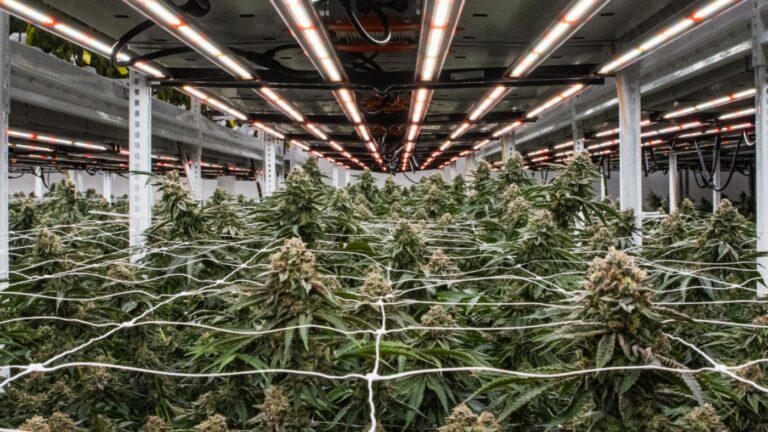
OLCC data show retail sales of $1.184 billion in 2021 and $926 million in 2025, a 21.8% drop (our arithmetic from the monthly figures), while the median retail price of usable marijuana, meaning dried flowers and leaves, fell from $5.55 a gram in January 2021 to $3.29 in September 2026 (OLCC market data). Falling prices make every square foot count: a producer’s canopy is capped by tier, and mature plants grown on racks count each layer as separate canopy (OAR 845-025-2040).

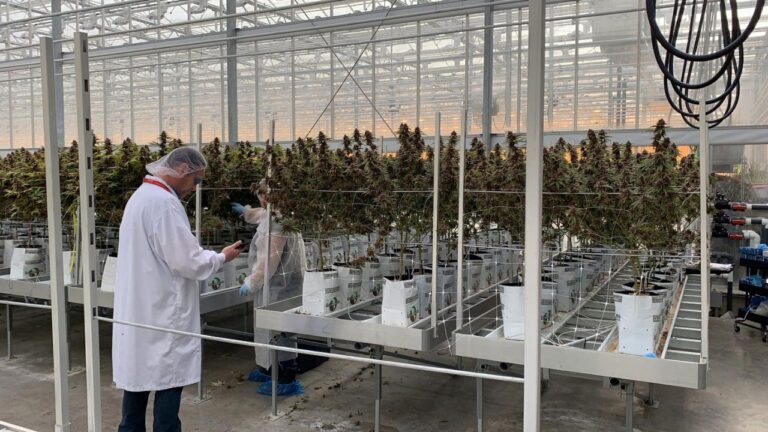
Michael Williamson, our Chief Operating Officer and a co-founder, co-founded Greenhaus Industries, which patented stackable cultivation trays, and has designed and consulted on over 7 million sq. ft. of cultivation facilities with over 3,000 compliant harvests (company-reported). For Oregon rooms we offer Oregon cannabis facility design with HVAC, dehumidification and odor control, controlled environment agriculture for consistent test results, cannabis vertical farming, since racked immature plants count only their footprint, operational optimization of harvest scheduling, labor and tracking records and, when margins slip, a cannabis turnaround review.

Our Oregon record: we have no Oregon client work to date. What we bring is the founders’ operating record elsewhere and the rule-by-rule reading on this page.

Our team: Leif Olsen, our Chief Executive Officer and a co-founder, is a cannabis application and licensing specialist with 18+ years as an owner, operator and advisor. Ian Miller, our Executive Chair and a co-founder, was founder and CEO of the Solace Companies, a wholesale vertically integrated cannabis licensee, and raised $22 million in private equity for a greenfield cultivation and processing operation.

Where we work: we have no Oregon office; we deliver work on-site and remotely, and the same team runs Catalyst BC’s national cannabis consulting practice.

A word against our own interest: the OLCC’s CAMP user guide covers submitting an application, renewing a license and requesting amendments (OLCC CAMP guides), so a routine renewal may not need a consultant. To talk through an Oregon file, contact us or call (USA) 303-305-3787.


Investing in Oregon cannabis

Already licensed in Oregon

0 +
Years Regulated Cannabis Operations Experience
0 +

Compliant Harvests

0 M+

Square Feet of Cultivation, Production, and Retail Facilities Designed

0 +

Licenses Secured

Can You File a New OLCC License Application in 2026?

No, for the four main license types. The OLCC’s licensing page says new applications for producers, processors, wholesalers and retailers are not being accepted, citing House Bill 4121 (2024) (OLCC licensing page). That law extended the 2022 moratorium on new licenses (OLCC bulletin IB2022-04) to December 31, 2024 and then applied per-capita caps: since January 1, 2025 the OLCC may accept a new application only while a license type has no more than one active license per 7,500 Oregon residents aged 21 or older for producers and retailers, or one per 12,500 for processors and wholesalers (2024 Oregon Laws, chapter 16; ORS 475C.155).

The OLCC runs that test once a year: it requests Portland State University’s population report in April, counts active licenses as of April 15, and decides within 15 days of receiving the report whether any type is under its cap. Active licenses include suspended licenses and expired licenses still eligible for renewal (OAR 845-025-1030(5)).

The OLCC’s October 5, 2026 license data list 1,374 active producer, 268 processor, 252 wholesaler and 790 retailer licenses (our count) (OLCC license data). At those ratios, the producer and retailer counts would need about 10.3 million and 5.9 million residents aged 21 or older, while the Census Bureau puts Oregon’s entire population at 4,273,586 on July 1, 2025, 19.0% of them under 18 (Census QuickFacts). Processors and wholesalers sit closer to their caps: 268 and 252 licenses need about 3.35 million and 3.15 million, against about 3.46 million residents aged 18 or older (our arithmetic). Laboratory licenses and research certificates are outside the caps, and the caps do not apply to renewals, ownership or location changes, canopy-size changes or the sale of a license issued before January 1, 2025 (ORS 475C.155(2); OAR 845-025-1030(5)(f)).

Application Status Note
New producer, processor, wholesaler or retailer license Not accepted Per-capita caps, tested each April
Laboratory license or research certificate Outside the caps Not subject to the per-capita test
Change of ownership, location or business structure Being processed The OLCC was assigning changes submitted September 22, 2026 (posted September 23)
Renewal or canopy-size change Exempt from the caps Licenses renew every year
Swipe to see the full table →

OLCC licensing page; ORS 475C.155; OAR 845-025-1030(5) and 845-025-1190. Every source is listed at the bottom of this page.

License Cap on new applications Active licenses, Oct 5, 2026
Producer 1 per 7,500 residents 21 or older 1,374
Processor 1 per 12,500 residents 21 or older 268
Wholesaler 1 per 12,500 residents 21 or older 252
Retailer 1 per 7,500 residents 21 or older 790
Swipe to see the full table →

ORS 475C.155(1); OLCC license data (data.oregon.gov dataset q32u-cmam, updated October 5, 2026), our count of licenses with status Active.

Test Who it covers
Ownership share Anyone who holds or controls a direct or indirect interest of 20% or more
Revenue share Anyone entitled to 20% or more of revenue, proceeds or profits, including a landlord paid that way
Control Anyone, other than an employee acting under direction, who controls the business or can bind it to contracts or debt
Premises The named lessee of the premises, or the property owner when there is no lease
Entity roles Managers of a manager-managed LLC, principal officers of a corporation and general partners of a limited partnership
Layered entities Indirect shares multiply: 50% of a holding company that owns 50% of the business is a 25% interest
Swipe to see the full table →

OAR 845-025-1045(3) to (5); OLCC guidance on disclosing interests (rev. April 13, 2021).

Buyers: see buying an OLCC license.

OLCC License Types, Producer Tiers and Processor Endorsements

A producer needs a production license for the premises where marijuana is produced (ORS 475C.065). A processor needs a separate OLCC endorsement for each product type it makes: edibles, topicals, concentrates or extracts (OAR 845-025-3210). A wholesaler resells marijuana items to retailers, other wholesalers, processors and certain other buyers (OAR 845-025-3500), a micro wholesaler may buy only from Micro Tier I and II producers (OAR 845-025-3510), and a retailer needs a retail license for the premises where it sells (ORS 475C.097).

Medical grow sites, processing sites and dispensaries register with the Oregon Health Authority instead (ORS 475C.792, 475C.815 and 475C.833), whose medical program merged with Oregon Psilocybin Services on September 1, 2026 to form a Medical Cannabis & Psilocybin Section (OHA bulletin 2026-01); our Oregon psilocybin service center license guide covers that framework. Hemp growers and handlers are licensed by the Oregon Department of Agriculture (OLCC hemp page).

License Canopy or scope Annual license fee
Producer, Micro Tier I Indoor up to 625 sq. ft.; outdoor up to 2,500 $1,000
Producer, Micro Tier II Indoor 626 to 1,250; outdoor 2,501 to 5,000 $2,000
Producer, Tier I Indoor 1,251 to 5,000; outdoor 5,001 to 20,000 $3,750
Producer, Tier II Indoor 5,001 to 10,000; outdoor 20,001 to 40,000 $5,750
Processor Edible, topical, concentrate or extract endorsements $4,750
Wholesaler Resells marijuana items to other licensees and certain other buyers $4,750
Micro wholesaler Buys only from Micro Tier I and II producers $1,000
Retailer Retail sales of marijuana items $4,750
Laboratory Testing of marijuana items $4,750
Swipe to see the full table →

OAR 845-025-2040(3) (mature canopy limits); OAR 845-025-1060(2); OAR 845-025-3210, 845-025-3500 and 845-025-3510.

Year Event
2022 House Bill 4016 moratorium on new licenses except laboratories, January 1, 2022 to March 31, 2024
2024 House Bill 4121 extends the moratorium to December 31, 2024 and sets per-capita caps
2026 OLCC rule changes from 2025 legislation take effect January 1; the medical and psilocybin sections merge September 1
Swipe to see the full table →

OLCC bulletin IB2022-04; 2024 Oregon Laws, chapter 16; OLCC bulletin CE2025-07; OHA bulletin 2026-01.

Producers can move into a larger tier, but slowly. After its first license year a producer may ask the OLCC for a higher production tier, at most once per license year, with a land use compatibility statement (the city or county’s statement that the use is allowed in that zone) and no OLCC sanction in the past year, paying the fee difference if the increase is approved between renewals (OAR 845-025-2040(6)).

Correction to published guidance (October 11, 2026): a consulting firm’s Oregon page, last modified October 24, 2025, lists the producer application fee as $4,750. The current rule sets a $250 application fee for every initial license, and the producer’s annual license fee of $1,000 to $5,750 by tier (OAR 845-025-1060).

What OLCC Licenses and Changes Cost Each Year

Every initial and renewal application carries a $250 nonrefundable application fee. For a new license, the annual license fee is due within 30 days of approval, prorated when the license is issued for six months or less; a renewal counts as submitted only when the $250 fee and the annual license fee arrive with it (OAR 845-025-1060; OAR 845-025-1135(3); OAR 845-025-1190(8)).

Licenses renew every year. A licensee that files on time may keep operating while the OLCC decides; one that misses the expiration date must stop, but may resume if it files within 30 days after, and retailers must also supply tax compliance certificates; after 30 days the OLCC will not accept a renewal, and the business would need a new application, which the OLCC is not accepting now for the four capped license types (OAR 845-025-1190).

LicenseApplication feeAnnual license fee
Producer, Micro Tier I$250$1,000
Producer, Micro Tier II$250$2,000
Producer, Tier I$250$3,750
Producer, Tier II$250$5,750
Processor$250$4,750
Wholesaler$250$4,750
Micro wholesaler$250$1,000
Retailer$250$4,750
Laboratory$250$4,750
Research certificate$250$4,750 for a three-year term
Swipe to see the full table →

OAR 845-025-1060(1) to (5).

ItemFee
Marijuana worker permit$100 for a five-year term
Criminal background check outside an application$50 per individual
Change of location review$1,000 per license
Packaging preapproval$100
Labeling preapproval$100
Hemp certificate$1,000 for one year
Swipe to see the full table →

OAR 845-025-1060(4), (7) and (8); OLCC forms and fees page (worker permit term).

YearRetail salesMedian usable marijuana price per gram, January
2021$1,184,090,296$5.55
2022$994,307,703$4.76
2023$955,415,749$4.00
2024$960,021,524$3.89
2025$926,211,098$3.50
Swipe to see the full table →

OLCC market data on data.oregon.gov (datasets 5prm-2vmn and sqst-8mwh, updated October 2, 2026); calendar-year totals are our sum of the monthly figures; prices rounded to the cent.

Budget accordingly: a Tier II producer that also holds a processor license pays $11,000 in OLCC application and license fees in a year it renews both, the two $250 application fees plus $5,750 and $4,750 (our arithmetic from OAR 845-025-1060).

Buying an OLCC License: Ownership Changes, Structure Changes and Timing

Oregon separates two kinds of deal. A change of business structure adds someone who qualifies as an applicant, short of a change of ownership, or removes one; the licensee files the OLCC form before the change, and the change is conditionally approved if the OLCC does not call the filing incomplete within five business days, unless a retailer has left out a new applicant’s tax compliance certificate, and the OLCC can still withdraw the approval (OAR 845-025-1165). A change of ownership means adding or replacing the licensee of record, or people who held no interest at the start of the license year together reaching 51% or more; it needs a new application from the buyer, and the current licensee must file a signed change-of-ownership notification within 14 calendar days of the buyer’s application (OAR 845-025-1170).

How to open a dispensary in Oregon by buying an OLCC-licensed store: five steps

For a buyer of an existing retail license:

  1. Check the target’s license status in the OLCC’s license data and ask whether the OLCC has issued a notice proposing revocation of the license, or certain notices proposing suspension, because the OLCC may delay a buyer’s application while one is pending (ORS 475C.049(2)(b)).
  2. List everyone in the buyer group who will count as an applicant: 20% owners, 20% revenue holders, anyone who controls the business or can bind it, general partners, LLC managers and corporate officers, and the named tenant or, with no lease, the property owner.
  3. File the new license application in CAMP; the current licensee files the change-of-ownership notification within 14 days, and each current licensee and new applicant supplies a Department of Revenue tax compliance certificate issued within the prior 90 days.
  4. Complete the application process within 60 calendar days of the OLCC assigning the file, including fingerprints when the OLCC requests them.
  5. Take no ownership interest and do not operate until the OLCC approves the change of ownership; a licensee that allows either early commits a Category I violation, the category for violations that make a licensee ineligible or pose a significant risk to public health and safety (OAR 845-025-8590(4)).

Plan the timing with the deal. When the OLCC posted its processing dates on September 23, 2026, it was assigning change applications submitted September 22 (OLCC licensing page), and in our view an incomplete buyer file is the delay a buyer can control.

Hidden Interests, Lender Rights and Public-Company Owners

Not every investor is an applicant, but every investor can be checked. The OLCC may require the names of everyone with a financial interest and a sworn statement of each interest, and it may refuse, suspend, revoke or refuse to renew a license if a person with a financial interest did something that would be grounds to refuse or revoke the license of a licensee (ORS 475C.189; OAR 845-025-1030(4)(b)). An undisclosed or unapproved ownership interest, other than a change handled under the business-structure rule, is grounds to refuse or revoke a license, and the rule classes that violation as Category I (OAR 845-025-1045(5) to (7)).

Lenders have a defined route. A secured party can ask the OLCC for temporary authority to operate a licensed business after the licensee defaults, with proof of the security interest, the default and legal access to the real property; the OLCC may issue the authority for at least 60 days and extend it, can revoke it if the lender does not operate the business immediately, and the authority exists to allow an orderly disposition of the business (OAR 845-025-1260).

Public companies get a 60-day window: when a shareholder reaches 20% or more of the voting stock, or principal officers change, the licensee must notify the OLCC within 60 calendar days after the change but need not notify it beforehand (OAR 845-025-1165(2)(c)).

Where an OLCC License Can Sit: Schools, Zoning and Local Opt-Outs

A retailer may not sit in an area zoned exclusively for residential use or within 1,000 feet of a public elementary or secondary school with compulsory attendance or a private or parochial elementary or secondary school (ORS 475C.097(2)). Two exceptions apply: a store at least 500 feet away where the OLCC finds a physical or geographic barrier capable of keeping children from reaching it, or a store established before August 1, 2017 under a city or county ordinance (ORS 475C.101). Senate Bill 162 (2025) took prekindergarten and kindergarten programs run by school districts or education service districts out of that test (OLCC bulletin CE2025-07), and the OLCC measures in a straight line from the school’s property line to the closest point of the licensed premises (OAR 845-025-2840(5)).

Every applicant needs a land use compatibility statement, and the OLCC may not issue a license if it shows the use is prohibited in that zone (ORS 475C.053). The OLCC’s September 2026 record lists 98 cities and counties; 97 prohibit at least one license type and 96 prohibit retail (our count; John Day is listed with no prohibition) (OLCC opt-out record).

Producers and processors that do not own their property must file the owner’s notarized consent with the application and, since January 1, 2026, with each renewal unless the owner consented for several license terms and the property has not changed hands since (OAR 845-025-1030(3)(g); OAR 845-025-1190(10)). A producer application also needs an electricity and water usage report and an Oregon Water Resources Department water use form showing a legal source of water (OAR 845-025-1030(3)(e)).

Metrc Tracking, OHA Testing Rules and Oregon’s 17% Retail Tax

Licensees record inventory in Metrc, Oregon’s Cannabis Tracking System (OLCC market data); since September 1, 2026, laboratories must use a new Metrc entry path for secondary samples, such as subcontracted and composited samples, with results attributed to the source batch, or the source package shows missing results (OLCC bulletin CE2026-01). Testing rules come from the Oregon Health Authority: every harvest-lot batch intended for consumers or patients must be tested before sale or transfer, including for pesticides, potency, heavy metals, mycotoxins and microbial contaminants; batches bound for processors follow a separate list (OAR 333-007-0320).

A licensee may ask the lab to reanalyze a failed sample within seven days, and a passing reanalysis must be confirmed by a second laboratory under different ownership. A batch that fails microbial testing may be sterilized or made into concentrate or extract by a sterilizing process; a batch of marijuana that fails pesticide testing may not be remediated and must be destroyed, except that, when the only failing analytes are piperonyl butoxide or pyrethrins and the Oregon Department of Agriculture finds the products were on its guide list and applied according to the label, the agencies may allow remediation (OAR 333-007-0450). That is why an Oregon cannabis compliance consulting review checks tracking records, sampling and failed-batch history before an inspector does.

A 17% state tax applies to the retail price of marijuana items and is paid by the consumer, and a city or county may add up to 3% if its voters approve (ORS 475C.674; ORS 475C.453). Retailers keep 2% of the 17% for administrative costs, pay the Department of Revenue monthly and file quarterly returns (Department of Revenue), and collect no tax on medical sales to Oregon Medical Marijuana Program patients or their caregivers (OAR 845-025-2890(2)).

What We Deliver First for Oregon Buyers and OLCC Operators

Investors get a purchase review before they sign: the target’s license status and any pending OLCC notices, every person who will count as an applicant, whether the deal is a change of ownership or of business structure, and an Oregon cannabis business plan with OLCC fees, the 17% retail tax and a Section 280E scenario for their tax adviser. Licensees get a canopy margin audit: failed-batch history by cause, room-by-room HVAC and dehumidification loads, the tier and racked canopy count, cost per gram against the falling median price, and a check of tracking records. Send your license number and your deal or production figures, and we will tell you plainly if another firm suits you better.

Oregon Cannabis License FAQ for Investors and Growers

No, not for producer, processor, wholesaler or retailer licenses. Per-capita caps keep those types closed while active licenses exceed one per 7,500 residents aged 21 or older for producers and retailers, or one per 12,500 for processors and wholesalers. The OLCC tests the counts each April; laboratory licenses and research certificates are outside the caps.

By buying an existing licensed business or a stake in one, or by lending against one. A purchase that adds or replaces the licensee of record, or brings people who held no interest at the start of the license year to 51% or more, needs a new OLCC application; other additions of applicants are business-structure changes, filed before they happen except certain public-company changes.

A secured lender can ask the OLCC for temporary authority to operate the business, with proof of the security interest, the licensee’s default and legal access to the property. The OLCC may issue it for at least 60 days and extend it, and it exists to allow an orderly disposition of the business; the lender may not operate until a certificate of authority has been issued.

Each initial or renewal application costs $250. Annual license fees run $1,000 to $5,750 for producers by tier, $4,750 for processors, wholesalers, retailers and laboratories, and $1,000 for micro wholesalers.

Indoors, Micro Tier I allows up to 625 square feet of mature canopy, Micro Tier II 626 to 1,250, Tier I 1,251 to 5,000 and Tier II 5,001 to 10,000. Outdoor limits are four times larger, up to 40,000 square feet for Tier II. Racked mature plants count each layer as canopy.

You may request a reanalysis within seven days, and a pass must be confirmed by a second laboratory. A microbial failure can be sterilized or processed into concentrate or extract; marijuana that fails pesticide testing must be destroyed, except that the agencies may allow remediation when the only failing analytes are piperonyl butoxide or pyrethrins from products on the state guide list, applied according to the label.

Consumers pay a 17% state tax on the retail price, plus up to 3% local tax where voters approved one. Retailers keep 2% of the state tax for administrative costs, pay the Department of Revenue monthly and file quarterly. Medical sales to Oregon Medical Marijuana Program patients and caregivers are not taxed.

Not within 1,000 feet of a public or private elementary or secondary school, with two exceptions. A store at least 500 feet away can qualify if the OLCC finds a physical or geographic barrier capable of keeping children from reaching it, and a store established before August 1, 2017 under a city or county ordinance may stay.

Facility Projects Elsewhere That Inform Our Oregon Work

None of these projects is in Oregon: the first three tiles each open a cultivation or facility project in another market, and the fourth opens our full projects page.

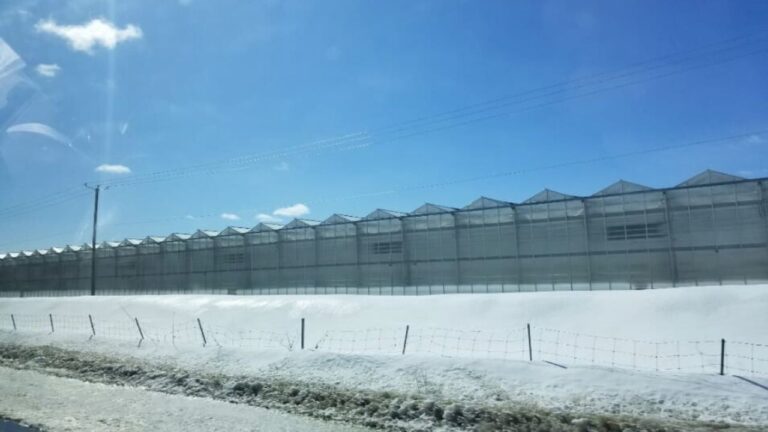
Exterior view of the Hexo Venlo glasshouse row spanning over 1 million square feet.

Hexo Corp.

Gatineau, Quebec, Canada

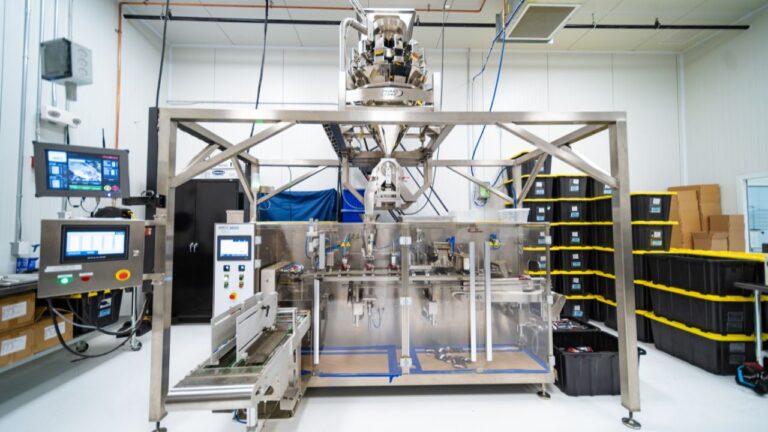
Modern stainless steel automated cannabis pre-roll processing machine in a dedicated production room.

Bostica

Lynn, MA, United States

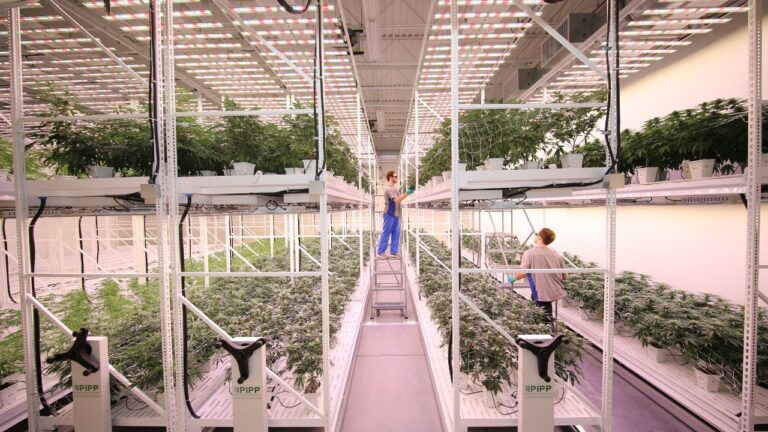
Catalyst BC consultants and LeafLine Cultivation Director inspecting vibrant plants in an organized vertical grow room.

Leafline Labs

Cottage Grove, MN, United States

Catalyst BC consultant recording air, environmental, and plant data measurements within a cultivation facility.

View All Projects

View all Catalyst BC Projects

Guides on Startup Costs, Rack Yields and HVAC

Provenance. Figures checked against statute, rule and agency text by Catalyst BC on October 11, 2026. ORS chapter 475C (2025 edition) and the 2024 and 2026 session laws were read on the Oregon Legislature’s site, and OAR chapters 845 and 333 on the Secretary of State’s rules database. OLCC pages, bulletins and the opt-out record were read on the OLCC site, and the OLCC’s license and market data on data.oregon.gov; the tax note comes from the Department of Revenue, the medical program note from the Oregon Health Authority, the hemp note from the Oregon Department of Agriculture, the federal order from the Federal Register, and the population figure from the U.S. Census Bureau (read October 12, 2026). The sales totals and change, the license and opt-out counts, the cap comparison and the fee total are our own arithmetic. Company figures come from Catalyst BC’s own records. Where this page and the official text differ, the official text governs.

Oregon statutes, rules and session laws

Oregon Liquor and Cannabis Commission records

Other agencies

Contact Us

Enough about us. We want to hear more about you, your project, and your vision! Get in touch with a real live person today. Don’t worry, we don’t have a long, confusing phone menu, and your email isn’t going to the abyss, we promise. At Catalyst, we provide the service and support we’d want to experience ourselves!

Scroll to Top