Oklahoma Cannabis Consultants for OMMA License Buyers and Growers
Oklahoma cannabis consulting starts with a closed door: OMMA is not issuing new grower, processor or dispensary licenses before August 1, 2028, unless its director ends the moratorium sooner. Investors enter by buying an existing licensee; growers face canopy fee tiers and a shrinking market. Our records: 58+ licenses secured.
A Decade of Harvesting Success - Trusted by Cannabis Operators Worldwide
OMMA and OBNDD Dates to Plan Around
Updated: 10/9/2026. Oklahoma is a medical-only market. Voters adopted State Question 788 on June 26, 2018, and the Oklahoma Medical Marijuana Authority (OMMA) licenses growers, processors, dispensaries and other businesses under it (63 O.S. § 420) and the Oklahoma Medical Marijuana and Patient Protection Act (63 O.S. § 427.1 et seq.). The rules in force are emergency rules effective August 28, 2026, which carry House Bill 3143’s extension of the new-license moratorium to August 1, 2028.
Two nearer dates matter to licensees. Each business also needs an active registration with the Oklahoma Bureau of Narcotics and Dangerous Drugs Control (OBNDD), renewed by October 31; OMMA says a licensee without it by November 1 must stop operating and loses access to Metrc, the state’s seed-to-sale tracking system (OMMA commercial licenses page). From November 1, 2026, OMMA enforces House Bill 4454’s rules on product shapes and packaging considered appealing to children for anything packaged and labeled from that date (OMMA newsletter, July 2026).
Meet Catalyst BC's Founders
-
Leif Olsen
Chief Executive Officer
-
Michael Williamson
Chief Operating Officer
-
Ian Miller
Executive Chair
Our partners bring multi-faceted expertise across business strategy, licensing, facility development, finance, and commercial operations. That breadth is complemented by subject matter experts across the wider Catalyst BC team, allowing us to bring the right combination of experience to each client and project. The result is bespoke, collaborative support shaped around your business, priorities, and goals - with the right expertise brought to the table when it matters most.
What an Oklahoma Cannabis Consultant Does That OMMA Will Not
OMMA licenses, inspects and disciplines businesses and audits their Metrc records; it does not value a license, vet a seller or redesign a grow room. An Oklahoma cannabis consultant works for the owner, from acquisition diligence and residency structures to the operating fixes that keep a license through renewal.
Buying Into Oklahoma Cannabis: Transfers, Residency and Who Counts as an Owner
New grower, processor and dispensary licenses are frozen until August 1, 2028 at the latest (63 O.S. § 427.14a), so an investor buys an existing licensee. Any change of owner needs a license transfer application filed by the new owner (OAC 442:10-5-2(f)), OMMA approval and then a new OBNDD registration before the buyer takes control (63 O.S. § 427.14c), and OMMA applies that process to the sale of any percentage of a business (OMMA transfers page). In our view, ownership is the hard part. Owners must be 25 or older, the applicant and every member, manager and board member must be Oklahoma residents, and residents must hold at least 75% of the ownership interests (OAC 442:10-5-3), so non-residents may hold no more than 25%. Because an LLC’s members are its owners, a non-resident stake in an LLC needs careful structuring. A resident has lived in the state for the two years before the application, or for five continuous years within the last 25.
Oklahoma’s rules define owners broadly, down to anyone holding an interest or a convertible note in an entity that owns, operates or manages a licensed facility (OAC 442:10-1-4). A publicly traded company organized in the United States or Canada may buy up to 40% of a grower, processor or transporter that has held its license for 18 months and is in good standing, but not of a dispensary (63 O.S. § 427.15a); the 75% residency test then applies to the rest of the ownership (OAC 442:10-5-2(e)(2)(D)).
Since April 28, 2026, a federal rule has placed state-licensed medical marijuana in Schedule III (91 FR 22714); OMMA quotes it as ending Section 280E, the federal tax rule that bars ordinary business deductions, for state licensees, while not deciding federal tax liability (OMMA bulletin, May 6, 2026).
For investors: diligence through cannabis business strategy, an Oklahoma cannabis business plan through cannabis financial planning, transfer and OBNDD filings through cannabis license application support, and cannabis startup support after closing.
Already Licensed by OMMA: Fewer Growers, Lower Tax Receipts and Canopy Tiers
OMMA counted 1,703 licensed growers on October 1, 2026, down from 7,086 on December 7, 2022, and 1,259 dispensaries, down from 2,599 (OMMA licensing and tax data). Taxed sales are shrinking too: OMMA reports $32,024,393 in 7% excise tax receipts from January through September 2026, 7.2% less than in the same months of 2025 (our arithmetic).
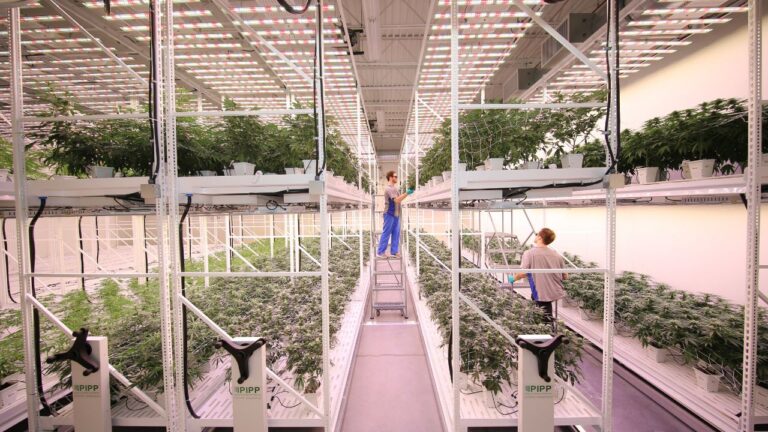
Grower fees follow canopy, the area used for flowering plants, and the surface of every tier or shelf counts toward it, while areas used only for immature plants and seedlings do not (63 O.S. § 427.14(D)). Adding a level of flowering racks can therefore move a grow up a fee tier, from $2,500 at up to 10,000 square feet to $5,000 at 10,001 to 20,000. For plants grown vertically in cylinders, canopy is the cylinder’s circumference times its length.
For Oklahoma rooms we offer Oklahoma cannabis facility design with HVACD (heating, ventilation, air conditioning and dehumidification) sized to keep yeast and mold counts under OMMA’s testing limit, controlled environment agriculture targets by room, cannabis vertical farming priced against the canopy tier it adds, operational optimization of batches, labor and Metrc records and, when cost per pound outruns price, a cannabis turnaround plan. Michael Williamson, our Chief Operating Officer and a co-founder, co-founded Greenhaus Industries, which patented stackable trays for growing on multiple tiers, and has 25,000+ hours in cultivation and dispensary operations (company-reported).
Our Oklahoma record and team: our records list Oklahoma client work from 2021 to 2024, and Catalyst BC has no current Oklahoma client. Leif Olsen, our Chief Executive Officer and a co-founder, leads our licensing work, and Ian Miller, our Executive Chair and a co-founder, raised $22 million in private equity (company-reported) for a greenfield cultivation and processing operation. We have no Oklahoma office; we work on-site and remotely, and the same team runs Catalyst BC’s national cannabis consulting practice.
A word against our own interest: OMMA’s transfer guidance points buyers to its commercial application checklist for the documents a transfer needs (OMMA commercial application checklist), and a buyer working with an Oklahoma attorney can file without a consultant. To talk through a deal or facility, contact us or call (USA) 303-305-3787.

Investing in Oklahoma cannabis
- Cannabis Business Strategy ConsultingDiligence on a licensee to buy
- Cannabis Financial Planning & ModelingTier fees, excise tax, falling sales
- Cannabis Licensing & Application SupportTransfer and OBNDD filings
- Cannabis Startup SupportFirst months under new owners
Already licensed in Oklahoma
- Cannabis Facility Design & HVAC / HVACD EngineeringDehumidification for clean counts
- Cannabis Controlled Environment Agriculture (CEA)Room targets set to test limits
- Cannabis Vertical Farming ConsultingTiers priced against canopy fees
- Cannabis Operational OptimizationBatches, labor and Metrc records
- Cannabis Business Turnaround & Operational RecoveryCost per pound back under price
Compliant Harvests
Square Feet of Cultivation, Production, and Retail Facilities Designed
Licenses Secured
Can You Apply in Oklahoma? Not for a New Grow, Processor or Store Before August 2028
No new grower, processor or dispensary license will be processed or issued from August 1, 2026 to August 1, 2028, and OMMA’s executive director may end the moratorium earlier only after deciding that all pending licensing reviews, inspections and investigations are complete (63 O.S. § 427.14a). The freeze does not stop renewals or a license issued because a business changes owner or location, and it does not cover testing laboratory, transporter, education, research or waste disposal licenses (OAC 442:10-5-3(h)).

OMMA says it processes commercial applications within 90 business days (OMMA apply page). A transfer cannot be filed while an administrative action that could revoke, suspend or not renew the license or OBNDD registration is pending (63 O.S. § 427.14c(C)).
OMMA filings open and closed as of October 9, 2026
| Filing | Status | Detail |
|---|---|---|
| New grower, processor or dispensary license | Closed | Moratorium from August 1, 2026 to August 1, 2028 at the latest |
| License transfer (change of owner or name) | Open | Filed by the new owner; OBNDD registration follows approval |
| Location change request | Open | $500 nonrefundable fee |
| Renewal of an existing license | Open | Timely if filed 120 to 60 days before expiration |
| Transporter, laboratory, waste disposal, research or education license | Open | Outside the moratorium |
| Hemp grower or processor/handler license (ODAFF) | Open | Apply at least 30 days before starting |
63 O.S. §§ 427.14, 427.14a and 427.14c; OAC 442:10-5-2; ODAFF 2026 hemp applications. Every source is listed at the bottom of this page.
How the moratorium was set and extended
| Law | Effect |
|---|---|
| HB 3208 (2022) | Moratorium on new dispensary, grower and processor licenses began August 26, 2022 |
| HB 2095 (2023) | Extended the end date to August 1, 2026 |
| HB 3143 (2026) | Extended the end date to August 1, 2028, unless OMMA’s executive director finds all pending reviews, inspections and investigations complete |
OMMA apply page; 63 O.S. § 427.14a.
What a license transfer file includes
| Item | Rule |
|---|---|
| Owners | A list of all owners and principal officers with formation documents |
| Residency | Proof that the applicant, members, managers, board members and 75% of the ownership are Oklahoma residents |
| Background checks | National fingerprint-based checks within 30 days before the application; for now OMMA accepts an Oklahoma State Bureau of Investigation (OSBI) state check together with OMMA’s attestation form |
| Lawful presence | An affidavit of lawful presence for each new owner |
| Grower bond | A bond of at least $50,000, or proof the licensee has owned the land for five years |
| Fee | The annual license or application fee for that license type |
OAC 442:10-5-2(e)(2)(B) and (f)(2); OAC 442:10-1-5; 63 O.S. § 427.14c(H); OMMA commercial licenses page. A transfer must also meet every requirement of a new application under OAC 442:10-5-3.
Investors weighing a purchase should jump to ownership rules.
OMMA License Types and What Each Lets You Do
Oklahoma’s business license covers commercial growers, processors, dispensaries, transporters and testing laboratories (63 O.S. § 427.14). Growers sell only to licensed processors, dispensaries and other growers (OMMA grower license page), and only a dispensary may sell to patients and caregivers (OMMA dispensary license page). A grower or dispensary license comes with a transporter license so the business can move its own product.
The statute sets no limit on how many licenses or categories one person or entity may hold, though each needs its own application and fee (63 O.S. § 427.14(E)(8)). A grower, processor and dispensary may share one address, but each license covers a single location, and a site with both indoor and outdoor growing needs two grower licenses.
OMMA license types and what each allows
| License | What it allows | Annual fee basis |
|---|---|---|
| Commercial grower (indoor, greenhouse or light deprivation) | Grow and sell to processors, dispensaries and growers | Square feet of canopy |
| Commercial grower (outdoor) | Grow and sell to processors, dispensaries and growers | Acres |
| Processor | Make concentrate and products; process for a patient for a fee | Pounds of biomass or liters of concentrate |
| Dispensary | Sell to patients, caregivers, a minor patient’s parent or guardian, research licensees and other dispensaries | 10% of a year’s state sales and excise tax |
| Transporter | Move product between licensed businesses | Flat $2,500 |
| Testing laboratory | Test marijuana and products | Flat $20,000 |
63 O.S. § 427.14(A) and (D); OMMA license pages.
Dispensary sales limits per transaction
| Item | Limit |
|---|---|
| Marijuana | 3 ounces (84.9 grams) |
| Concentrate | 1 ounce (28.3 grams) |
| Edible products | 72 ounces (2,037.6 grams) |
| Plants | 6 mature plants and/or 6 seedlings |
| Processing for a patient | 1 ounce of concentrate per transaction |
| Dispensary-made pre-rolls | No more than 1 gram net weight each |
OAC 442:10-5-12; 63 O.S. § 421(D).
Every business license runs 12 months. A renewal is timely only if filed between 120 and 60 days before expiration; one filed later but before expiration owes no late fee, yet the license lapses on its expiration date until OMMA approves it (OMMA transfers and renewal page).
OMMA also visits new growers, processors and dispensaries within 180 days of licensing; one not yet operating or working toward it gets a 180-day grace period, and after a follow-up visit OMMA may seek revocation (OAC 442:10-5-4.1).
Correction to published guidance (October 9, 2026): a seed-to-sale software vendor’s Oklahoma license guide, last modified January 13, 2026 according to its page metadata, still says the moratorium ends August 1, 2026 and that late renewal carries a 90-day grace period with a $500 late fee. House Bill 3143 moved the end date to August 1, 2028, and the statute charges $500 for each week a license is expired and bars renewal after 60 days.
OMMA Tier Fees, the Grower Bond and the 7% Excise Tax
Fees scale with use: a grower’s first fee follows the canopy or acreage it expects to harvest, transfer or sell, and each renewal what it actually did in the previous 12 months; processors and dispensaries pay $2,500 at first, then a fee set by the previous 12 months’ volume or taxes (OMMA tiered licensing page). Statute and rule set the transfer fee at the annual license or application fee for that license type (63 O.S. § 427.14c(H)); OMMA’s transfers page, citing the same subsection, says $2,500 plus the tier fee, so confirm the amount with OMMA before closing. Every grower also files a bond of at least $50,000 per license, or proof it has owned the land for at least five years (63 O.S. § 427.26).
Grower fees: indoor, greenhouse and light deprivation
| Tier | Canopy | Fee |
|---|---|---|
| Tier 1 | Up to 10,000 sq ft | $2,500 |
| Tier 2 | 10,001 to 20,000 sq ft | $5,000 |
| Tier 3 | 20,001 to 40,000 sq ft | $10,000 |
| Tier 4 | 40,001 to 60,000 sq ft | $20,000 |
| Tier 5 | 60,001 to 80,000 sq ft | $30,000 |
| Tier 6 | 80,001 to 99,999 sq ft | $40,000 |
| Tier 7 | 100,000 sq ft and over | $50,000 plus $0.25 per sq ft over 100,000 |
63 O.S. § 427.14(D)(2)(a). Paying by card adds a processing fee of about 2.25% plus $2; OMMA’s table shows $58.30 on a $2,500 fee and $227.05 on $10,000. Light deprivation means a structure with concrete floors that can manipulate natural light (OAC 442:10-1-4).
Grower fees outdoors, and processor fees
| Tier | Outdoor grower | Processor (previous 12 months) | Fee |
|---|---|---|---|
| Tier 1 | Under 2.5 acres | Up to 10,000 lb biomass or 100 L concentrate | $2,500 |
| Tier 2 | 2.5 to 5 acres | 10,001 to 50,000 lb or 101 to 350 L | $5,000 |
| Tier 3 | 5 to 10 acres | 50,001 to 150,000 lb or 351 to 650 L | $10,000 |
| Tier 4 | 10 to 20 acres | 150,001 to 300,000 lb or 651 to 1,000 L | Grower $20,000; processor $15,000 |
| Tier 5 | 20 to 30 acres | Over 300,000 lb or 1,000 L | Grower $30,000; processor $20,000 |
| Tiers 6 to 8 (outdoor only) | 30 to 40, 40 to 50, over 50 acres | None | $40,000; $50,000; $50,000 plus $250 for each additional acre |
63 O.S. § 427.14(D)(2)(b) and (D)(3). Every 1,000 grams of nonliquid concentrate counts as one liter.
Other license fees and taxes
| Item | Amount | Notes |
|---|---|---|
| Dispensary license | $2,500 to $10,000 | First year $2,500; then 10% of state sales and excise tax |
| Transporter license | $2,500 a year | Flat |
| Testing laboratory license | $20,000 a year | Flat |
| Waste disposal facility license | $5,000 | OMMA fee table |
| Research or education license | $500 | OMMA fee table |
| Employee credential | $30 | Required before employment |
| Late renewal | $500 a week | No renewal after 60 days expired |
| Medical marijuana excise tax | 7% of retail sales | Collected by dispensaries; remitted to the Oklahoma Tax Commission by the 20th of the next month |
63 O.S. §§ 426 and 427.14; OAC 442:10-5-7; OMMA apply page.
Budget accordingly (our arithmetic from 63 O.S. § 427.14): a buyer taking over an indoor grow that used 30,000 square feet of canopy in the previous 12 months pays a $10,000 transfer fee under the statute, or $12,500 on OMMA’s page, and needs a bond of at least $50,000 unless the licensee has owned the land for at least five years. A dispensary hits the $10,000 cap once its state sales and excise tax passes $100,000 a year; a smaller store pays less, down to $2,500.
How a Buyer Takes Over an Oklahoma Dispensary or Grow, Step by Step
Buying an existing licensee under 63 O.S. § 427.14c and OAC 442:10-5-2(f):
- Screen the seller: license status in OMMA Verify (OMMA’s license lookup), pending administrative actions against the license or OBNDD registration, Metrc records and, for a dispensary, the risk of a city setback objection.
- Structure the buyer: owners 25 or older, the applicant and every member, manager and board member Oklahoma residents, non-residents at no more than 25%, and convertible notes counted as ownership.
- File the license transfer application as the new owner, with background checks, residency proof, the grower bond if it is a grow, and the fee; the seller must keep the license active, including its renewal, until the transfer is final.
- After OMMA approval, register with the OBNDD, and within 60 days of that approval file an OBNDD attestation confirming or denying any foreign financial interest, one for each license, or the license is revoked. The law counts from OMMA’s approval of a business license application, which in our view includes a transfer (63 O.S. § 427.15). The buyer may not take possession or control until both approvals are in place, though it may work for the seller with an employee credential.
- On taking control, give OMMA a detailed inventory and move product in Metrc within 15 business days of the new OBNDD registration; the seller stops being a licensee 15 business days after that registration is issued.
In our view, Oklahoma deals fail on residency structures and sellers with open enforcement files more often than on paperwork, so our cannabis licensing and application team checks both before a letter of intent is signed.
Who May Own an Oklahoma Marijuana Business, and How Control Changes
Among those who may not hold a license: anyone under 25, anyone convicted of a nonviolent felony within two years or any other felony within five, police, prosecutors and OMMA or municipal staff, and licensees behind on marijuana business taxes (63 O.S. § 427.14(H)).
Ownership changes only by an approved transfer. Any attempt to transfer a business or its product without OMMA approval is grounds to revoke or not renew the license, and to deny, revoke or not renew licenses owned by anyone involved (63 O.S. § 427.14c(G)). A seller whose license or OBNDD registration was annulled, revoked or suspended must wait at least six months after that term ends before applying to transfer (63 O.S. § 427.14c(C)). Lenders have a route: if a licensed grower, processor or dispensary is foreclosed or goes into receivership, OMMA may issue a 60-day, renewable Certificate of Authority to a secured party or receiver who meets the licensing standards, including residency, so the business can keep operating while it is sold or wound down. The certificate cannot run past the license’s own expiration date (OAC 442:10-10-1 and 10-10-2(b)).
Where an Oklahoma Grow or Dispensary Can Locate: Schools, Cities and Tribal Land
Apart from grandfathered sites, such as a business licensed before a nearby school opened, a dispensary may not be within 1,000 feet of a school entrance, and the statute measures in a straight line from the school door nearest the dispensary’s front door to that front door; a grower may not be within 1,000 feet of a school, measured property line to property line (63 O.S. § 425). OMMA’s application rule asks a dispensary for proof measured from the school’s property line to the dispensary’s nearest perimeter wall (OAC 442:10-5-3(e)(6)), so in our view a site should clear both measures.
A city may not change its zoning to keep dispensaries out entirely, but it may use its usual planning and zoning process to decide which districts suit marijuana businesses. Before an initial renewal or a transfer, a city may object that a dispensary sits inside the setback from a school that was openly in existence before the store was licensed, after allowing for a measurement error of up to 500 feet (63 O.S. § 425(G)); OMMA may then deny the renewal or transfer and move to revoke (OAC 442:10-5-2.1).
OMMA licenses are not valid on tribal trust or tribal restricted land or on federal land in the state (OAC 442:10-1-3), and every applicant attests that its licensed premises are not on tribal lands. Outdoor growers must also register with the Oklahoma Department of Agriculture, Food and Forestry (ODAFF) as environmentally sensitive crop owners, which tells pesticide applicators where the crops are (OAC 442:10-5-1.1). Our cannabis facility design work starts by screening zoning, both school measures and land status.
OMMA Testing, Inspections and Tax Rules, and Oklahoma Hemp
Growers and processors test samples from every final harvest batch and production batch before it goes to a dispensary, for microbials, mycotoxins, residual solvents, pesticides, potency, terpenes, heavy metals, foreign matter and filth, and water activity and moisture (OAC 442:10-8-1). A harvest batch may weigh no more than 15 pounds, or 50 pounds for plant material sold to a processor for concentrate. Flower and most products must show total yeast and mold below 10,000 colony-forming units per gram. A failed batch may be retested; it may be sold only after two passing retests on the failed test, and otherwise it must be remediated, decontaminated or disposed of; a harvest batch that fails microbial testing may be decontaminated and returned to the grower if it stays in its original form, or, if it is flower or trim, remediated into a solvent-based concentrate.
OMMA may make two on-site inspections a year of each grower, processor, dispensary and transporter, plus more to investigate violations (OAC 442:10-5-4); it need not give notice, but since April 6, 2026 it has told licensees of a seven-day window for each routine inspection (OMMA bulletin, April 2, 2026). Correctable violations must be fixed within 30 days of written notice.
Dispensaries collect the 7% excise tax and file monthly with the Oklahoma Tax Commission, and a licensee that intentionally fails to remit it has its license permanently revoked and can never hold another OMMA business license (63 O.S. § 426). Our Oklahoma cannabis compliance consulting review checks Metrc records, test history, OBNDD status and the tax file against the rules before an inspector does.
Hemp in Oklahoma: ODAFF Licenses and the November 12, 2026 Federal Change
Hemp is licensed by ODAFF, not OMMA. A grower pays a $500 application fee plus $5 an acre outdoors or $0.33 a square foot in a greenhouse (ODAFF 2026 grower application), and a processor/handler pays $1,000 to $5,000 depending on annual sales (ODAFF 2026 processor/handler application). ODAFF’s January 16, 2026 letter says that from November 12, 2026 the federal hemp definition excludes cannabinoids not naturally produced by the plant or synthesized outside it, and any final hemp-derived cannabinoid product with more than 0.4 milligrams of total THC per container (ODAFF hemp clarification letter). In our view, a hemp business whose products will fall outside the definition should price buying into an existing OMMA processor before that date.
Two Ways to Start: Licensee Diligence or a Canopy and Cost Review
Investors get diligence before they sign: the seller’s OMMA and OBNDD record, Metrc and test history, a structure that passes the residency test, and an Oklahoma cannabis business plan with tier fees, the bond and the 7% excise tax. Licensees get a canopy and cost review: flowering area by tier, yield by room, yeast and mold failures, HVACD capacity and labor, priced against current sales. Send your license numbers and your deal or production figures for an Oklahoma marijuana consulting review, and we will tell you plainly if another firm suits you better.
Oklahoma Moratorium, Ownership and Grow Questions From Buyers and Licensees
Can I apply for a new Oklahoma dispensary, grow or processor license now?
No. A moratorium stops OMMA from processing or issuing new grower, processor and dispensary licenses from August 1, 2026 to August 1, 2028, unless its executive director ends it sooner after all pending reviews, inspections and investigations are complete. Renewals, changes of owner or location and other license types continue.
How do I buy an existing Oklahoma marijuana business?
The new owner files a license transfer application with OMMA, pays the transfer fee (the annual license fee under the statute) and, after approval, registers with the OBNDD. The buyer cannot take possession or control until both approvals are in place, and inventory moves in Metrc within 15 business days of the new OBNDD registration.
Can someone outside Oklahoma own part of a licensed business?
Yes, up to 25% of the ownership, but the applicant and every member, manager and board member must be Oklahoma residents. In an LLC, where members are owners, that limits how a non-resident can hold a stake. A publicly traded company organized in the United States or Canada may hold up to 40% of a grower, processor or transporter licensed for at least 18 months and in good standing, with the residency test applied to the rest of the ownership; it may not invest in a dispensary this way.
What does an Oklahoma grow license cost?
Indoor, greenhouse and light deprivation growers pay $2,500 for up to 10,000 square feet of canopy, rising to $50,000 plus $0.25 a square foot over 100,000; outdoor growers pay $2,500 to $50,000 plus $250 an acre over 50. Each also needs a bond of at least $50,000 unless it has owned the land for five years.
Do stacked grow tiers count toward my canopy fee?
Yes. The surface area of each tier or shelf used for flowering plants counts toward canopy, so adding a level of flowering racks can move a grow into a higher fee tier. Areas used only for immature plants and seedlings are excluded.
What happens if my Oklahoma license renewal is late?
A renewal is timely only if filed 120 to 60 days before expiration. After expiration the business cannot operate, pays $500 a week in late fees, and cannot renew after 60 days.
Does Schedule III lift the Section 280E tax burden from OMMA licensees?
The federal rule effective April 28, 2026 says state medical marijuana licensees will no longer be subject to Section 280E, but also that it is not a determination of federal tax liability. A petition filed in May 2026 asks a federal appeals court to set the rule aside.
Can an OMMA license operate on tribal land?
No. OMMA licenses are not valid on tribal trust or tribal restricted land, or on federal land in Oklahoma.
Cultivation and Extraction Projects Behind Our Advice to OMMA Licensees
These cultivation, extraction and facility projects show the work we offer Oklahoma licensees; all are on our projects page.

Hexo Corp.
Gatineau, Quebec, Canada

Bostica
Lynn, MA, United States

Leafline Labs
Cottage Grove, MN, United States

View All Projects
View all Catalyst BC Projects
Reading for Oklahoma Buyers and OMMA Licensees

How Much Does It Cost to Open a Dispensary in 2026?
The allure of jumping into the legalized cannabis industry often paints a picture of quick riches and burgeoning demand, yet the reality of establishing a

Cannabis Startup Costs: From Licensing to Profitability
Starting a legal cannabis business isn’t just about getting a license—it’s about building a profitable, compliant, and sustainable operation in one of the world’s most

Demystifying HVACD Systems for Cannabis Grow Facilities
Cannabis grow rooms require precisely controlled environments, making Heating, Ventilation, Air Conditioning, and Dehumidification (HVACD) systems essential for success. As plants progress through their growth
Oklahoma Sources: Title 63, OMMA Rules and Pages, OBNDD, ODAFF and Federal Law
Provenance. Figures checked against the statute, rule and agency text by Catalyst BC on October 9, 2026. Oklahoma statutes were read on the Oklahoma State Courts Network (OSCN); OMMA’s rules were read in the emergency rules effective August 28, 2026 that OMMA posts; OMMA and ODAFF PDFs were read by text extraction. License counts and excise tax receipts come from OMMA’s licensing and tax data page; figures marked as our arithmetic are our own. Company figures come from Catalyst BC’s own records. Where this page and the official text differ, the official text governs.
Oklahoma statutes (Title 63)
- 63 O.S. § 420, State Question 788 licensing provisions
- 63 O.S. § 425, school setbacks and municipal zoning
- 63 O.S. § 426, 7% medical marijuana excise tax
- 63 O.S. § 427.14, business license fees, eligibility and renewal
- 63 O.S. § 427.14a, moratorium on new licenses
- 63 O.S. § 427.14c, transfer of a medical marijuana business
- 63 O.S. § 427.15, foreign financial interest attestation
- 63 O.S. § 427.15a, publicly traded company investment
- 63 O.S. § 427.26, grower bond
Oklahoma Medical Marijuana Authority rules, pages and bulletins
- OAC 442, emergency rules effective August 28, 2026
- Rule impact statement for the August 28, 2026 emergency rules (HB 3143)
- OMMA apply page and application fees
- OMMA commercial licenses page, including the OBNDD registration deadline
- OMMA tiered licensing page
- OMMA license transfers and renewal time frames
- OMMA grower bond requirement
- OMMA grower license page
- OMMA dispensary license page
- OMMA commercial application checklist
- OMMA licensing and tax data, October 1, 2026 report
- OMMA bulletin, compliance inspections update (April 2, 2026)
- OMMA bulletin, DEA rescheduling status and lawsuit (May 6, 2026)
- OMMA commercial newsletter, July 2026 (HB 4454 packaging)
Oklahoma Department of Agriculture, Food and Forestry
- ODAFF 2026 hemp grower license application
- ODAFF 2026 hemp processor/handler license application
- ODAFF hemp clarification letter (January 16, 2026)
Federal law
Contact Us
Enough about us. We want to hear more about you, your project, and your vision! Get in touch with a real live person today. Don’t worry, we don’t have a long, confusing phone menu, and your email isn’t going to the abyss, we promise. At Catalyst, we provide the service and support we’d want to experience ourselves!