NJ-CRC Licensing and Margins: New Jersey Cannabis Consultants
New Jersey cannabis consulting for a market open now: the NJ-CRC accepts adult-use applications in every license class on a rolling basis, with no statewide cap. We work with investors new to cannabis and licensed operators protecting margin, and have supported seven New Jersey clients from 2021 to present.
A Decade of Harvesting Success - Trusted by Cannabis Operators Worldwide
Upcoming NJ-CRC and Hemp Dates
Updated: 10/1/2026. New Jersey runs an adult-use market, open to buyers 21 and over since April 21, 2022 (NJ-CRC news archive), alongside its medicinal program. The Cannabis Regulatory Commission (NJ-CRC) licenses both under the CREAMM Act, the 2021 law that legalized adult use, and its own rules (N.J.A.C. 17:30). Sales reached $1.16 billion in 2025, $1.12 billion of it adult-use (NJ-CRC sales report, Q4 2025), and 397 businesses were operating on December 24, 2025, including 272 retailers, 62 manufacturers and 46 cultivators (NJ-CRC Benchmark Data, Q4 2025).
Because licensing is open, the contest is for a workable site, a willing town and a margin that survives falling prices. The dates that decide most files are the business’s own: a conditional license that expires 120 days after issuance and a renewal filed at least 90 days before each annual license expires. The statewide change ahead is hemp drinks: the provision letting liquor licensees sell them expires on November 13, 2026 (P.L.2025, c.215, as amended by P.L.2026, c.7), and a drink above 0.4 milligrams of total THC per container is then treated as cannabis (NJ-CRC Intoxicating Hemp FAQ). The Commission next meets on October 29 and December 10 (NJ-CRC meetings).
Meet Catalyst BC's Founders
-
Leif Olsen
Chief Executive Officer
-
Michael Williamson
Chief Operating Officer
-
Ian Miller
Executive Chair
Our partners bring multi-faceted expertise across business strategy, licensing, facility development, finance, and commercial operations. That breadth is complemented by subject matter experts across the wider Catalyst BC team, allowing us to bring the right combination of experience to each client and project. The result is bespoke, collaborative support shaped around your business, priorities, and goals - with the right expertise brought to the table when it matters most.
Why Hire a New Jersey Cannabis Consultant If NJ-CRC Licensing Is Open to All?
The NJ-CRC lists the pressures that sink new businesses before they open: high municipal licensing fees, expensive rents, mandatory attorney representation for local zoning approvals, steep contracts and limited access to startup capital (NJ-CRC High Points, April 2026). Solving those is the work a New Jersey cannabis consultant is hired for.
Investing in New Jersey Cannabis From Outside the Industry
New Jersey offers two routes in today: apply for a license yourself, in any class, or put money into a business that already holds one. The first has a catch for wealthy founders. A conditional license, the 120-day starter license that lets an applicant secure a site and financing before touching cannabis, requires each owner with decision-making authority to have had adjusted gross income of no more than $200,000, or $400,000 filing jointly, in the prior tax year (N.J.A.C. 17:30-7.3 and 7.4). The NJ-CRC’s FAQ adds that the ownership as a whole stays subject to that test, so confirm any structure with the Commission. The annual application has no income test. Investors above the line can back a conditional applicant as a passive investor or lender, or apply for an annual license.
Buying in is narrower than it sounds. From the conversion or annual application until two years after opening, no more than half of the ownership may change hands, and a social equity or diversely owned business must keep that status (17:30-9.3). An annual microbusiness license cannot be sold (17:30-6.7). Any change of owners, even adding a passive investor, requires an amended-license application (17:30-9.2), and moving more than half the ownership costs $20,000 (NJ-CRC Fee Schedule).
The rules also set what you can own. A passive investor holds less than 5% with no control and may hold such stakes in several businesses; at 5% or more you are an owner, and a person may own only one applicant or license holder (17:30-1.2 and 6.8). While a license is conditional, the original majority stays put (17:30-7.6); the NJ-CRC’s worked example keeps the original owners at 50.1% or more, leaving new owners at most 49.9%.
Returns come three ways. Owners share profits and losses in proportion to their stake. A loan must be repayable early without penalty, interest above 20% is treated as excessive, and the lender may hold a future right to ownership only if it qualifies as an owner (17:30-6.10). A financier or manager may take a flat fee or a share of revenue or profits, never equity (17:30-6.8).
One team carries you from diligence to opening day: town and market diligence through our cannabis business strategy work, the capital plan and pro forma through cannabis financial planning, the license file through our cannabis licensing and application team, and the build and opening through cannabis startup support.
Licensed in New Jersey and Squeezed on Price, Canopy or Test Results
For businesses already open, the pressure is price. The statewide average retail price of an ounce, which sets the per-ounce Social Equity Excise Fee cultivators pay, was $373.00 in September 2023, $330.68 in August 2024 and $251.06 in September 2025 (Resolution 2023-142; Resolution 2024-298; Resolution 2025-12-17-02): down about a third, to roughly $8.86 a gram (our arithmetic: $251.06 ÷ 28.35 grams). Profit now comes from yield per square foot and cost per gram. The fee sits near a cliff, too: the latest average is $1.06 above $250, below which the rule’s schedule raises the fee from $30 to $40 an ounce (17:30-3.4). The Commission set that schedule aside to charge $2.50 in 2025 and 2026; watch the next resolution.
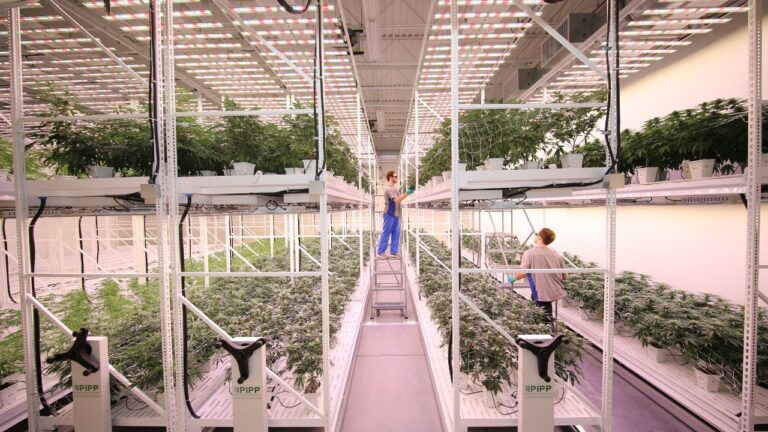
Canopy, the area where mature plants grow, is capped by tier, assigned at licensing and reassigned at renewal. It is measured horizontally, every level of a vertical rack counts, and drying, curing, packaging and storage rooms do not; Tier VI tops out at 150,000 square feet (17:30-10.4). There is room inside a tier: in September 2026 the Commission approved The Fireplace New Jersey adding 17 hoop houses and 39,780 square feet within its Tier V, subject to the $2,000 modification fee and an onsite assessment (NJ-CRC decision of September 16, 2026).
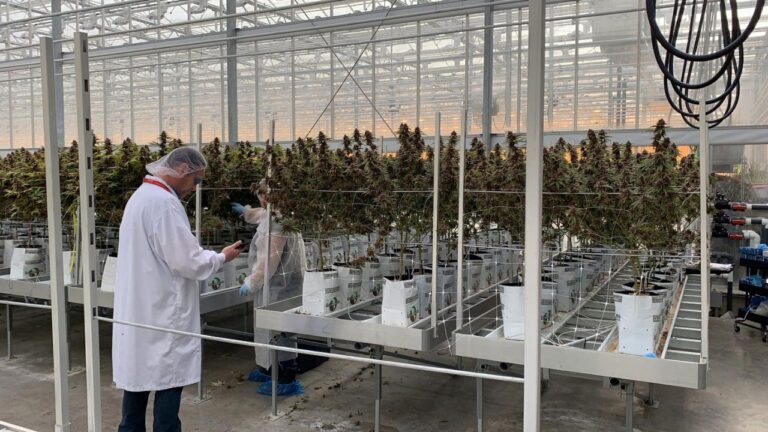
Testing is the other margin line. A batch that fails only on total yeast and mold may go to a manufacturer for solvent extraction and retesting; another failed batch may be remediated, meaning treated and retested, on notice to the Commission, or else it is destroyed (17:30-16.1 and 19.4). In our experience, yeast and mold failures usually trace back to HVAC, dehumidification and airflow in the flower room.
We work on cannabis facility design and HVACD (heating, ventilation, air conditioning and dehumidification), controlled environment agriculture setpoints, cannabis vertical farming layouts that fill a tier without changing it, operational optimization and, where cost per gram climbs as prices fall, a cannabis turnaround diagnostic. We also prepare renewal and modification files and reconcile Metrc, the state’s seed-to-sale tracking system, with point-of-sale records. Michael Williamson, our Chief Operating Officer and a former licensed operator, has designed and consulted on more than 7 million square feet of indoor, greenhouse and outdoor cultivation facilities.
Who does the New Jersey work. Leif Olsen, our Chief Executive Officer and a co-founder, leads our licensing and application work. We have no New Jersey office; we work with New Jersey clients on-site and remotely, and the same team runs Catalyst BC’s national cannabis consulting practice.
A word against our own interest: the NJ-CRC publishes free tutorials and the mistakes that most often trigger cure letters (NJ-CRC recreational business application page), and it says no applicant who completes the application and meets every requirement is denied. You may not need a consultant to file a conditional application. Outside help earns its fee on the town, the site, the money and the build. To talk through a New Jersey file, contact us or call (USA) 303-305-3787.

Investing in New Jersey cannabis
- Cannabis Business Strategy ConsultingTown screens and acquisition diligence
- Cannabis Financial Planning & ModelingPro formas, NJ-CRC fees and the excise fee
- Cannabis Licensing & Application SupportConditional, conversion and annual files
- Cannabis Startup SupportLocal approval to opening day
Already licensed in New Jersey
- Cannabis Facility Design & HVAC / HVACD EngineeringIndoor, greenhouse and hoop house
- Cannabis Controlled Environment Agriculture (CEA)Setpoints that cut yeast and mold failures
- Cannabis Vertical Farming ConsultingRacks with every level counted as canopy
- Cannabis Operational OptimizationGrams per square foot and cost per gram
- Cannabis Business Turnaround & Operational RecoveryWhen costs outpace price
Compliant Harvests
Square Feet of Cultivation, Production, and Retail Facilities Designed
Licenses Secured
Which New Jersey Applications the NJ-CRC Is Accepting This Fall
Every adult-use class. The NJ-CRC is accepting applications for testing laboratories and all categories of adult-use business (NJ-CRC Cannabis Business Licensing), on the continuous rolling basis its rules require while a class is open (17:30-6.1), with no statewide limit on licenses. No closing date has been announced, though the Commission may change which classes it accepts. Medicinal business applications are not being accepted (NJ-CRC Medicinal Cannabis Businesses). By September 1, 2026, 3,267 applications had been submitted and 2,568 approved, with 122 awaiting resubmission after a cure letter, the NJ-CRC’s notice of missing items (NJ-CRC meeting slides, September 9, 2026). Supply is still coming: 1,702 conditional licenses, 509 conversions and 363 annual licenses had been awarded by September 9, 2026 (NJ-CRC Reports, Statistics & Information), against 397 businesses operating at the end of 2025.
NJ-CRC routes and their status on October 1, 2026
| Route | Status | Who uses it |
|---|---|---|
| Conditional license, any class | Open; rolling review | Applicants still securing a site and financing |
| Annual license, any class | Open; rolling review | Applicants with site, local approval and financing |
| Conditional-to-annual conversion | Open | Conditional holders, before the license expires |
| Testing laboratory | Open; rolling review | Laboratories |
| Consumption area endorsement | Open | Class 5 retailers and medicinal dispensaries |
| Medicinal cannabis business | Not accepting | Existing operators use Expanded ATC certification |
| Ownership, location or capacity change | Open, by amended-license application | License holders |
Statuses from NJ-CRC pages read September 28 to October 1, 2026.
The countdowns your own New Jersey award starts
| Clock | Rule | Source |
|---|---|---|
| Conditional license term | 120 days from issuance; a 45-day extension case by case, or for good cause; extended while a complete conversion application is under review | N.J.A.C. 17:30-7.6 |
| Extension request | At least 15 days before the deadline; a passed deadline cannot be extended | NJ-CRC extension request guidance |
| Annual renewal | Application and fee at least 90 days before expiration | N.J.A.C. 17:30-7.16 |
| Majority ownership lock | From the conversion or annual application to two years after opening | N.J.A.C. 17:30-6.8 and 9.3 |
Rule text from the NJ-CRC-posted compilation of N.J.A.C. 17:30.
Review takes time even when nothing goes wrong. The NJ-CRC’s posted averages, dated September 9, 2025, are 4 to 5 weeks for a conditional application and 12 to 26 weeks for an annual or conversion application (NJ-CRC License Application Process).
New Jersey’s Six License Classes, Microbusinesses and Cultivation Tiers
The CREAMM Act created six classes: Class 1 cultivator, Class 2 manufacturer, Class 3 wholesaler, Class 4 distributor, Class 5 retailer and Class 6 delivery, with testing laboratories licensed separately. One license holder and its owners may hold a cultivator, manufacturer, retailer and delivery license together, or a wholesaler and distributor license together (17:30-6.8). Every applicant needs at least one owner who has lived in New Jersey for at least two years (17:30-7.4 and 7.11).
What each New Jersey class allows, and how many towns permit it
| Class | What it allows | Towns allowing it* |
|---|---|---|
| Class 1 Cultivator | Grow cannabis | 178 |
| Class 2 Manufacturer | Make cannabis products | 180 |
| Class 3 Wholesaler | Store, buy and sell cannabis items between licensees | 172 |
| Class 4 Distributor | Transport cannabis items in bulk between licensees | 161 |
| Class 5 Retailer | Buy from licensed producers and sell to consumers in a store | 176 |
| Class 6 Delivery | Carry a consumer’s retail purchase from the retailer to the consumer | 135 |
*Our count of rows marked “Yes” in the NJ-CRC opt-in table of 233 municipalities, read September 29, 2026; the NJ-CRC notes the table may become outdated.
Cultivation tiers by mature canopy and their annual licensing fees
| Tier | Mature canopy | Annual licensing fee |
|---|---|---|
| Microbusiness | Up to 2,500 sq ft, and up to 24 ft high | $1,000 |
| Tier I | Up to 10,000 sq ft | $5,000 |
| Tier II | More than 10,000, up to 25,000 sq ft | $10,000 |
| Tier III | More than 25,000, up to 50,000 sq ft | $20,000 |
| Tier IV | More than 50,000, up to 75,000 sq ft | $30,000 |
| Tier V | More than 75,000, up to 100,000 sq ft | $40,000 |
| Tier VI | More than 100,000, up to 150,000 sq ft | $50,000 |
Canopy limits from N.J.A.C. 17:30-10.4; fees from N.J.A.C. 17:30-7.17.

Microbusinesses. A microbusiness may employ no more than 10 people at a time and occupy no more than 2,500 square feet; a micro cultivator may hold no more than 1,000 mature plants a month, and a micro manufacturer, retailer or wholesaler may acquire no more than 1,000 pounds of usable cannabis a month. All owners must have lived in New Jersey for the past two years, and at least 51% of its owners, or of its principals (people with decision-making authority), or of its employees, or of all of them together, must live in the host town or a bordering one. It pays half the standard fees, is exempt from the labor peace requirement and may later convert to a standard license (17:30-6.7).

Consumption areas. A licensed retailer or medicinal dispensary may add one consumption area, with no sales of food or drinks there (consumption area rules, R.2024 d.010).
What the NJ-CRC Charges Under N.J.A.C. 17:30-7.17
Each application fee has two parts: a submission fee, 20% of the total, paid when you file, and an approval fee, the other 80%, paid only if you are approved. Licensing fees are due on approval and at each renewal, and the first year’s licensing fee is reduced by the application fees already paid.
Application fees, submission plus approval
| Application | Standard business | Microbusiness |
|---|---|---|
| Conditional license | $200 + $800 | $100 + $400 |
| Conditional-to-annual conversion | $200 + $800 | $100 + $400 |
| Annual license | $400 + $1,600 | $200 + $800 |
| Testing laboratory | $400 + $1,600 | n/a |
| Consumption area endorsement | $200 + $800 | One rate listed for all |
| Expanded ATC certification (an alternative treatment center, the state’s term for a medicinal operator, adding adult-use sales) | $400,000 cultivator; $300,000 manufacturer; $100,000 dispensary; $800,000 to $1,000,000 vertically integrated with one to three dispensaries | n/a |
From N.J.A.C. 17:30-7.17, as amended for consumption areas by R.2024 d.010; the NJ-CRC fee schedule effective November 20, 2024 shows the same amounts.
Annual licensing fees by class
| Class | Standard business | Microbusiness |
|---|---|---|
| Class 1 Cultivator | $5,000 to $50,000 by canopy tier | $1,000 |
| Class 2 Manufacturer | $20,000 with premises up to 10,000 sq ft; $30,000 above | $1,000 |
| Class 3 Wholesaler | $10,000 | $1,000 |
| Class 4 Distributor | $3,000 | $1,000 |
| Class 5 Retailer | $10,000 | $1,000 |
| Class 6 Delivery | $3,000 | $1,000 |
| Consumption area endorsement | $5,000 | $1,000 |
| Testing laboratory | $4,000 | n/a |
Change, background-check and ID card fees
| Fee | Standard business | Microbusiness |
|---|---|---|
| Location change, per premises moved | $10,000 | $1,000 |
| Capacity or physical plant change, including added canopy | $2,000 | Not listed in the fee schedule |
| Transfer of more than 50% of ownership | $20,000 | $20,000 |
| Microbusiness conversion to standard | n/a | $200 + $800 |
| Background investigation | $1,000 per financial source or management services contractor; $250 per owner or principal | Same |
| Cannabis business ID card | $25 | $25 |
Conditional license applicants and holders and social equity businesses are exempt from background investigation fees (N.J.A.C. 17:30-7.17(m)). Microbusiness cells follow the NJ-CRC fee schedule; N.J.A.C. 17:30-6.7 says a microbusiness pays 50% of any standard fee, so ask the Commission which applies to a change or transfer.
Municipal fees, local tax, rent, zoning counsel, fit-out and working capital will dwarf these. For a grower, any canopy addition carries the $2,000 modification fee, and a higher tier also raises the licensing fee, so more yield inside the current tier usually pays back first.
How the NJ-CRC Queues, Cures and Converts New Jersey Applications
New Jersey runs no competitive rounds: each application is scored, and those reaching a full score are approved (17:30-6.1). The rules give social equity, diversely owned and impact zone businesses priority over other applicants, conditional over annual applications, microbusinesses over standard businesses, and bonus-point applicants over the rest. In practice, the NJ-CRC reviews testing laboratories and social equity businesses first, then diversely owned businesses (certified minority-, woman- or disabled veteran-owned), then impact zone businesses (tied to large towns or towns with high unemployment, crime or marijuana-arrest rates), each first in time (NJ-CRC Priority Applications).
A social equity business is more than 50% owned by people who either lived in an Economically Disadvantaged Area, as the NJ-CRC designates them, for five of the last ten years with household income at or below 80% of the state median (the NJ-CRC uses $72,355.20), or have at least two marijuana- or hashish-related disorderly persons offenses or one indictable offense, expunged or not (17:30-6.6). Bonus points go to applicants with an owner who has lived in New Jersey for five years, a collective bargaining agreement with a union representing cannabis workers, or a project labor agreement for the build (CREAMM Act, P.L.2021, c.16).
A cured application goes to the end of its priority group, not the whole queue. Here is how to open a dispensary in New Jersey, in the order the rules set:
- Pick a town that allows Class 5 retail and read its ordinance, local fee and transfer tax before you sign anything.
- Choose a conditional or annual application, standard or micro, and document any priority status.
- File through the NJ-CRC application platform, pay the submission fee and answer any cure letter quickly.
- Before the conditional license expires, 120 days after issuance, secure the site, the landlord’s certification, zoning approval and proof of local support, then file the conversion.
- Build out, pass the NJ-CRC’s inspection, pay the licensing fee and register every worker for a cannabis business ID card before the first sale.
Who Can Own What in New Jersey: Equity Status, Conditional Owners and Consultant Contracts
During the conditional phase, owners may transfer interests to qualified parties and the license holder may add qualified owners, but the majority stays with the people the license was issued to (17:30-7.6), and a diversely owned, impact zone or social equity holder may not make a transfer that costs it that status. A social equity business proves its status again at every renewal.
This is also how New Jersey treats a consultant. A management services agreement is any contract for staffing, administrative, operational, advisory or management services paid for in money, not ownership, and the rule names “consulting” among them (17:30-1.2 and 6.9). The license holder must send the Commission a copy before signing; the term may not exceed five years without a chance to renegotiate; profit shares above the license holder’s own are treated as unfair. A manager may serve up to five applicants or license holders and a financial source may fund up to seven (17:30-6.8). Before you sign anyone, including us, ask which kind of agreement it is.
Choosing a New Jersey Town and Site: Opt-Ins, Default Zoning and Premises Limits
Towns had 180 days after the CREAMM Act took effect to ban one or more classes. Where a town did not act, the statute makes cultivation, manufacturing, wholesale, distribution and delivery permitted uses in every industrial zone, and retail a conditional use, allowed if set conditions are met, in commercial and retail zones. Every five years such a town gets a new 180-day window to ban classes, but a new ban applies only going forward (N.J.S.A. 24:6I-45). By our arithmetic the first window opened in August 2026 and runs to about February 2027, which makes an operating site worth more than an optioned one.
The NJ-CRC’s opt-in table lists 233 municipalities in all 21 counties, 176 allowing Class 5 retail by our count (NJ-CRC municipal opt-in table). The annual or conversion file needs a zoning letter, proof of local support (usually a resolution by the town’s governing body), proof of control of the premises and, for a leased site, the landlord’s certification that it knows the use, without which an annual application is disqualified (17:30-7.10). The statute also bars a retailer from premises that sell food or alcohol.
Staying Licensed in New Jersey: Inspections, Labor Peace, Testing, Marketing and Tax
In 2025 the NJ-CRC’s Office of Compliance and Investigations ran 166 investigations and issued 37 notices of violation, including over mismatched Metrc and point-of-sale data (NJ-CRC High Points, 2025 in Review). In October 2025 all eight licensed laboratories received notices for not using the testing standard the NJ-CRC requires; nine are listed today (NJ-CRC Testing Laboratories). Three or more major violations in 12 months, or a lost social equity, diversely owned or microbusiness status, may be grounds to deny renewal (17:30-7.16).
A labor peace agreement, a contract in which a union agrees not to disrupt the business while workers decide whether to organize, is an ongoing condition of every license except a microbusiness. If most employees vote to join a union and no collective bargaining agreement follows within 200 days of opening, the business may be referred to the National Labor Relations Board (17:30-9.4).
Advertising must reach an audience at least 71.6% aged 21 or older, carry the state’s health warning, say the business is licensed by the State of New Jersey, stay off television, streaming and radio from 6 a.m. to 10 p.m., and not appear within 200 feet of a school (17:30-17.2). An inhalable package may hold a quarter ounce at most, an edible package 100 mg of THC, a single serving 10 mg and a single-serving drink 5 mg (17:30-11.5).
Tax. Retail sales carry the 6.625% state sales tax (NJ-CRC General FAQ), reported quarterly on Form ST-50 by Class 5 and Class 6 license holders (NJ Division of Taxation, cannabis sales tax filing). Cultivators pay the Social Equity Excise Fee, $2.50 an ounce in 2026, monthly on Form SF-100 (NJ Division of Taxation, Social Equity Excise Fee). Medical cannabis has been exempt from sales tax since July 1, 2022 (NJ Division of Taxation, medical cannabis). Towns may add a transfer tax of up to 2% on sales by cultivators, manufacturers and retailers and 1% by wholesalers, with a matching user tax on transfers between a business’s own locations (C.40:48I-1).
Bringing Capital to New Jersey Cannabis, or Pushing More Out of a Licensed Room?
Investors get an entry memo before they commit: which route fits their money (their own application, a passive stake, a loan or an acquisition), what N.J.A.C. 17:30 lets them own and how returns can be paid. License holders get a canopy and cost-per-gram review: tier headroom, the causes behind failed tests and a modification plan priced against the $2,000 fee. Send your town, license class and canopy or capital; if we are not the right fit, we will say so.
New Jersey Cannabis Business Questions: Applications, Ownership, Canopy and Tax
Is New Jersey’s cannabis market recreational, medical or both?
Both. Adult-use sales to buyers 21 and older began on April 21, 2022, and the medicinal program continues alongside; the Cannabis Regulatory Commission regulates both. The medicinal program had 42,984 patients on September 15, 2026, down from 52,877 at the end of 2025.
Can I apply for a New Jersey cannabis license right now?
Yes. The NJ-CRC accepts applications for testing laboratories and every adult-use class on a rolling basis, with no closing date announced and no statewide cap. A conditional license gives you 120 days from issuance to secure a site, local approval and financing; an annual license is for applicants who already have them. Medicinal applications are closed.
How much does a New Jersey cannabis license cost?
A conditional application costs $200 on submission and $800 on approval, an annual application $400 and $1,600; microbusinesses pay half. Annual licensing fees run from $3,000 for distribution or delivery to $50,000 for a Tier VI cultivator, and $1,000 for any microbusiness. Rent, local fees and the build cost far more.
How long does a New Jersey conditional license last?
120 days from issuance under N.J.A.C. 17:30-7.6. The Commission may grant a 45-day extension case by case and must extend while a complete conversion application is under review. Its process page says 165 days, so calendar the 120-day date and ask for any extension at least 15 days before it.
Can an outside investor own part of a New Jersey cannabis business?
Yes, within limits. A passive investor holds under 5% with no control and may do so in several businesses; at 5% or more you are an owner, and may own only one applicant or license holder. Decision-making owners of a conditional applicant must have had income of no more than $200,000, or $400,000 jointly. Majority ownership is locked from the conversion or annual application until two years after opening.
How does New Jersey count canopy toward a cultivation tier?
Canopy is the horizontal area of mature plants, and every level of a vertical rack counts; rooms used only for harvesting, drying, curing, packaging, labeling or storage do not. Tiers run from up to 10,000 square feet (Tier I) to 150,000 (Tier VI). Adding canopy needs an approved modification and a $2,000 fee, even within your tier.
What happens when a New Jersey batch fails a lab test?
It may not be sold to another business. If it failed only on total yeast and mold, a cultivator may sell it to a manufacturer for a solvent extract that leaves no yeast or mold, and the product is retested. Another failed batch may be remediated and retested on notice to the Commission; otherwise it is destroyed.
Does my New Jersey town have to approve a cannabis business?
Yes. An annual or conversion application must include a zoning letter from the town and proof of local support, usually a resolution by its governing body. Towns may also set distance rules and a transfer tax of up to 2%. Read the ordinance itself before signing a lease.
Selected Catalyst BC Projects
Selected projects are below; the full results sit in our case studies.

Hexo Corp.
Gatineau, Quebec, Canada

Bostica
Lynn, MA, United States

Leafline Labs
Cottage Grove, MN, United States

View All Projects
View all Catalyst BC Projects
New Jersey Cannabis Articles From Catalyst BC

Open a Cannabis Consumption Lounge in New Jersey: 2026 Guide to Compliance and Success
As of April 2026, the New Jersey cannabis market has matured into a sophisticated $4 billion powerhouse. The initial “novelty” phase has passed, and the

Regulatory Maturity and Market Dynamics: A Comprehensive Analysis of the New Jersey Cannabis Industry
The legal landscape of cannabis in New Jersey has transitioned from a period of rapid legislative enactment into an era of complex regulatory maturity and

Cannabis Consumption Lounges: Which States Permit On-Site Use in 2026?
Across much of the U.S., legally consuming cannabis remains largely restricted to private residences – and even then, landlords or HOAs frequently ban it. While
Where This Page’s New Jersey Figures Come From: NJ-CRC, N.J.A.C. 17:30 and Taxation
Rules and statutes
- N.J.A.C. 17:30, Personal Use Cannabis Rules, NJ-CRC compilation, Supp. 3-6-23 (PDF)
- P.L.2025, c.215, intoxicating hemp law, section 17 (effective dates) (PDF)
- P.L.2026, c.7, amending P.L.2025, c.215 (approved March 30, 2026) (PDF)
- N.J.A.C. 17:30 consumption area adoption, R.2024 d.010, 56 N.J.R. 273(a), effective February 20, 2024 (PDF)
- P.L.2021, c.16, the CREAMM Act, including N.J.S.A. 24:6I-45 and C.40:48I-1 (PDF)
NJ-CRC licensing pages
- NJ-CRC, Fee Schedule effective November 20, 2024 (PDF)
- NJ-CRC, Recreational Cannabis Business Applications (tutorials, business navigator, avoiding cure letters)
- NJ-CRC, Recreational Business Application page (status, classes, microbusiness and premises FAQs, fee schedule)
- NJ-CRC, Medicinal Cannabis Businesses
- NJ-CRC, License Application Process
- NJ-CRC, Priority Applications
- NJ-CRC, Testing Laboratories
NJ-CRC guidance and FAQs
- NJ-CRC, Intoxicating Hemp FAQs
- NJ-CRC, Extension Requests guidance (PDF)
- NJ-CRC, Government Relations: Municipalities Opted-In to Adult-Use Cannabis Market (table read September 29, 2026)
- NJ-CRC, General FAQs
NJ-CRC decisions and resolutions
- NJ-CRC, Resolution 2023-142, 2024 Social Equity Excise Fee (PDF)
- NJ-CRC, Resolution 2024-298, 2025 Social Equity Excise Fee (PDF)
- NJ-CRC, Resolution 2025-12-17-02, 2026 Social Equity Excise Fee (PDF)
- NJ-CRC, Final Agency Decision approving a capacity modification for The Fireplace New Jersey LLC, September 16, 2026 (PDF)
NJ-CRC reports, meetings and news
- NJ-CRC, News archive (first adult-use sales, April 21, 2022)
- NJ-CRC, Recreational and medicinal sales, Q4 2025 (PDF)
- NJ-CRC, Benchmark Data, Q4 2025 (PDF)
- NJ-CRC, Public meetings calendar (read October 1, 2026)
- NJ-CRC, High Points, April 2026 (costs facing new businesses)
- NJ-CRC, Public meeting slides, September 9, 2026 (PDF)
- NJ-CRC, Reports, Statistics & Information (license awards; patient count on September 15, 2026; read October 1, 2026)
- NJ-CRC, High Points, “2025 in Review” (February 2026; 52,877 patients at the end of 2025)
New Jersey Division of Taxation
Contact Us
Enough about us. We want to hear more about you, your project, and your vision! Get in touch with a real live person today. Don’t worry, we don’t have a long, confusing phone menu, and your email isn’t going to the abyss, we promise. At Catalyst, we provide the service and support we’d want to experience ourselves!