Nebraska Cannabis Consultants for MCC Applicants and Growers

Nebraska cannabis consulting starts with one open door: the Medical Cannabis Commission accepts product manufacturer applications through December 14, 2026, while all four cultivator licenses are taken and dispensary applications have not opened. Investors face a four-year residency rule; growers face a 1,250-plant cap. Our records: 58+ licenses secured.

A Decade of Harvesting Success - Trusted by Cannabis Operators Worldwide

MCC Hearing, Renewal and Deadline Dates

Oct 15, 2026Public hearing on proposed MCC fee rules
Oct 19, 2026Commission vote on three cultivator renewals
Dec 14, 2026Manufacturer application period closes

Updated: 10/9/2026. Nebraska is a medical-only market. Voters approved Initiatives 437 and 438 in November 2024; the Nebraska Medical Cannabis Commission (MCC) registers and regulates businesses that possess, manufacture, distribute, deliver and dispense medical cannabis under the Nebraska Medical Cannabis Regulation Act (Neb. Rev. Stat. § 71-24,109). The Commission’s permanent rules were approved by the Attorney General on June 30, 2026 and by the Governor on July 1, 2026. Funding appropriated in April 2026 let the Commission begin hiring staff and securing office space, and it still operates without a full complement of five commissioners (MCC minutes, September 14, 2026, draft).

Three dates shape the next quarter. On October 15, 2026 the Commission takes public comment on proposed rules that would establish application, license and renewal fees (MCC public hearing notice). On October 19 it is scheduled to decide three cultivator renewals and consider the rule package. On December 14 the current manufacturer application period closes, and the Commission says applications filed now must be updated and resubmitted once the new rules take effect.

Meet Catalyst BC's Founders

  • Leif Olsen - Chief Executive Officer

    Leif Olsen

    Chief Executive Officer

  • Michael Williamson - Chief Operating Officer

    Michael Williamson

    Chief Operating Officer

  • Ian Miller - Executive Chair

    Ian Miller

    Executive Chair

Our partners bring multi-faceted expertise across business strategy, licensing, facility development, finance, and commercial operations. That breadth is complemented by subject matter experts across the wider Catalyst BC team, allowing us to bring the right combination of experience to each client and project. The result is bespoke, collaborative support shaped around your business, priorities, and goals - with the right expertise brought to the table when it matters most.

Learn more about our team

Where a Nebraska Cannabis Consultant Fits Between You and the MCC

The Commission scores applications, licenses businesses and inspects them; it is the regulator, not an advisor on ownership structure, facility size or product pricing. A Nebraska cannabis consultant works for the owner, from residency-compliant structures and business plans to the room design and test results that keep a license through renewal.

Investing in Nebraska Medical Cannabis: Who Can Own, What You Can Hold and What It Costs

Nebraska rewards local owners. An individual applicant must be a United States citizen who has lived in Nebraska for the four years before applying; an entity must be majority owned by such citizens, and its officers and directors must meet the same four-year residency test (238 NAC 1 § 04.03). An entity counts as majority owned when four-year residents hold more than 51% of either its financial interests or its voting interests (more than 50% under the proposed rules), so the rule text does not cap a non-resident below 49% of both; ask the Commission in writing before relying on such a structure.

Three more limits shape a deal. An applicant may hold only one license type, because vertical licensing is not permitted, and licenses cannot be transferred, so there is no license to buy. A license also may not be issued to or held by a person who has had any citation, fine, sanction, injunction or court judgment involving cannabis- or cannabinoid-related operations or sales, levied against the person or a business the person owns (238 NAC 1 § 04.07). In our view, that last rule needs checking against every partner’s record before an investor commits capital.

For investors: structure and site screening through cannabis business strategy, a Nebraska cannabis business plan and bond budget through cannabis financial planning, the scored application through cannabis license application support, and cannabis startup support from license acceptance to final inspection.

Already Licensed as a Nebraska Cultivator: 1,250 Flowering Plants and Organic-Only Inputs

Each of Nebraska’s four cultivators may possess no more than 1,250 flowering plants at one time, in any mix of indoor, outdoor or greenhouse space, and may use only pesticides, herbicides and fertilizers certified organic by the Organic Materials Review Institute or a similar standards body (238 NAC 1 §§ 14.06 and 14.07). Seeds and clones may come only from another Nebraska cultivator or a cultivator authorized in another U.S. state (238 NAC 1 § 14.09). A cultivator sells only to licensed product manufacturers and other cultivators, and dispensaries may not sell raw plant material, smokable or vaped products, or food and drink (238 NAC 1 § 13.09).

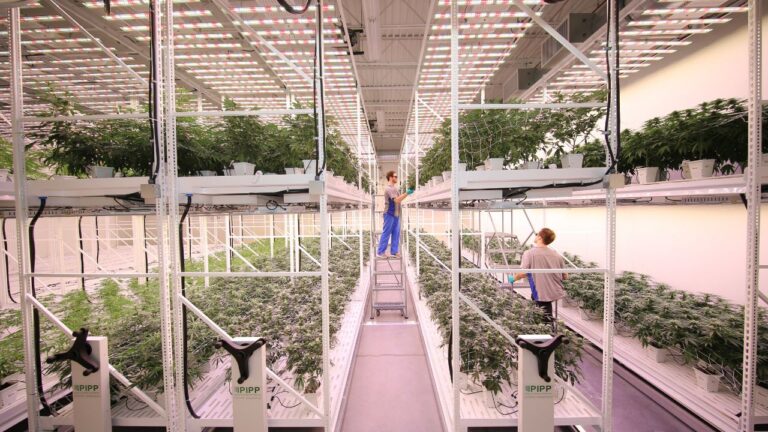
In our view, revenue therefore depends on yield per plant and on how much cannabinoid a manufacturer can extract from each batch, not on adding plants. Because the cap counts flowering plants rather than canopy, stacking tiers does not raise it; in our view stacking shrinks the building and its envelope load, but the HVACD (heating, ventilation, air conditioning and dehumidification) load still follows the plants and lights, so it is sized per tier.

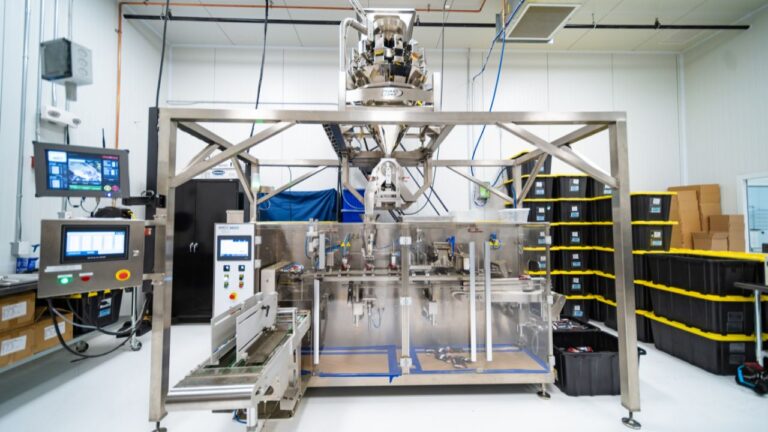
For Nebraska rooms we offer Nebraska cannabis facility design with HVACD sized to a 1,250-plant room plan, controlled environment agriculture targets by room, cannabis vertical farming priced against a smaller footprint, operational optimization of batches, labor and tracking records and, when costs outrun a small patient market, a cannabis turnaround plan. Michael Williamson, our Chief Operating Officer and a co-founder, co-founded Greenhaus Industries, which patented stackable trays for growing on multiple tiers, and has 25,000+ hours in cultivation and dispensary operations (company-reported).

Our Nebraska record and team: Catalyst BC has no Nebraska client work, past or current, and no Nebraska office; we work on-site and remotely. Leif Olsen, our Chief Executive Officer and a co-founder, leads our licensing work, and Ian Miller, our Executive Chair and a co-founder, raised $22 million in private equity (company-reported) for a greenfield cultivation and processing operation. The same team runs Catalyst BC’s national cannabis consulting practice.

A word against our own interest: no consultant can fix a residency or prior-sanction problem, and the Commission accepts applications by email or mail with no filing fee today, so an owner who meets the rules and writes well can file without us. To talk through a Nebraska plan, contact us or call (USA) 303-305-3787.


Investing in Nebraska cannabis

Already licensed in Nebraska

0 +
Years Regulated Cannabis Operations Experience
0 +

Compliant Harvests

0 M+

Square Feet of Cultivation, Production, and Retail Facilities Designed

0 +

Licenses Secured

Can You Apply in Nebraska? Manufacturer Applications Close December 14, 2026

Yes, for one license type. The Commission is accepting only product manufacturer applications, through 11:59 p.m. Central time on December 14, 2026 (the Commission’s page says CDT); no other applications are open (MCC how-to-apply page). Applications filed now must follow the emergency regulations the Commission approved on January 22, 2026, and will need to be updated and resubmitted after the new rules take effect. The Commission expects the new rules to take effect in early 2027 and will then open a new manufacturer period in which it may select up to four manufacturers. Missing December 14 does not shut anyone out: new applicants may also apply in that period, and every application will be judged under the new criteria. Ten manufacturer applications were pending on September 14, 2026 (draft minutes) for up to four licenses.

Cultivator applications ran from September 4 to September 23, 2025 and are closed. The Commission received 39 cultivator applications and drew them by lottery on September 25, 2025 (MCC minutes, September 30, 2025). It approved its fourth cultivator on March 16, 2026, and on April 13, 2026 declared the cultivator process concluded (MCC minutes, April 13, 2026). The how-to-apply page lists dispensary applications as not yet open.

License Status Detail
Product manufacturer Open Through December 14, 2026; resubmission required under the new rules
Cultivator Closed Four licenses approved from the 2025 round
Dispensary Not yet open The Commission’s page lists the period as pending legislative action
Transporter Not yet open The proposed rules replace it with a manufacturer transportation certification
Cultivator renewals Pending Three renewals set for the October 19, 2026 meeting
Swipe to see the full table →

MCC how-to-apply page; MCC minutes, September 14, 2026 (draft); 238 NAC 1 proposed amendments § 06.14. Every source is listed at the bottom of this page.

Step What happened
Applications 39 received in the September 4 to 23, 2025 window
Lottery Drawn on September 25, 2025; applications reviewed in drawn order
Scoring An average score above 70 of 100 was needed for an offer; at least five drawn applicants were denied for scores of 70 or below
Licenses Two issued October 8, 2025; a third approved January 5, 2026; the fourth approved March 16, 2026
Swipe to see the full table →

MCC minutes of September 30 and October 7, 2025, December 2, 2025, January 5, March 16 and April 13, 2026; 238 NAC 1 § 03.04.

Item Rule
Money Proof of financial capability to build, launch and sustain the business: access to capital, a detailed budget and funding sources
Facility Facility design and operational readiness, including compliance with state law and readiness to start operating
Residency How the applicant meets the four-year residency rules
Products Each product type, with extraction methods, processing techniques and equipment
Quality Sanitation and safety procedures, the Good Manufacturing Practices (GMP) to be followed, and the certifications to be pursued
Team and partners Leadership qualifications, regulated-industry and cannabis experience, and any contractors for manufacturing work
Projections Financial projections for the next year
Swipe to see the full table →

238 NAC 1 § 06.05 (permanent rules). Applications filed through December 14, 2026 follow the January 22, 2026 emergency regulations.

Investors checking who may own a license should jump to ownership rules.

Four Nebraska License Types, Their Caps and What Each May Sell

The current rules create four license types, each capped. The Commission may issue no more than four cultivator and four product manufacturer licenses statewide, and no more than one dispensary and one transporter license in each of Nebraska’s 12 district court judicial districts (238 NAC 1 §§ 04.11, 05.11, 06.11 and 07.11). If the Commission finds supply short of demand in a year, it may add one license of that type the next year, or one per district for dispensaries and transporters.

Product flows one way: cultivators sell to manufacturers and other cultivators, manufacturers sell to dispensaries and other manufacturers, and only a dispensary sells to patients and caregivers. Every product must be registered with the Commission before sale. Manufacturers must also meet food safety law, and every ingredient other than those naturally occurring in cannabis must be approved by the U.S. Food and Drug Administration (238 NAC 1 § 15.09).

License Cap May sell or transfer to
Cultivator 4 Licensed product manufacturers and other cultivators
Product manufacturer 4 Licensed dispensaries and other manufacturers
Dispensary 1 per judicial district (12 districts) Qualified patients and caregivers, at the licensed premises only
Transporter 1 per judicial district Moves product between licensees; replaced in the proposed rules by a manufacturer transportation certification
Swipe to see the full table →

238 NAC 1 §§ 02, 05.11, 06.11, 07.11, 13.04, 14.02 and 15.02; Neb. Rev. Stat. § 24-301.02; proposed amendments § 06.14.

Allowed Not allowed
Oral tablets, capsules or tinctures Raw plant material
Gels, oils, creams or other topicals Anything smoked, combusted or vaped
Suppositories and transdermal patches Food or drink infused with cannabis, or added flavoring or coloring
Nasal sprays Products over 60% total THC or 40 mg THC per dose
Liquids or oils for a nebulizer or inhaler Products with synthetic cannabinoids, or shaped like a human, animal or leaf
Swipe to see the full table →

238 NAC 1 § 13.09.

While the Commission charges no application or renewal fee, a license is valid for six months from issuance; once a fee applies, it runs one year (238 NAC 1 § 03.09). Renewals are filed between 90 and 30 days before expiration (238 NAC 1 § 08.01). The Commission may revoke, cancel or refuse to renew a license that has been inactive, without good cause, for six months or more (238 NAC 1 § 10.02).

Correction to published guidance (October 9, 2026): a competing consultancy’s Nebraska page, last modified July 21, 2025 according to its page metadata, says medical patient registrations were slated to begin in October 2025. The October 1, 2025 deadline in Neb. Rev. Stat. § 71-24,111 was for the Commission to begin granting registrations to businesses (§ 71-24,111), and it issued two cultivator licenses on October 8, 2025 (MCC minutes, March 16, 2026).

Proposed MCC Fees, the $300,000 in Bonds and What Is Free Today

Since April 8, 2026, LB 1235 has let the Commission set fees by rule, capped at $50,000 per fee (Neb. Rev. Stat. § 71-24,113). Until fee rules take effect, the Commission charges no application, license or renewal fee and keeps six-month renewals (MCC regulations page; MCC minutes, August 17, 2026). Bonds apply now: within 30 days of licensing, every establishment files a reclamation bond of at least $200,000 and a performance bond of at least $100,000, each naming the State of Nebraska (238 NAC 1 §§ 12.11 and 12.12).

The proposed amendments to 238 NAC 1 set the schedule below (proposed amendments, § 07.02), and written comments are due by 11:59 p.m. on October 15, 2026. One point to raise there: the draft lists a $10,000 transportation certification fee, then says there is no additional cost to submit a certification application with a manufacturer application.

LicenseApplicationLicense feeAnnual renewal
Cultivator$5,000$20,000$23,500
Product manufacturer$5,000$20,000$23,500; $28,500 with a transportation certification
Dispensary$5,000$15,000$18,000
Transportation certification (manufacturers)Filed with the manufacturer application$10,000 listedIncluded in the $28,500 renewal
Swipe to see the full table →

Proposed amendments to 238 NAC 1 (August 2026) §§ 003.03(A), 04.13, 05.13, 06.13, 06.15, 06.16 and 07.02. Proposed, not in force.

ItemAmountStatus
State inventory tracking system$13,000, plus $13,000 at each renewalProposed; due February 1, 2027 or at licensing
Product registration$250 per product name; $100 to renewProposed
Relocation request$1,500Proposed
Reclamation bondAt least $200,000In force; filed within 30 days of licensing
Performance bondAt least $100,000In force; filed within 30 days of licensing
Fingerprint background checkFee payable to the Nebraska State PatrolIn force; national check since September 1, 2026
Swipe to see the full table →

Proposed amendments §§ 13.07(B), 13.07(F), 04.10, 18.09 and 18.10; 238 NAC 1 §§ 12.11 and 12.12; MCC how-to-apply page.

LicenseFirst-year feesEach renewal year
Cultivator$38,000$36,500
Product manufacturer, no certification$38,000$36,500
Dispensary$33,000$31,000
Swipe to see the full table →

Application plus license fee plus the $13,000 tracking fee; renewal plus the $13,000 tracking renewal. Excludes bond premiums and background check fees.

Budget for the market, not just the fees. A dispensary may not sell more than five grams of total THC for the same patient in any 90-day period (125 doses at the 40 mg cap), or more than a 30-day supply at the written-order dose, so in our view every license is priced against a small, dose-limited patient base. A cultivator paying $36,500 a year under the proposed renewal and tracking fees, plus bond premiums, needs yield per plant that justifies it.

Patient access sets the size of that base. A patient must see an enrolled practitioner in person, and written orders go electronically to one named dispensary (238 NAC 1 §§ 19 and 20). A state patient registry depends on the Legislature funding one.

From Lottery to Opening Day: How a Nebraska Dispensary or Manufacturer Gets Licensed

Under 238 NAC 1 §§ 03, 12.11, 12.12 and 12.17, the path from application to an open dispensary or manufacturing site runs in five steps:

  1. Qualify before you file: residency for the applicant, officers and directors; no disqualifying conviction or cannabis- or cannabinoid-related sanction; a site at least 1,000 feet from schools, churches, hospitals and other covered locations; and one license type per applicant.
  2. File one complete application in the posted window, by email, the Commission’s portal or mail postmarked by the deadline. Applications that share any officer or owner, including a minority owner of 5% or more, are treated as one applicant, and applications that break this rule are not entered into the lottery or considered (238 NAC 1 §§ 003.04(A), 03.05).
  3. Pass the pre-lottery completeness review. If applications outnumber licenses, a lottery sets the review order, and the Commission scores each drawn application with primary emphasis on its business plan, financial stability, facility design and operational readiness; an average above 70 of 100 qualifies.
  4. Accept the offer in writing within five business days, then file the reclamation and performance bonds within 30 days of licensing.
  5. Pass the final inspection before opening: a State Fire Marshal inspection and certificate of occupancy, proof of ownership or the owner’s consent, a final diagram showing storage and security equipment, and compliance with the business plan you filed.

A denied applicant may request reconsideration, but not of a denial for being excluded from or not drawn in the lottery; a licensee may appeal a denial or sanction by requesting a hearing within ten business days (238 NAC 1 § 11). In our view, applications fail on the score more often than on paperwork, so our cannabis licensing and application team writes each business-plan section against those four emphasized criteria.

Who May Own a Nebraska Medical Cannabis Business, and Who Is Barred

Besides the cannabis-sanction bar in the investor section, a license may not be issued to or held by anyone convicted of a felony or controlled-substance offense in the past ten years, an entity whose officers, directors or owners have such a conviction or had a license suspended or revoked under these rules, a person under the age of majority, a government body, or a health care practitioner who has issued a written recommendation or order in the past five years (238 NAC 1 § 04.07). Practitioners enrolled to recommend medical cannabis may not hold an economic interest in any licensee.

Every application names the applicant’s officers, directors and owners, including any minority owner with 5% or more of the financial or voting interests, counting parent and subsidiary entities; the proposed rules would require any minority owner with any financial or voting interest to be named (proposed § 04.04). Residency is proved, on request, with three of six records covering the four prior years: Nebraska vehicle registration, owned or rented Nebraska property, a Nebraska mailing address, a Nebraska address on tax returns, Nebraska voter registration or a Nebraska driver’s license. In our view, because licenses are non-transferable, an exit plan should assume the license stays with the licensee. Residency and ownership are retested at every renewal, now every six months, so selling equity that leaves residents without more than 51% of either the financial or the voting interests can cost the license at the next renewal (238 NAC 1 § 08.03).

Where a Nebraska Facility Can Go: 1,000-Foot Buffers, County Zoning and Judicial Districts

No license is issued for premises within 1,000 feet of a covered location: a school, a licensed child care business, a church, a hospital or a mental health substance use treatment center. The distance runs in a straight line from the covered location’s nearest property line to the licensed premises’ nearest perimeter wall, and a licensee operating before the covered location was established is exempt (238 NAC 1 § 04.08). Only one license may be issued for the same address (238 NAC 1 § 09.03).

Local approval matters as much as state approval: the Commission may sanction a licensee that fails to comply with state or local government requirements (238 NAC 1 § 10.04).

Dispensary and transporter caps follow the 12 district court judicial districts, which range from a single county to 17 counties in District 11 (Neb. Rev. Stat. § 24-301.02). Our cannabis facility design work starts by screening buffers, county zoning and power before a site is optioned.

Security also shapes the building: cameras recording at least 15 frames per second must cover every area where cannabis is present, recordings must be kept for at least 120 days, and battery backup must support at least 60 minutes of recording (238 NAC 1 § 12.09).

Testing, Tracking, Federal Tax and Nebraska Hemp

Independent laboratories test every lot or batch for potency, foreign matter, microbials, pesticides, heavy metals and mycotoxins, residual solvents in concentrates and products, and water activity in flower and finished products (238 NAC 1 § 16). A lot fails if its water activity exceeds 0.65. A failed lot may be remediated only under a Commission-approved plan filed within 15 days of the failed result, and if a lot fails three times, products sold or made from it are subject to mandatory recall (238 NAC 1 § 16.04).

On September 14, 2026 the Commission approved a quote and statement of work for METRC as its seed-to-sale tracking system (MCC minutes, September 14, 2026, draft), and the rules require every transfer and sale to be tracked in it once it is in use. Commission staff have described a planned inspection program: pre-operational inspections, harvest inspections generally tied to a licensee’s first harvest, and annual inspections (MCC minutes, August 17, 2026). Licensees must also report a significant change to their business plan within three business days (238 NAC 1 § 12.03). Our Nebraska cannabis compliance consulting review checks test history, tracking records, security video retention and bond status against the rules before an inspector does.

The Regulation Act creates no cannabis excise tax. Federally, a final rule effective April 28, 2026 states that state medical licensees will no longer be subject to the Section 280E deduction bar, while saying it is not a determination of federal tax liability (91 FR 22714). Nebraska’s label rules still require the words “Schedule I controlled substance.”

Hemp in Nebraska: USDA Licenses and the Federal Change

Hemp is outside the Commission’s cannabis definition (Neb. Rev. Stat. § 71-24,107). Since January 1, 2025, Nebraska growers have been licensed by the U.S. Department of Agriculture or a tribal program (Nebraska Department of Agriculture hemp page; § 2-505), and hemp in transit must travel with a copy of the license it was grown under and, with limited exceptions, its test results (Neb. Rev. Stat. § 2-515). LB 316, a bill to prohibit conduct involving hemp other than cannabidiol products, was indefinitely postponed on April 17, 2026 (LB 316 history). Federally, Public Law 119-37 narrows the hemp definition from November 12, 2026 (Pub. L. 119-37 § 781): until December 11, 2026 it applies only to products containing cannabinoids the plant cannot naturally produce (Pub. L. 119-103 § 2019); after that, the exclusions extend to final products over 0.4 mg of total THC per container and to cannabinoids synthesized outside the plant, among others.

Two Ways to Start: A Manufacturer Application Review or a 1,250-Plant Yield Plan

Investors get an application review before December 14: residency and sanction screening for every owner, a site check against the 1,000-foot buffers, and a Nebraska cannabis business plan with bonds, proposed fees and a five-gram patient market priced in. Cultivators get a yield plan for 1,250 flowering plants: grams per plant, organic input programs, HVACD sizing and the water-activity and microbial results that decide whether a lot sells. Send your ownership chart or your room and test data for a Nebraska marijuana consulting review, and we will tell you plainly if another firm suits you better.

Nebraska Medical Cannabis License Questions From Applicants and Growers

Only the product manufacturer license, through 11:59 p.m. Central time on December 14, 2026. Cultivator licenses are filled and dispensary applications have not opened. Manufacturer applications filed now must be updated and resubmitted once the new rules take effect, which the Commission expects in early 2027. New applicants may also apply when that new period opens.

Mostly, yes. An individual applicant must be a U.S. citizen who has lived in Nebraska for the four years before applying. An entity must be more than 51% owned by such residents, measured by financial or by voting interests, and its officers and directors must also meet the four-year rule.

No Commission fees today, but proposed rules would charge a $5,000 application fee, a $15,000 to $20,000 license fee and a $13,000 tracking fee, then $18,000 to $28,500 plus the $13,000 tracking fee at each annual renewal. Bonds of at least $200,000 and $100,000 are already required within 30 days of licensing.

No. Nebraska’s rules make licenses non-transferable, and an applicant may hold only one license type.

No more than 1,250 flowering plants at one time, in any mix of indoor, outdoor or greenhouse space. Only organic-certified pesticides, herbicides and fertilizers may be used.

No. Raw plant material, smokable or vaped products and cannabis food or drink are prohibited. Allowed forms are tablets, capsules, tinctures, topicals, suppositories, transdermal patches, nasal sprays and nebulizer or inhaler liquids, up to 60% total THC and 40 mg per dose.

The licensee may submit a remediation plan within 15 days of the failed result and, after approval, prepare the batch for resampling within 60 days. If a batch fails three times, products sold or made from it are subject to mandatory recall, and a batch that cannot be remediated in time is destroyed.

No. Hemp is excluded from the cannabis definition, and Nebraska growers have been licensed by the U.S. Department of Agriculture or a tribal program since January 1, 2025. A federal law narrows the hemp definition in two steps: from November 12, 2026 for products with cannabinoids the plant cannot naturally produce, and in full from December 11, 2026.

Cultivation and Extraction Projects Behind Our Advice to Nebraska Licensees

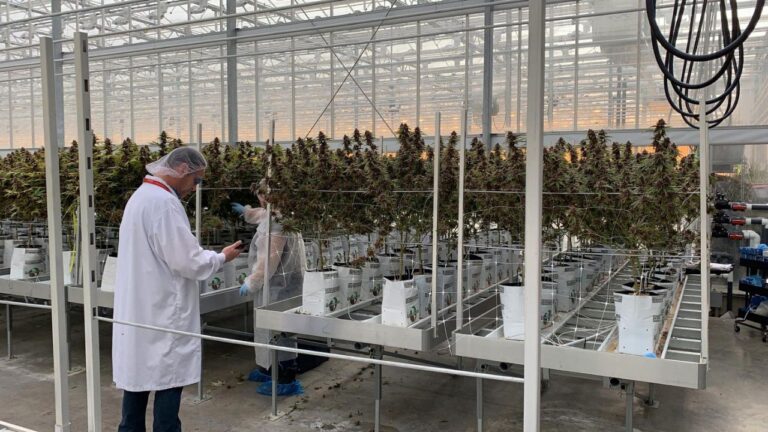
None of these projects is in Nebraska; they show the cultivation, extraction and facility work we offer Nebraska applicants and growers, and all are on our projects page.

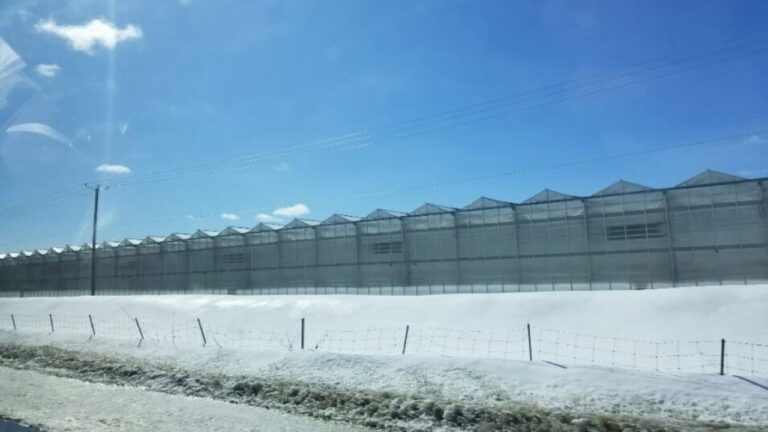
Exterior view of the Hexo Venlo glasshouse row spanning over 1 million square feet.

Hexo Corp.

Gatineau, Quebec, Canada

Modern stainless steel automated cannabis pre-roll processing machine in a dedicated production room.

Bostica

Lynn, MA, United States

Catalyst BC consultants and LeafLine Cultivation Director inspecting vibrant plants in an organized vertical grow room.

Leafline Labs

Cottage Grove, MN, United States

Catalyst BC consultant recording air, environmental, and plant data measurements within a cultivation facility.

View All Projects

View all Catalyst BC Projects

Cost and Grow-Room Reading for Nebraska Applicants and Growers

Provenance. Figures checked against the statute, rule and agency text by Catalyst BC on October 9, 2026. Nebraska statutes and LB 316’s history were read on the Nebraska Legislature’s website; the Commission’s permanent rules, proposed amendments and meeting minutes were read by text extraction from the PDFs the Commission posts; minutes marked draft had not been approved when read. Federal law was read on Congress.gov and the Federal Register. Fee totals marked as our arithmetic are our own. Company figures come from Catalyst BC’s own records. Where this page and the official text differ, the official text governs.

Nebraska statutes

Nebraska Medical Cannabis Commission rules, pages and minutes

Hemp and federal law

Contact Us

Enough about us. We want to hear more about you, your project, and your vision! Get in touch with a real live person today. Don’t worry, we don’t have a long, confusing phone menu, and your email isn’t going to the abyss, we promise. At Catalyst, we provide the service and support we’d want to experience ourselves!

Scroll to Top