Massachusetts Cannabis Consultants for CCC Buyers and Growers

Massachusetts cannabis consulting starts with mostly open doors: the Cannabis Control Commission (CCC) reviews license applications on a rolling basis, though new cultivator applications are paused. Investors weigh a six-store cap and November’s Question 8; retail vaults hold 3.5 years of flower. Our records show 58+ licenses secured nationwide.

A Decade of Harvesting Success - Trusted by Cannabis Operators Worldwide

Ballot, Equity and Credit-Rule Dates

Nov 3, 2026Voters decide Question 8 on adult-use retail sales
Nov 30, 2026Social Equity Program application window closes
Jan 1, 202860-day credit rule and delinquent list take effect

Updated: 10/8/2026. Massachusetts licenses adult-use Marijuana Establishments under Massachusetts General Laws (M.G.L.) c. 94G and medical establishments under c. 94I, both through the Cannabis Control Commission. Chapter 65 of the Acts of 2026, signed April 19, 2026, raised the retail ownership cap from three licenses to six and ended the vertical integration requirement for medical licensees. The CCC’s current rules, 935 CMR 500 and 501, took effect September 11, 2026 (935 CMR 500.000).

Three dates matter most to investors. On November 3, 2026, voters decide Question 8, which would repeal the laws that legalize and tax adult-use retail sales, effective January 1, 2028, if it passes (2026 Information for Voters). The Social Equity Program application window closes November 30, 2026. From January 1, 2028, a licensee that leaves another licensee’s bill for marijuana unpaid past 60 days must be reported to the CCC and may be posted on a delinquent list, and the CCC may not approve an ownership change for a listed licensee.

Meet Catalyst BC's Founders

  • Leif Olsen - Chief Executive Officer

    Leif Olsen

    Chief Executive Officer

  • Michael Williamson - Chief Operating Officer

    Michael Williamson

    Chief Operating Officer

  • Ian Miller - Executive Chair

    Ian Miller

    Executive Chair

Our partners bring multi-faceted expertise across business strategy, licensing, facility development, finance, and commercial operations. That breadth is complemented by subject matter experts across the wider Catalyst BC team, allowing us to bring the right combination of experience to each client and project. The result is bespoke, collaborative support shaped around your business, priorities, and goals - with the right expertise brought to the table when it matters most.

Learn more about our team

Where a Massachusetts Cannabis Consultant Fits Beside the CCC

The CCC licenses, inspects, approves ownership changes and reviews host community agreements; it does not value a license, size a dehumidifier or forecast a margin. A Massachusetts cannabis consultant works on the owner’s side of those files: diligence before a purchase, the three-part license application, and the building, energy and testing work the CCC inspects.

Buying Into Massachusetts Cannabis Under the Six-Store Cap

New applications are reviewed on a rolling basis, and existing licenses change hands with CCC approval. Since Chapter 65, one owner may hold up to six retail licenses and three each of cultivation, product manufacturing and fully integrated medical licenses; an equity stake under 20% does not count toward the caps if it carries no control (M.G.L. c. 94G, § 16). During the 12 months after the CCC begins accepting applications under the new cap, only a Social Equity Business, one at least 51% owned by Social Equity Program participants or Economic Empowerment Priority Applicants (two CCC equity designations for people from communities harmed by past marijuana enforcement), may receive a sixth retail license.

Price the downside first: Question 8 could end adult-use retail sales in 2028. Separately, the April 2026 federal rule left all marijuana other than FDA-approved drug products and marijuana under a state medical license in Schedule I (91 FR 22714), so in our reading adult-use sales still face Section 280E, the federal rule that bars business deductions.

Our work for Massachusetts investors: diligence on a target’s licenses, caps and CCC record through cannabis business strategy; a Massachusetts cannabis business plan with fees, taxes and a Question 8 scenario through cannabis financial planning; the application and change-of-ownership filings through cannabis license application support; and build-out to inspection through cannabis startup support.

Already Licensed by the CCC: Canopy Tiers, Watts and a Price Slide

CCC data presented October 8, 2026 put bud in retailer vaults at 1,286 days of sales, about 3.5 years, and the average wholesale price at $778.93 a pound in September, down from $907.79 in June (CCC meeting materials, October 8, 2026). Canopy counts every shelf level of a vertical rack once plants are larger than eight inches tall and wide, an indoor cultivator may move up a tier only after selling 85% of its product consistently for six months at the top of its tier, and one that sells less than 70% may be moved down at renewal.

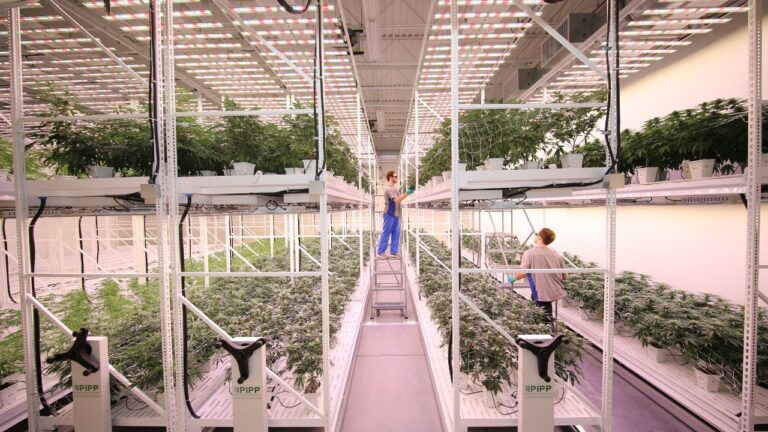
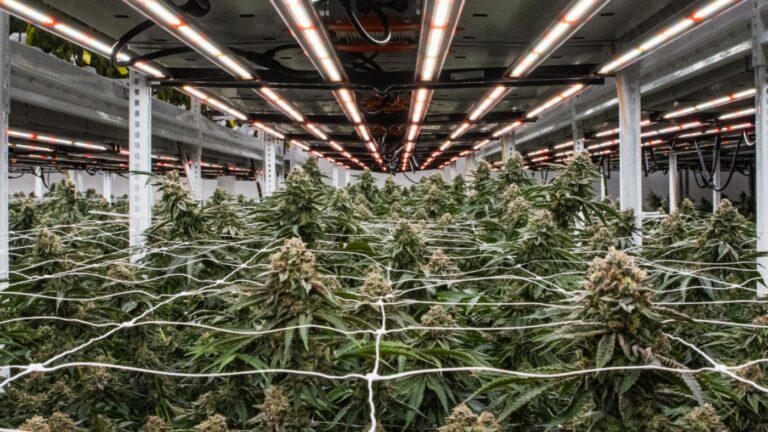
For Massachusetts rooms we offer Massachusetts cannabis facility design with HVAC and dehumidification sized to the lighting load, controlled environment agriculture targets that pass testing the first time, cannabis vertical farming where the tier math still pays, operational optimization of harvest scheduling, labor and Metrc records (the state’s seed-to-sale tracking system) and, when margins slip, a cannabis turnaround diagnostic.

Our Massachusetts record: our records list Massachusetts client work from 2020 to present. It includes multi-year operations advisory for Bostica, LLC, a CCC-licensed cultivator and product manufacturer in Lynn, on equipment selection, environmental control and fertigation; a ten-month optimization for a vertically integrated operator ahead of its acquisition, during which flower yield peaked at 109 grams per square foot; and facility design and financial models for a social equity venture (all company-reported).

Our team: Leif Olsen, our Chief Executive Officer and a co-founder, leads our licensing work. Our Chief Operating Officer and co-founder Michael Williamson has 25,000+ hours in cultivation and dispensary operations and co-founded Greenhaus Industries, which patented stackable trays for growing on multiple tiers (company-reported). Ian Miller, our Executive Chair and a co-founder, holds a master’s degree in building construction. As owners and operators, our team counts 3,000+ compliant, lab-tested harvest batches, including in Massachusetts (company-reported).

Where we work: we have no Massachusetts office; we deliver work on-site and remotely, and the same team runs Catalyst BC’s national cannabis consulting practice.

A word against our own interest: the CCC’s Model Host Community Agreement, used unchanged, is presumed compliant, and in our view many applicants need no consultant to negotiate it. To talk through a Massachusetts file, contact us or call (USA) 303-305-3787.


Investing in Massachusetts cannabis

Already licensed in Massachusetts

0 +
Years Regulated Cannabis Operations Experience
0 +

Compliant Harvests

0 M+

Square Feet of Cultivation, Production, and Retail Facilities Designed

0 +

Licenses Secured

Can You Apply for a Massachusetts Cannabis License Today?

Yes, for most license types. The CCC considers each application on a rolling basis and must grant or deny a provisional license within 90 days after it tells the applicant every required section is complete (935 CMR 500.102). The exception is cultivation: the CCC stopped accepting new indoor and outdoor cultivator applications on June 16, 2026, for 120 days, and may shorten or extend the pause; Microbusiness applications from eligible Social Equity Program participants and Economic Empowerment Priority Applicants are not covered (CCC bulletin, June 12, 2026).

The Commission’s October 8, 2026 agenda listed the pause and possible additional license freezes for discussion, and the Chair’s memo recommended extending the cultivation pause through June 2027. Check the Commission’s announcement before you file. The CCC is still writing rules for the new standalone medical license types Chapter 65 allows.


License Status Who may apply
Retailer Open Anyone eligible; a sixth license goes only to a Social Equity Business for the first 12 months
Cultivator (indoor or outdoor) Paused since June 16, 2026 Applications filed by June 16 are still processed
Microbusiness Open to equity applicants; the pause bulletin does not address others, so confirm with the CCC Majority of executives or members Massachusetts residents for 12 months
Product Manufacturer, Independent Testing Laboratory, Transporter, Research Open Anyone eligible
Craft Marijuana Cooperative, fully integrated medical Not named in the June 12 pause bulletin; confirm intake with the CCC Cooperative members Massachusetts residents for 12 months
Marijuana Courier, Delivery Operator, Delivery Endorsement Open, equity only Majority-owned by Social Equity Program participants or Economic Empowerment Priority Applicants until April 1, 2029
Social consumption, three classes Rules adopted; Supplemental applications expected in the coming months Equity owners, Microbusinesses and Craft Marijuana Cooperatives until 36 months after each class has an operating licensee
Swipe to see the full table →

935 CMR 500.050 and 500.102; CCC bulletin, June 12, 2026; CCC release, October 8, 2026. Every source is listed at the bottom of this page.

Rule Detail
License types Marijuana Courier (delivers for a retailer or medical establishment), Delivery Operator (buys wholesale, stores and delivers) and the Delivery Endorsement for a Microbusiness
Ownership Exclusive to businesses majority-owned and controlled by equity participants until April 1, 2029; the CCC may vote to extend that or to admit worker cooperatives and certified diverse businesses
Caps No more than three Delivery Operator and three Courier licenses per controlling person
Fees Courier $1,500 and $5,000; Delivery Operator $1,500 and $10,000; equity owners pay no first license fee and half thereafter
Where Any city or town, unless a town with no retail license obtains a CCC waiver, valid for up to two years
Swipe to see the full table →

935 CMR 500.005 and 500.050(1)(b)6, (10) and (11); M.G.L. c. 94G, § 4(b)(2), as amended by St. 2026, c. 65, § 25.

Class What it allows Fees (application / annual)
Supplemental On-site Consumption inside an existing licensee’s premises $1,500 / $5,000
Hospitality On-site Consumption inside a new or existing non-cannabis business $1,500 / $5,000
Marijuana Event Organizer Temporary consumption events, up to 30 days per city or town a year $1,000 / $5,000
Swipe to see the full table →

935 CMR 500.005(1)(d) and 500.050(6). Sales run 7 a.m. to midnight unless the city or town sets other hours (935 CMR 500.141).

Investors buying an existing license should jump to control changes.

CCC License Classes, Ownership Caps and Exclusive Windows

Adult-use licenses are Marijuana Establishments: cultivators in 11 canopy tiers up to 100,000 square feet, Craft Marijuana Cooperatives, product manufacturers, Microbusinesses, retailers, testing and standards laboratories, transporters, delivery licensees, social consumption establishments and research facilities (935 CMR 500.050). Medical licenses are Medical Marijuana Establishments; today the only type is the fully integrated license that cultivates, processes and sells its own products. Chapter 65 reserves any new medical license type other than the fully integrated license for Social Equity Businesses for 24 months after the first such license receives a notice to commence operations, a period the CCC may extend (St. 2026, c. 65, § 61).

The CCC counted 782 operating businesses, including 91 medical dispensaries, in September 2026.

License What it allows Cap per controlling person
Cultivator Grow, process and package; sell only to licensees Three licenses; 100,000 sq ft of canopy across all licenses
Product Manufacturer Make and package products; sell only to licensees Three licenses
Retailer Sell to adults 21 and over Six licenses (five for non-equity owners in the first 12 months)
Microbusiness Tier 1 cultivation and/or manufacturing Counts toward the cultivation and manufacturing caps
Fully integrated medical Cultivate, process and sell to patients Three licenses
Testing laboratory Test for licensees No license in any other class
Swipe to see the full table →

935 CMR 500.050(1)(b) and (8); M.G.L. c. 94G, § 16.

Date Change
March 27, 2026 Delivery exclusivity for equity owners extended to April 2029
April 19, 2026 Chapter 65 signed: retail cap from three to six, medical vertical integration ended, delivery allowed statewide
June 16, 2026 New cultivator applications paused for 120 days
June 17, 2026 Emergency rules approved: retail caps and the 20% equity threshold
September 11, 2026 Current 935 CMR 500 and 501 take effect
Swipe to see the full table →

CCC releases of March 31, April 19, July 3 and September 16, 2026; CCC bulletin, June 12, 2026; CCC regulations page.

A license expires one year after the provisional license is issued and renews every year; the renewal application and license fee are due at least 90 days before expiration, and the CCC issues the renewal within 30 days if the licensee qualifies (935 CMR 500.103(4)). Each renewal includes a compliant host community agreement or waiver, certificates of good standing and progress on the positive impact and diversity plans; an indoor cultivator also reports 12 months of energy and water use.

CCC Fees: $1,500 Retail Applications and Canopy-Tier Cultivation Fees

Massachusetts sets its fees in 935 CMR 500.005 (fee schedule). A retailer pays a $1,500 application fee and a $10,000 annual license fee; cultivation fees rise with canopy tier, from $200 to apply and $1,250 a year for an indoor Tier 1 to $2,000 and $50,000 for Tier 11. Fees are nonrefundable, and the license fee is due within 90 days of provisional approval or the approval expires.

Some owners pay less. Application fees are waived for Microbusinesses, for businesses majority-owned by Social Equity Program participants or Economic Empowerment Priority Applicants, and for certified minority-, women- or veteran-owned small businesses; the equity-owned and certified small businesses also pay half the annual license fee.

LicenseApplication feeAnnual license fee
Cultivator Tier 1 (up to 5,000 sq ft)$200 indoor / $100 outdoor$1,250 / $625
Cultivator Tier 3 (10,001 to 20,000 sq ft)$600 / $300$5,000 / $2,500
Cultivator Tier 11 (90,001 to 100,000 sq ft)$2,000 / $1,500$50,000 / $25,000
Product Manufacturer$1,500$10,000
Retailer$1,500$10,000
Microbusiness$050% of applicable license fees
Medical Marijuana Establishment$3,500$50,000
Swipe to see the full table →

935 CMR 500.005(1)(d); 935 CMR 501.005(2). Tiers 2 and 4 to 10 run $400 to $2,000 to apply and $2,500 to $45,000 a year indoors.

ItemAmount
Change of ownership or control, entity$5,000 per entity, per license
Change of ownership or control, individual$500 per person
Change of location (adult use)50% of the license fee
Architectural review request$1,500
Surety bond before openingEqual to the license fee; if no bond is available, escrow of at least $5,000 or another amount the CCC approves
Swipe to see the full table →

935 CMR 500.005(1)(e) and 500.105(16).

MeasureCCC figure
Average wholesale price per pound, September$778.93 (June $907.79)
Bud in retailer vaults, October 223,376,609 ounces, 1,286 days of sales
Share of bud sold within 90 days of receipt27%
Average wholesale price per pound by tierTier 1 $1,093.70; Tier 3 $727.77; Tier 5 $450.16
Average retail price per gram$3.89 in May; $3.81 in August
Active cultivator licenses in operation123, with 3.35 million sq ft of maximum canopy
Swipe to see the full table →

CCC public meeting materials, October 8, 2026, licensing freeze data slides (Metrc data). The CCC cautions that four months of data is too few to establish a trend.

Budget accordingly: because the first renewal fee is due at least 90 days before the license’s first anniversary, an indoor Tier 3 cultivator pays $10,600 in its first 12 months, the $600 application fee plus two $5,000 license fees, and a retailer pays $21,500, before bonds, background checks, fingerprints and monthly Metrc fees (our arithmetic from 935 CMR 500.005 and 500.103). The CCC’s own fee page lists a $10,000 social consumption license fee; the rule in effect since September 11, 2026 sets $5,000, and the rule governs.

How Control of a Massachusetts License Changes Hands

A provisional or final license may not be assigned or transferred without prior CCC approval. A licensee must also request approval before any change in which an equity holder reaches 10% or more of the equity, or contributes 10% or more of the capital, including land or buildings, and before any new person or entity gains control (935 CMR 500.104(1)(b)). The Executive Director may approve a new equity owner or executive below 10%, a reorganization that leaves ownership unchanged, and name or location changes. In short, 10% triggers CCC approval and a suitability check, 20% makes a holder an Owner, and an equity stake under 20% with no control stays outside the license caps.

A licensee that received Cannabis Social Equity Trust Fund money may not sell, transfer or relocate its license during the contract term without the Executive Office of Economic Development’s written approval (CCC bulletin, May 6, 2026). From January 1, 2028, the CCC may not approve an ownership change for a licensee on its delinquent list until its debts to other licensees are paid, except for court-appointed receivers or trustees.

Five steps to open a Massachusetts dispensary

These steps follow 935 CMR 500.101 to 500.105 and the CCC’s licensing process for a new Marijuana Retailer.

  1. Secure the site: a lease, deed or option in the entity’s name, outside the 500-foot school buffer or the local distance, and allowed by local zoning.
  2. Hold a community outreach meeting, advertised 14 days ahead and mailed to residents within 300 feet, and sign a host community agreement or waiver with the city or town.
  3. File the three application sections in the Massachusetts Cannabis Industry Portal: Application of Intent, Background Check, and Management and Operations Profile, with a bank record of capital dated within 60 days.
  4. Pay the license fee within 90 days of provisional approval, then obtain architectural review approval before construction begins.
  5. Pass the post-provisional inspection, post a surety bond or escrow, receive the final license, then pass the post-final license inspection and wait for the CCC’s notice to commence operations.

In our work, Massachusetts openings slow down on host community terms and local zoning more often than on floor plans, so our cannabis licensing and application team settles those first.

Who Counts as an Owner in Massachusetts, and Who Gets Equity Priority

An Owner holds 20% or more of the equity, and the tests for direct control include a voting interest of 20% or more, a veto over significant events, the right to 20% or more of profits, and contractual power over operations, financial decisions or officers (935 CMR 500.002). A management agreement or loan terms that confer those powers can make a manager or lender a controlling person, and every controlling person must be listed on the application.

Equity status changes what you may own. A Social Equity Business is at least 51% owned by Social Equity Program participants or Economic Empowerment Priority Applicants (a CCC certification issued in 2018), and businesses majority-owned by such participants qualify for the delivery licenses and, with Microbusinesses and Craft Marijuana Cooperatives, for social consumption licenses until 36 months after each class has an operating licensee. To join the Social Equity Program, an individual must meet one of four tests, such as household income at or below 400% of area median income plus five of the past ten years in an Area of Disproportionate Impact; applications run September 1 to November 30, 2026 (CCC release, August 24, 2026).

Correction to published guidance (October 8, 2026): a consulting firm’s Massachusetts license guide, last updated October 24, 2025, still says one person may hold a maximum of three Marijuana Retailer licenses, that Delivery Operator licenses are exclusive for 36 months, and that a social consumption license costs $10,000 a year. Chapter 65 raised the retail cap to six, delivery exclusivity now runs to April 1, 2029, and 935 CMR 500.005 sets the social consumption license fee at $5,000.

Massachusetts Site Selection: Host Communities, the 500-Foot Buffer and Delivery Waivers

Every new license application needs a compliant host community agreement (HCA) or HCA waiver with the city or town before the CCC deems it complete (935 CMR 500.180). The HCA may include a community impact fee only for costs reasonably related to the business’s actual operations, never after its eighth year of operation (M.G.L. c. 94G, § 3(d)), and the town may not demand more than 3% of gross sales. The rule bars upfront payments, charitable contributions and escrow demands, and an HCA that matches the CCC’s Model HCA is presumed compliant.

A Marijuana Establishment entrance may not be closer than 500 feet to the nearest school entrance, measured in a straight line unless an impassable barrier forces a walking route; a city or town may reduce the distance by ordinance or bylaw (935 CMR 500.110(3)). Cities and towns may also govern the time, place and manner of operations and limit the number of establishments.

Delivery now reaches every city or town unless one with no retail license obtains a CCC waiver, which lasts no more than two years and may be extended in two-year steps (CCC release, July 15, 2026). Our cannabis facility design work starts with a zoning, buffer and HCA screen before you sign a lease.

CCC Testing, Energy Rules and the 10.75% Excise Tax

Every product must pass an Independent Testing Laboratory before sale, for cannabinoids and contaminants including mold, mildew, heavy metals, plant growth regulators and pesticides (935 CMR 500.160). After a failed contaminant test, a licensee may reanalyze at the same laboratory, and a passing result must then be confirmed at a second laboratory; it may instead remediate, up to two times, or dispose of the batch. Results are valid for one year.

Horticultural lighting may not exceed 36 watts per square foot, or 50 for Tiers 1 and 2, unless every fixture is on the DesignLights Consortium horticultural list at an efficacy at least 15% above its threshold or the CCC grants a waiver. A Massachusetts licensed mechanical engineer must certify the HVAC and dehumidification sizing, and a Massachusetts licensed engineer or architect must sign an energy compliance letter before final licensure; Tier 1 and 2 Microbusinesses and cooperatives, and cultivators granted a waiver, may also meet these rules through a certified energy auditor or manager. An indoor cultivator generating 80% or more of its energy on site from clean or renewable sources, and retiring renewable energy credits for the rest, is exempt from the lighting and HVAC tests (935 CMR 500.120(11)). A Massachusetts cannabis compliance consulting review checks the engineer’s certification, the energy compliance letter, the testing record and Metrc before an inspector does.

Adult-use retail sales carry a 10.75% state excise tax, the 6.25% sales tax and a local tax of up to 3% where the town adopts it; medical sales are exempt from all three (M.G.L. c. 64N, § 2; § 3; CCC taxes page).

What the Massachusetts Supply Data Means for a Licensed Grower

In the CCC’s October 2026 data, Tiers 1 to 3 hold 84 of the 123 operating cultivator licenses but 32% of the maximum authorized canopy, and the CCC counts 71 cultivator licenses surrendered since licensing began. For an indoor grower, the renewal test turns this into a license risk: sell less than 70% of what you produced in the six months before renewal and the CCC may cut your canopy tier. In our experience, the answer is fewer, better harvests and sales contracts in place before a room is planted, not more canopy.

Two Massachusetts Engagements We Offer: License Diligence and a Supply-Glut Audit

Investors get a license review before they sign: the target’s classes against the caps, every controlling person, HCA terms, renewal dates, any Trust Fund or delinquency restriction, and a Massachusetts cannabis business plan with Question 8 and Section 280E scenarios for your tax adviser. Licensees get a supply-glut audit: inventory days, wholesale pricing by tier, lighting watts and HVAC loads, tier relegation risk and a Massachusetts cannabis compliance consulting check of your testing and Metrc records. Send your license numbers and your deal or production figures, and we will tell you plainly if another firm suits you better.

What Investors and CCC Licensees Ask About Massachusetts

Yes, for most types. The CCC reviews applications on a rolling basis, but it paused new cultivator applications on June 16, 2026, delivery licenses are reserved for equity-qualified owners, and social consumption licenses will be reserved for equity owners, Microbusinesses and Craft Marijuana Cooperatives until 36 months after each class has an operating licensee.

Up to six Marijuana Retailer licenses since Chapter 65 of the Acts of 2026. For the first 12 months after the CCC begins accepting applications under the new cap, only a Social Equity Business may receive a sixth. The same owner may also hold three fully integrated medical licenses, and an equity stake under 20% with no control does not count toward the cap.

Before any equity holder reaches 10% or more of the equity or contributes 10% or more of the capital, and before any new controlling person is added. The fee is $5,000 per entity per license, or $500 per individual.

A $1,500 application fee and a $10,000 annual license fee under 935 CMR 500.005. Equity-owned businesses and certified small minority-, women- or veteran-owned businesses pay no application fee and half the license fee.

If voters approve it on November 3, 2026, it would repeal the laws that legalize and tax adult-use retail sales, effective January 1, 2028. The CCC would regulate only the medical market, and licensed adult-use businesses could apply on an expedited basis to become medical dispensaries.

Yes. When plants larger than eight inches tall and wide grow on shelves, the surface area of each level counts toward canopy, so racking can push a cultivator into a higher tier and fee.

Beyond ordinary fees every business pays, such as water, sewer and property tax, only a community impact fee reasonably related to the business’s actual operations, certified by the CCC, never more than 3% of gross sales and never after the eighth year of operation. Upfront payments, charitable contributions and escrow demands are prohibited.

In our reading, yes. The April 2026 federal rule left all marijuana other than FDA-approved drug products and marijuana under a state medical license in Schedule I. The rule is not a tax determination, so confirm your position with a tax adviser.

Massachusetts and National Projects Behind Our Recommendations

These projects show the cultivation, extraction and facility work we offer Massachusetts licensees; each tile opens its full write-up, and all of them are on our projects page.

Exterior view of the Hexo Venlo glasshouse row spanning over 1 million square feet.

Hexo Corp.

Gatineau, Quebec, Canada

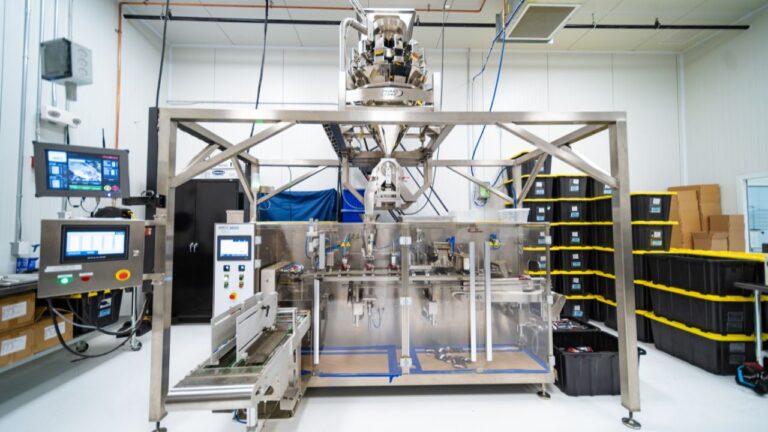
Modern stainless steel automated cannabis pre-roll processing machine in a dedicated production room.

Bostica

Lynn, MA, United States

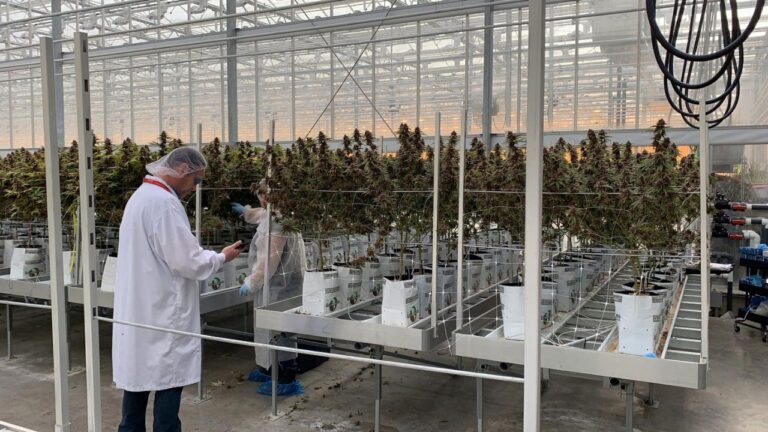
Catalyst BC consultants and LeafLine Cultivation Director inspecting vibrant plants in an organized vertical grow room.

Leafline Labs

Cottage Grove, MN, United States

Catalyst BC consultant recording air, environmental, and plant data measurements within a cultivation facility.

View All Projects

View all Catalyst BC Projects

Reading for Massachusetts Investors and CCC Licensees

Provenance. Figures checked against the statute, regulation and agency text by Catalyst BC on October 8, 2026. General Laws and Chapter 65 were read on the Massachusetts Legislature’s site; 935 CMR 500 and 501 were read in the CCC’s posted text effective September 11, 2026, which the CCC labels unofficial (the official version is sold by the State Bookstore). CCC PDFs and the Information for Voters booklet were read by text extraction. Market data are CCC Metrc figures presented on October 8, 2026; budget figures are our own arithmetic. Company figures come from Catalyst BC’s own records. Where this page and the official text differ, the official text governs.

Massachusetts statutes

Cannabis Control Commission rules and records

Ballot and federal law

Contact Us

Enough about us. We want to hear more about you, your project, and your vision! Get in touch with a real live person today. Don’t worry, we don’t have a long, confusing phone menu, and your email isn’t going to the abyss, we promise. At Catalyst, we provide the service and support we’d want to experience ourselves!

Scroll to Top