Delaware Cannabis Consultants: OMC Stakes, Canopy Tiers and Clean Batches

Delaware cannabis consulting starts with timing: the Office of the Marijuana Commissioner (OMC) has no application window open, so the route in today is an approved stake in, or transfer of, an existing license. We help investors buy in and help licensees grow; our records show 58+ licenses secured.

A Decade of Harvesting Success - Trusted by Cannabis Operators Worldwide

OMC Dates Through Early 2027

Oct 21, 2026Infused-beverage rules take effect
Nov 1, 2026Last conversion licenses expire unless renewed
Feb 6, 2027Latest 18-month mark for the first 64 conditional licenses

Updated: 10/8/2026. Delaware licenses adult-use cannabis under the Delaware Marijuana Control Act (4 Del. C. Chapter 13), administered by the Office of the Marijuana Commissioner, which also runs the medical program after a 2024 merger. Adult-use sales began August 1, 2025 at medical compassion centers holding conversion licenses (OMC launch release); the licenses drawn by lottery in 2024 open one by one as each holder clears background checks, local approvals and a final inspection.

The dates ahead are law changes and license clocks, not an application round. On October 21, 2026, amendments take effect that add an infused-beverage endorsement for licensed manufacturers and certain alcohol licensees. No conversion license could be issued after November 1, 2024, and each expires 24 months after issue, so the last of them lapse by November 1, 2026 unless renewed as open licenses. OMC reported 64 conditional licenses issued by August 6, 2025, and each holder has 18 months to find an approved site and become operational unless OMC extends it for good-faith efforts.

Meet Catalyst BC's Founders

  • Leif Olsen - Chief Executive Officer

    Leif Olsen

    Chief Executive Officer

  • Michael Williamson - Chief Operating Officer

    Michael Williamson

    Chief Operating Officer

  • Ian Miller - Executive Chair

    Ian Miller

    Executive Chair

Our partners bring multi-faceted expertise across business strategy, licensing, facility development, finance, and commercial operations. That breadth is complemented by subject matter experts across the wider Catalyst BC team, allowing us to bring the right combination of experience to each client and project. The result is bespoke, collaborative support shaped around your business, priorities, and goals - with the right expertise brought to the table when it matters most.

Learn more about our team

Hiring a Delaware Cannabis Consultant After the 2024 Lottery

OMC gives applicants technical help with filings, but its own guidance says it “cannot provide legal advice” and urges licensees to consult qualified legal counsel before any change in ownership or control (OMC administrative requests guide). A Delaware cannabis consultant fills the space between OMC’s filing help and a lawyer’s advice: the business plan, the operating and security plans, the capitalization table and the facility that has to pass a final inspection.

Buying Into a Delaware License Without Waiting for a Lottery

For investors new to cannabis, the Act decides what you may buy and when. No change in ownership, officers, directors, financial interest or lease may take effect until it is reported to and approved by the Commissioner (4 Del. C. § 1371). Anyone holding 10% or more of a licensed establishment, and every director and officer, must pass a state and national fingerprint background check (§ 1347). No owner or holder of a financial interest may own or operate more than one establishment of the same license type in a single county, though different license types in one county are allowed, and OMC’s rule exempts converted medical licenses (§ 1344; rule 4.1.2.2). A social equity license may not pass to someone who fails the social equity test until three years after it was awarded as an active license (§ 1366(c)).

OMC also reads the side agreements. Its change-in-ownership form requires disclosure of options, warrants and convertible debt and treats converting debt to equity as a change in ownership that needs prior approval (change-in-ownership form). The guide asks whether a lender holds veto power over daily operations and says the Commissioner may deny any transfer where an outside management, consulting or intellectual-property agreement gives an unlicensed entity “Effective Control.” We structure investor returns as distributions on an approved stake, not as control by contract.

Our work for Delaware investors: diligence on a licensee and its capitalization table through cannabis business strategy; a Delaware cannabis business plan with pro forma statements through cannabis financial planning; ownership-change and future license filings through cannabis license application support; and the local approvals and site work through cannabis startup support.

Already Licensed in Delaware: Canopy Math, 400 CFU and 24-Foot Racks

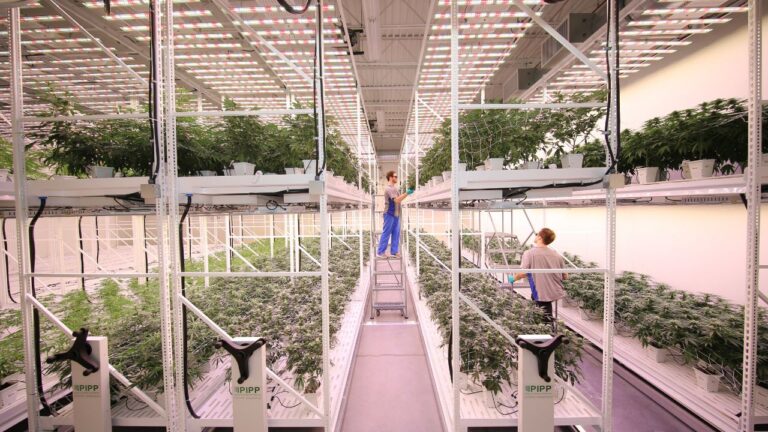
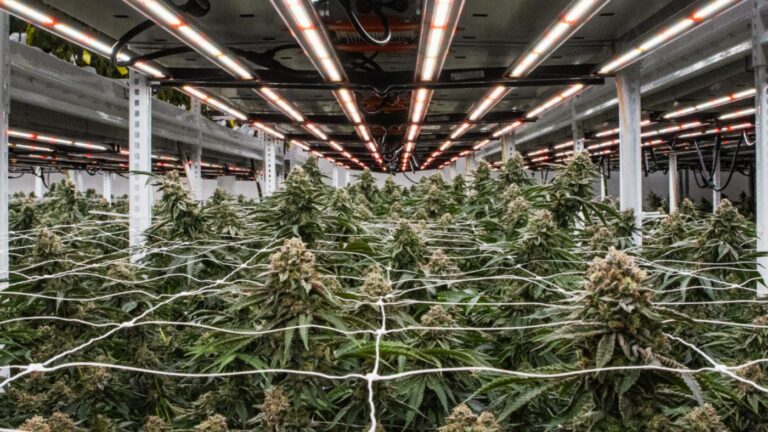
Delaware prices cultivation licenses by canopy, and the Act counts every shelf: if a vertically tiered or shelving system is used, the surface area of each tier counts toward canopy, racks may not exceed 24 feet in height, and areas used only for harvesting, drying, curing, packaging, labeling or storage are excluded (§ 1334(b)). Indoor canopy tops out at 12,500 square feet unless the Commissioner creates more tiers, and a licensee may request a one-tier increase at each renewal with an updated safety, security and diversion plan. A microbusiness licensee may not request a tier increase (rule 5.1.7). The math bites fast: a 7,000-square-foot Tier 2 room that adds a matching second tier reports 14,000 square feet, past the cap. The licensed tier governs first: Tier 2 stops at 7,500, and one tier up at the next renewal allows 10,000, so that second tier can be 3,000 square feet at most (our arithmetic from § 1334).

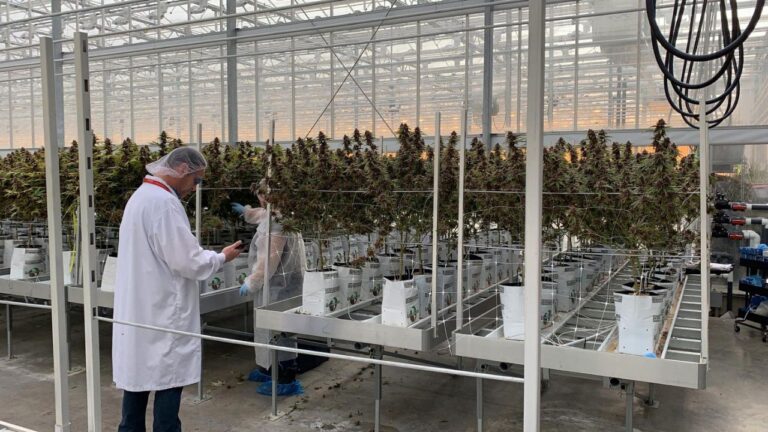
A sample fails at 400 colony-forming units per gram (CFU/g) of mold or of yeast, or on any detected coliform or E. coli (4 DE Admin. Code 5001, rule 11.3). A failed batch may be retested or remediated, except that pesticide failures cannot be remediated; approved methods are pascalization (high-pressure processing), ozone, and non-ionizing and ionizing radiation, and you must act within 30 days of the failure notice or the Commissioner may order destruction (rule 11.6). Flower that fails a retest may go to a licensed manufacturer for extraction, with the Commissioner’s approval first. In our work, a 400 CFU/g limit is decided in the dehumidification design, not after harvest.

For Delaware rooms we work on Delaware cannabis facility design with HVACD (heating, ventilation, air conditioning and dehumidification), controlled environment agriculture targets built around the mold and yeast limits, cannabis vertical farming layouts that weigh each added tier against its canopy fee, operational optimization and, when margins slip, a cannabis turnaround diagnostic. Our Chief Operating Officer and co-founder Michael Williamson has 25,000+ hours in cultivation and dispensary operations and co-founded Greenhaus Industries, which patented stackable trays for growing on multiple tiers.

Our Delaware record: we have not yet had a Delaware client. Leif Olsen, our Chief Executive Officer and a co-founder, leads our licensing work, and Ian Miller, our Executive Chair and a co-founder, raised $22 million in private equity to build a greenfield cultivation and processing operation outside Delaware. We have no Delaware office; we deliver work on-site and remotely, and the same team runs Catalyst BC’s national cannabis consulting practice.

A word against our own interest: OMC posts its forms and application guide free, and in 2024 it warned applicants not to pay upfront fees for help obtaining a social equity license (OMC warning). To talk through a Delaware file, contact us or call (USA) 303-305-3787.


Investing in Delaware cannabis

Already licensed in Delaware

0 +
Years Regulated Cannabis Operations Experience
0 +

Compliant Harvests

0 M+

Square Feet of Cultivation, Production, and Retail Facilities Designed

0 +

Licenses Secured

Is the OMC Taking License Applications in October 2026?

No. OMC’s licensing page reads “No Longer Accepting Applications” (OMC licensing process). The only window for new establishment licenses so far ran August 19 to September 30, 2024, and drew 1,271 applications for 125 licenses in 11 categories, including 529 applications for 15 open retail licenses (OMC release, February 11, 2025). Since August 1, 2025, the Act has let the Commissioner accept applications for any license type and issue more licenses than the 2024 numbers if more stores or facilities are needed, or if fewer licenses of a type were issued than allowed (§ 1343(g)). When a round opens, OMC must announce it at least 10 business days ahead and then accepts applications for 30 calendar days (rule 4.3). OMC’s 2024 annual report said five forfeited licenses would go to a lottery in 2025; the licensing page and OMC releases we read on October 8, 2026 announce no such round. A Delaware cannabis license application in the next round will need the plans and capitalization table described in the lottery section below.

Filing Status Detail
New establishment license (any type) Closed No round announced; any round needs 10 business days’ notice
Change in ownership Open to licensees Prior approval; fee above a 10% change
License transfer without compensation Open to licensees Restructurings and transfers by operation of law, such as on a death
Change in officers or directors Open to licensees Notice within 7 days of the election
Change of premises Open to licensees Application, fee and Commissioner approval
Infused-beverage endorsement From October 21, 2026 Licensed marijuana manufacturers and certain alcohol licensees
Swipe to see the full table →

OMC licensing process page and documents and forms page, read October 8, 2026; 4 Del. C. §§ 1335E, 1366, 1371 to 1375; rule 5.3. Every source is listed at the bottom of this page.

License Open Social equity Microbusiness
Cultivation, canopy above 2,500 sq ft indoor or 1 acre outdoor 20 10 None
Cultivation, canopy up to 2,500 sq ft indoor or 1 acre outdoor None 10 20
Product manufacturing 10 10 10
Retail store 15 15 None
Testing facility 3 2 None
Swipe to see the full table →

4 Del. C. § 1343(c) to (e) and the OMC license application guide; 125 licenses in all.

Stage Rule
Supplemental application and license fee Due 30 days after notice of selection; OMC may extend for good faith
Before a conditional license No buying or growing cannabis, and no transfer of control
Conditional license 18 months to secure an approved site and become operational; OMC may extend
Active license Approved final plans, labor peace attestation, local-law compliance form, site control and a full inspection
Renewal Every two years; apply by the first day of the third month before expiry
Swipe to see the full table →

Rules 4.5, 4.6, 4.8 and 5.1; 4 Del. C. §§ 1345, 1346 and 1353.

Investors who will not wait for a round should read ownership next.

Four OMC Establishment Licenses and Three Ownership Tracks

Delaware’s cannabis law sits in two places: the Act at 4 Del. C. Chapter 13 and OMC’s rules at 4 DE Admin. Code 5001, last amended effective in June 2026 (Rules of the Office of the Marijuana Commissioner). OMC issues four establishment types (retail store, testing facility, cultivation facility and product manufacturing facility) on three tracks: open, social equity and microbusiness, the last for cultivation and manufacturing only. A retail store may buy from licensed cultivators or grow its own supply if it also holds a cultivation license (§ 1332(c)), so one ownership group can hold a store, a grow and a manufacturing facility in the same county, one of each type.

License What it allows Key limit
Retail store Sells cannabis, cannabis products, accessories and non-consumable goods to adults 21+ No online sales or delivery to anyone not in the store
Cultivation facility Grows, harvests, dries, cures and sells flower, kief and trim to other licensees No concentrates or products; batches of 10 pounds or less
Product manufacturing facility Makes and distributes cannabis products Exclusive-use premises and equipment; products must be shelf-stable
Testing facility Tests and researches cannabis ISO/IEC 17025 (lab competence) accreditation; no financial interest in any other license type
Conversion license A medical-program business converted into the adult-use market Retail conversions keep serving medical patients
Swipe to see the full table →

4 Del. C. §§ 1331(19) to 1335B; rule 6.7.

Track Who qualifies
Social equity At least 51% ownership and control by people who lived 5 of the preceding 15 years in a disproportionately impacted area, or who have, or whose parent, guardian, child, spouse or dependent has, a qualifying Delaware marijuana conviction before April 23, 2023
Microbusiness A cultivation or manufacturing applicant that intends to employ no more than 10 people and will not operate more than 2,500 sq ft of canopy
Open Any applicant age 21 or older that is not on the other two tracks
Swipe to see the full table →

4 Del. C. §§ 1336 and 1340 (OMC social equity eligibility page); OMC FAQ.

Every license runs two years. Open and social equity licenses renew only with documentation of a labor peace agreement, an agreement under which a bona fide labor organization agrees not to picket or stop work and the licensee agrees not to disrupt organizing efforts (§ 1302).

OMC Application, Biennial License and Ownership-Change Fees

Every application carries a nonrefundable fee, and a selected applicant pays the biennial license fee before its conditional license issues (rule 4.5; OMC licensing cost page). Social equity and microbusiness licensees pay 40% of the matching open license fee (§§ 1337(b) and 1341(b)).

LicenseApplication feeOpen license (2 years)Social equity or microbusiness (2 years)
Retail store$5,000 open; $1,000 social equity$10,000$4,000 (social equity only)
Testing facility$5,000 open; $1,000 social equity$10,000$4,000 (social equity only)
Product manufacturing$5,000 open; $1,000 social equity; $3,000 microbusiness$10,000$4,000
Cultivation$5,000 open; $1,000 social equity; $3,000 microbusiness$2,500 to $10,000 by canopy tier40% of the tier fee
Swipe to see all fees →

4 Del. C. §§ 1331(5), 1332 to 1335, 1337 and 1341; OMC licensing cost page. The Commissioner may adjust application fees annually for inflation.

Tier Indoor canopy Outdoor canopy Open license fee (2 years)
Tier 1 Up to 2,500 sq ft Up to 1 acre $2,500
Tier 2 2,501 to 7,500 sq ft 1.1 to 2.5 acres $5,000
Tier 3 7,501 to 10,000 sq ft 2.6 to 5 acres $7,500
Tier 4 10,001 to 12,500 sq ft 5.1 to 7.5 acres $10,000
Swipe to see the full table →

4 Del. C. § 1334(b)(3) and (f). Each shelf of a vertical system counts toward canopy.

ItemAmount
Change in ownership or financial interest above 10%$5,000 or 15% of the transaction value, whichever is higher
Conversion license (paid by former compassion centers)$100,000, or $200,000 for cultivation; 10% more if paid over 18 months
Renewing a conversion license as an open license$10,000
Infused-beverage endorsement, from October 21, 2026$1,500 application ($600 for social equity or microbusiness manufacturers); $1,000 renewal ($400)
Fine for a violationAt least $250, up to 10% of estimated average gross monthly sales over the prior 12 months
Swipe to see the full table →

4 Del. C. § 1375; §§ 1335A, 1335E and 1343A; rule 14.2.2.

Budget accordingly: an open retail store pays OMC $15,000 in state fees to reach a two-year license, the $5,000 application plus the $10,000 license fee, while a Tier 4 cultivator pays the same $15,000. An investor buying a stake above 10% for $2 million owes OMC $300,000, 15% of the price (our arithmetic from the fee table above and § 1375). Our cannabis startup costs breakdown covers the build-out side of the budget.

How Delaware’s 2024 Lottery Picked Licensees and What Follows

Delaware chose a pass/fail screen and a random draw instead of scored applications. Each application had to include a business plan with pro forma financial statements, safety, security and diversion plans, an operating plan, a staffing and training plan and a capitalization table; cultivators and manufacturers added environmental and quality assurance plans (OMC license application guide). Passing applications went to lotteries held October 24 and December 19, 2024, in each category with more applicants than licenses, and selected applicants then faced financial and criminal background investigations.

In January 2026 the Marijuana Appeals Commission upheld the denial of a selected retail applicant whose owner did not disclose a conviction, and held that nothing in the Act or rules requires OMC to offer a chance to cure before denying (appeal decision, January 8, 2026). In April 2026 it upheld OMC’s denial of two social equity licenses because OMC found the applicant’s consulting and option agreements predatory: they made it “inevitable,” OMC found, that the licensee would become so indebted that the consultant would take ownership of the licenses (appeal decision, April 22, 2026).

How to open a dispensary in Delaware once you hold the license

These steps apply to a conditional retail licensee preparing to open (rule 4.8 and 4 Del. C. §§ 1351 and 1354).

  1. Confirm the town has not prohibited marijuana establishments and get a certificate of compliance showing the site is zoned for the use and permitted.
  2. Check spacing: no existing retail store within 1,200 feet by road inside a city or town, or within one mile by road in an unincorporated area (OMC may approve a site between 9/10 of a mile and one mile).
  3. Secure legal control of the site through a lease or purchase.
  4. File the labor peace attestation and the final safety, security, diversion and operations plans for approval.
  5. Pass the full site inspection by OMC and the Division of Alcohol, Tobacco and Marijuana Enforcement.

In our work in other states, denials more often start with ownership papers than with floor plans, so our cannabis licensing and application team reviews ownership papers and side agreements first.

Changing Ownership of a Delaware License: Prior Approval and the 15% Fee

OMC sorts changes into four filings: a change in ownership with compensation, a transfer without compensation for restructurings or a death, a change in officers or directors, and a report of a licensee’s death (OMC documents and forms page). A change in ownership covers a change in the entire ownership, a partial change, or a sale or exchange of shares, and the filing includes financial statements for the new owners and everyone holding 10% or more, the sale agreement and the profit and loss distribution (§ 1372).

The OMC guide says the change-in-ownership form is required for every change regardless of percentage, that no transfer is effective without Commissioner approval, and that operating before approval is a violation. If a transfer is later found to violate law or binding contracts, the Commissioner may fine the parties, void the transfer or cancel the license (rule 5.2.4). Lottery selections themselves cannot be transferred (OMC release, December 23, 2024); OMC’s change-in-ownership form, revised March 23, 2026, takes requests from conditional and active licensees, each needing prior approval.

Timing matters as much as price. Until a selected applicant holds its conditional license, it may not transfer an ownership interest that changes who holds the controlling interest, transfer control, or let a social equity applicant fall below the social equity test (rule 4.5.7). Social equity status carries through after that: the license may go only to another qualifying owner for three years after it becomes active. Correction to published guidance (October 8, 2026): a Delaware licensing guide we read on October 8, 2026 says a social equity owner must have lived in a disproportionately impacted area for 5 of the past 10 years. Under 4 Del. C. § 1336(1), the test is 5 of the preceding 15 years.

Where Delaware Allows Cannabis Businesses After SB 75

A city or town may prohibit marijuana establishments by ordinance, and may regulate their time, place, manner and number (§ 1351). Counties’ power to restrict cannabis businesses has been narrower since Senate Bill 75 became law on July 1, 2026, when the General Assembly overrode a veto (OMC legislative update). A county may not prohibit an indoor, fully enclosed cultivation facility in an agricultural or industrial zone, and in a commercial or industrial zone may bar a retail store only within half a mile of another store or within 500 feet of a school or college, licensed child care, residential treatment facility, park or library. Counties must let stores open at least 9 a.m. to 9 p.m. Monday through Saturday and noon to 8 p.m. on Sunday (§ 1351A).

State spacing applies to retail only; House Bill 271, signed June 24, 2026, clarified that state spacing rules do not reach cultivation, manufacturing or testing. If 10 or more people who live or own property within one mile file a protest within 30 days of an application, OMC must hold a hearing (§ 1352(b)). Licensees stay assigned to their counties; OMC may approve a move with proof of efforts in the original county, site control and local zoning confirmation (OMC policy release).

Before you sign a lease, confirm the zoning, the spacing and the building’s fit; our cannabis facility design work starts with that screen.

OMC Testing Rules, Seed-to-Sale Tracking and the 15% Marijuana Tax

Batches must pass compliance testing by a licensed testing facility before moving to a retail store, though OMC may temporarily waive an analyte when public health is not at risk. The licensee picks samples at random under the enforcement division’s supervision, in person or on camera, and a failed result reaches OMC and the licensee within 48 hours (rules 11.1, 11.4 and 11.5). Every licensee tracks cannabis from seed to sale in the state system, and a single serving of an edible may hold no more than 10 mg of THC (rule 8.2).

Converted medical operators carry extra duties. A retail conversion licensee must keep serving patients at its former compassion center, suspend adult-use sales in a shortage and file maximum prices with OMC; converted cultivators and manufacturers report wholesale prices monthly (§§ 1335B to 1335D).

OMC reported $7,354,293 in retail sales in the first month of adult-use sales, with flower 55% of the total, and a statewide plant count of 109,412 (OMC release, September 2, 2025). Its 2024 annual report recorded 88,755 plants processed in 2024, up 20% from 2023, and a 41% rise in bulk storage inventory (OMC 2024 annual report). In our work in other states, rising inventory pushes wholesale prices down, so yield per square foot and first-pass tests decide margins.

Delaware’s 15% Tax and Where the Money Goes

A 15% tax applies to the retail sales price of adult-use cannabis products and is stated separately on the receipt; it does not apply to medical sales (§ 1382). From October 21, 2026, infused beverages are exempt from the 15% tax (§ 1382(a)); OMC says House Bill 373 sets a $0.50 per-container tax on them instead. The store files a return and pays by the 15th of each month for the prior month, even in a month with no sales (rule 13.2). Each month 7% of marijuana tax receipts go to the Justice Reinvestment Fund, and the state fees and taxes replace county and municipal license fees and taxes on the cannabis business itself, though general taxes applied uniformly to a whole class still apply (§§ 1383(e) and 1386).

Two Delaware Engagements Built Around Today’s Rules

Investors get a stake review before they sign: the capitalization table, the one-per-county test and its conversion-license exemption, the 15% fee on the price and every option, loan and consulting agreement OMC will read. Licensees get a canopy and testing review: tier math for your racks, a Delaware cannabis compliance consulting check of your sampling and remediation records against rule 11, and HVACD sized for the 400 CFU/g mold and yeast limits. Send your license type and deal or production figures, and we will tell you plainly if another firm suits you better.

Delaware Cannabis License Questions From Buyers and Growers

No. OMC’s licensing page says it is no longer accepting applications, and no new round had been announced as of October 8, 2026. The Commissioner may open one for any license type, with at least 10 business days’ notice and a 30-day filing window.

By filing OMC’s change-in-ownership request and getting the Commissioner’s approval before the change takes effect. Owners of 10% or more pass a fingerprint background check, and options, convertible debt and outside management agreements must be disclosed.

A change in ownership or financial interest above 10% costs $5,000 or 15% of the transaction value, whichever is higher. On a $2 million purchase that is $300,000.

Applications cost $5,000 for open licenses, $1,000 for social equity and $3,000 for microbusiness. Two-year open licenses cost $10,000 for retail, testing and manufacturing, and $2,500 to $10,000 for cultivation by canopy tier; social equity and microbusiness licensees pay 40% of the open fee.

Canopy is the area used to produce flowering plants, measured around the outermost plants. Every tier of a vertical or shelving system counts, racks may not exceed 24 feet, and areas used only for harvesting, drying, curing, packaging, labeling or storage are excluded. Indoor canopy is capped at 12,500 square feet unless OMC creates more tiers.

Yes, within limits. A batch that fails at 400 CFU/g of mold or yeast may be retested or remediated by pascalization (high-pressure processing), ozone or radiation, and flower that fails a retest may go to extraction with the Commissioner’s approval. Pesticide failures cannot be remediated, and you must act within 30 days.

Yes, if each is a different license type in a given county. No owner or holder of a financial interest may own or operate more than one establishment of the same license type in a single county; converted medical licenses are exempt (rule 4.1.2.2).

A 15% tax applies to the retail sales price of adult-use cannabis products, collected by the store and paid monthly by the 15th. Medical sales are exempt, and from October 21, 2026 so are infused beverages; the state tax replaces local license fees and taxes on the cannabis business itself; general business taxes still apply.

Grow-Room Projects That Inform Our Delaware Work

These projects show the cultivation, extraction and facility work we bring to Delaware licensees; each tile opens its full write-up, and all of them are on our projects page.

Exterior view of the Hexo Venlo glasshouse row spanning over 1 million square feet.

Hexo Corp.

Gatineau, Quebec, Canada

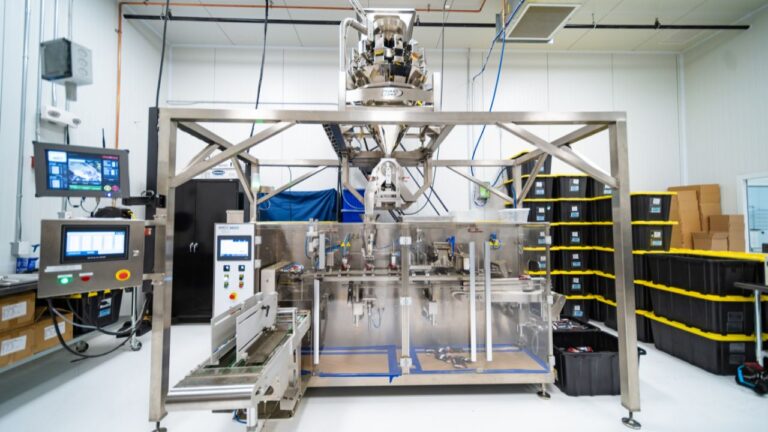
Modern stainless steel automated cannabis pre-roll processing machine in a dedicated production room.

Bostica

Lynn, MA, United States

Catalyst BC consultants and LeafLine Cultivation Director inspecting vibrant plants in an organized vertical grow room.

Leafline Labs

Cottage Grove, MN, United States

Catalyst BC consultant recording air, environmental, and plant data measurements within a cultivation facility.

View All Projects

View all Catalyst BC Projects

Reading for Delaware Buyers and Growers

Provenance. Figures checked against the Act, rule and agency text by Catalyst BC on October 8, 2026. The Act was read on the Delaware Code Online and the rules in the full text OMC’s regulations page links, published in the June 2026 Delaware Register of Regulations. The budget figures are our own arithmetic from the fee schedule; company figures come from Catalyst BC’s own records. Where this page and the official text differ, the official text governs.

Statute and rules

Office of the Marijuana Commissioner pages and records

State of Delaware news releases

Contact Us

Enough about us. We want to hear more about you, your project, and your vision! Get in touch with a real live person today. Don’t worry, we don’t have a long, confusing phone menu, and your email isn’t going to the abyss, we promise. At Catalyst, we provide the service and support we’d want to experience ourselves!

Scroll to Top