Connecticut Cannabis Consultants for EJVs and DCP Growers
Connecticut cannabis consulting for a market with no open lottery, where the Department of Consumer Protection (DCP) admits new owners through equity joint ventures. We serve investors new to cannabis and licensed growers facing falling prices; Catalyst BC has secured 58+ licenses.
A Decade of Harvesting Success - Trusted by Cannabis Operators Worldwide
Connecticut Dates DCP Licensees Face
Updated: 10/5/2026. Connecticut allows adult-use and medical cannabis, both regulated by DCP: adult use under Chapter 420h of the General Statutes and the medical program under Chapter 420f. By September 30, 2025, DCP had issued 112 final licenses to businesses in 53 towns (DCP licensing report, July to September 2025, the latest DCP has published). Retail sales totaled $293.9 million in the 12 months to August 2026, up 1.6% on the 12 months before, our sum of DCP weekly retail sales data.
Public Act 26-8, the 2026 cannabis law, is now fully in force. A disproportionately impacted area (DIA) is a census tract the state designated for its social equity program. December 31, 2026 is the last day DCP may grant a provisional license to an approved DIA cultivator applicant that has not yet applied; after that day, the route closes.
Meet Catalyst BC's Founders
-
Leif Olsen
Chief Executive Officer
-
Michael Williamson
Chief Operating Officer
-
Ian Miller
Executive Chair
Our partners bring multi-faceted expertise across business strategy, licensing, facility development, finance, and commercial operations. That breadth is complemented by subject matter experts across the wider Catalyst BC team, allowing us to bring the right combination of experience to each client and project. The result is bespoke, collaborative support shaped around your business, priorities, and goals - with the right expertise brought to the table when it matters most.
Where DCP Stops and a Connecticut Cannabis Consultant Starts
DCP licenses, inspects and enforces. It does not find you a joint venture partner, structure the deal, price your buildout or tell you whether a grow will clear its costs.
New to Cannabis? How Outside Capital Gets Into Connecticut Today
If your capital comes from outside cannabis, start with what is open. An equity joint venture (EJV) is a new cannabis business of any type except cultivator, at least 50% owned and controlled by people who meet the state’s equity tests, formed with a sponsor: an existing producer, dispensary facility or DIA cultivator. EJVs skip the lottery and have no application window, but the Social Equity Council must approve each one before it applies for a provisional license, and most sponsors may form no more than two (DCP Equity Joint Venture page).
DCP’s report counts 46 EJV licenses issued, provisional or final, out of a possible 74, and puts the remaining room at 26, although 74 minus 46 is 28; the report does not explain the gap. Neither DCP nor the Council publishes which sponsors still have a slot. eLicense, DCP’s online licensing system, has a free lookup (DCP, finding issued licenses) whose license details show when a license was issued as an equity joint venture, but not its sponsor, so a sponsor’s remaining capacity has to be confirmed with the sponsor.
What you may own is written down. A backer is any individual with a direct or indirect financial interest in the business, which the statute defines to include ownership, investment and compensation arrangements, so on our reading a private lender or revenue-share holder is a backer as much as an owner. Only two exemptions apply: a bank or credit union giving non-equity financing with no role in control, and a passive investor whose stake, counting spouse, parent and child, is 5% or less (Chapter 420h, 2026 Supplement). Each backer needs a $100 annual license; DCP’s pages say “5% or more,” but the statute exempts stakes of 5% and below. Outside owners can hold up to 50% of an EJV, a share they split with the sponsor, and up to 35% of a social equity applicant. You do not need to live in Connecticut to hold a license (DCP residency FAQ).
Buying an existing license is narrower than it sounds. Provisional licenses cannot be transferred, no backer may be added between application and final license, and an approved sale of a social equity license to a non-equity buyer ends its reduced fees. Since October 1, 2026, a social equity applicant may make a one-time replacement of an original backer who is not an equity owner. A deal that adds a backer, changes a backer’s stake or merges or acquires an establishment must first be filed with the Attorney General, followed by a 30-day wait, and since October 1, 2026 a deal involving a social equity licensee must also be reported to the Council within 30 days of closing (CGS §21a-422k, amended by Public Act 26-8, §90).
How you get paid is disclosed up front. Every EJV application gives the Council its organizing documents and each backer’s initial investment and payout terms, so any preferred return or payout schedule is on file before approval. From November 1, 2026, no new agreement may give you control of the equity owner’s business.
In the 12 months to August 2026, adult-use sales rose 7.1% to $227.1 million while medical sales fell 13.5% to $66.7 million, our arithmetic from DCP’s weekly sales data.
Our cannabis business strategy team vets the sponsor and structures the deal; cannabis financial planning covers the capital plan, fee schedule and tax model; cannabis licensing and application support prepares the Council and DCP filings; and cannabis startup support takes the site, buildout and launch.
Licensed in Connecticut: Protecting Margin as Flower Prices Fall
For a license holder the pressure is price. The average gram of flower sold for $6.61 in August 2026, down from $8.89 a year earlier and $12.51 at the March 2024 peak (DCP average price per gram), and flower was still about 45% of August sales, our arithmetic from DCP sales by product type. Margin has to come from the room: more saleable grams from each licensed square foot at a lower cost per gram.
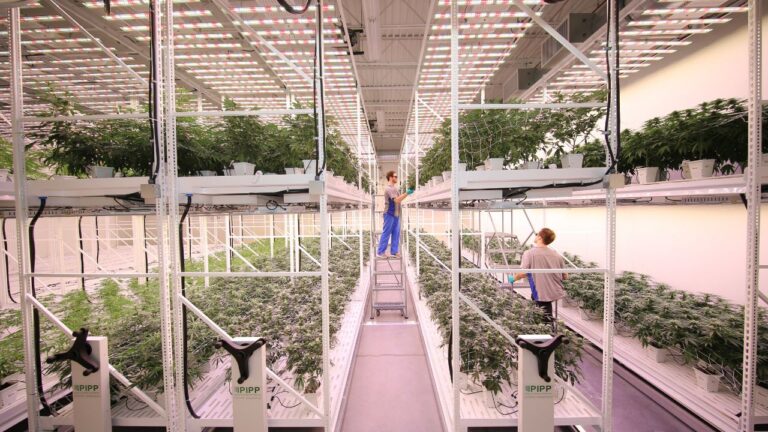
Connecticut’s grow-space (canopy) rules help. Grow space is measured from the outermost walls of the room holding live plants, and stacked tiers do not count separately: only the floor area does (DCP, tiered grow space). A cultivator needs at least 15,000 square feet and, under DCP’s Policies and Procedures, no more than 250,000 (DCP Policies and Procedures, effective November 12, 2024, §21a-421j-23). A micro-cultivator starts at 2,000 to 10,000 square feet and may apply at each renewal to add 5,000, up to 25,000, then move to a cultivator license a year later without a lottery. Before adding racks or making HVAC, electrical or layout changes, a licensee must apply to DCP and wait for written approval, and DCP may inspect the work (Policies and Procedures §21a-421j-12(h)).
For growers we provide cannabis facility design and HVACD engineering (heating, ventilation, air conditioning and dehumidification) for multi-tier rooms, controlled environment agriculture climate targets that reduce mold losses and failed batches, cannabis vertical farming layouts built around the tier rule, operational optimization, and a cannabis turnaround review for a grow whose costs have outrun its selling price. Michael Williamson, our Chief Operating Officer and a former licensed operator, co-founded a company that developed and patented stackable trays for multi-tier growing, and has designed and consulted on more than 7 million square feet of cultivation facilities.
Our Connecticut record. Leif Olsen, our Chief Executive Officer, co-founded Catalyst BC in 2015 and leads our licensing and application work. We serve Connecticut clients on site and remotely, with the same senior team that runs Catalyst BC’s national cannabis consulting practice.
To talk through a Connecticut project, contact us or call (USA) 303-305-3787.

Investing in Connecticut cannabis
- Cannabis Business Strategy ConsultingSponsor and deal vetting
- Cannabis Financial Planning & ModelingCapital, fee and tax models
- Cannabis Licensing & Application SupportCouncil and DCP filings
- Cannabis Startup SupportSite and town approval
Already licensed in Connecticut
- Cannabis Facility Design & HVAC / HVACD EngineeringMulti-tier rooms
- Cannabis Controlled Environment Agriculture (CEA)Fewer failed tests
- Cannabis Vertical Farming ConsultingTiers that add no grow space
- Cannabis Operational OptimizationCost per gram
- Cannabis Business Turnaround & Operational RecoveryWhen price falls below cost
Compliant Harvests
Square Feet of Cultivation, Production, and Retail Facilities Designed
Licenses Secured
No Open Lottery in Connecticut: The Routes That Still Accept Applications
DCP is running no lottery and has announced no future date (DCP Cannabis Licensing Program, dated August 27, 2026). The only lottery round, run in 2022, drew 37,002 entries for 56 licenses, half reserved for social equity applicants.

Connecticut application routes and their status at October 5, 2026
| Filing route | Status | Filed in |
|---|---|---|
| General and social equity lotteries, all license types | Closed; no future date announced | — |
| Equity joint venture with a producer, dispensary facility or DIA cultivator | Open, no window; Social Equity Council approval first | eLicense |
| Retailer converting to hybrid retailer | Open since October 1, 2025; no fee; DCP inspection | eLicense |
| DIA provisional cultivator license, for approved applicants | Open until December 31, 2026 | eLicense |
| Approved DIA applicant switching to micro-cultivator | Open until December 31, 2026 | eLicense |
| Retailer or hybrid endorsement for an indoor micro-cultivator | Open only within one year of its final license; the June 30, 2026 alternative has passed | eLicense |
Sources: DCP Cannabis Licensing Program and license pages; CGS §§21a-420o, 21a-420p, 21a-420s; Public Acts 25-166 and 26-8.
Upcoming Connecticut deadlines and new limits after October 5, 2026
| Date | Event | What it means |
|---|---|---|
| November 1, 2026 | Equity owners may not sign agreements that hand over control | New restriction starts |
| December 31, 2026 | Last DIA provisional cultivator grant; last day to apply to switch to micro-cultivator | Deadline |
| January 15, 2027 | First annual ownership, control and financing certification to the Council | Deadline, then yearly |
| December 31, 2027 | DIA cultivators licensed at 5,000 sq ft must reach 15,000 or pay a $500-a-day extension fee | Deadline |
| July 1, 2028 | DCP’s Policies and Procedures lapse unless adopted as regulations first | Rules end |
Sources: Public Acts 25-166, 26-8 (§§65, 78) and 26-100 (§§51, 54); CGS §§21a-420n, 21a-420o, 21a-420q, 21a-420bb, 21a-420cc, 21a-421j.
A retailer converting to a hybrid retailer pays no conversion fee: it files a conversion form in eLicense and DCP inspects the store before issuing the new license, a step most owners can complete without outside help (DCP retailer conversion notice).
Connecticut’s Establishment Licenses, From 2,000-Square-Foot Micro-Cultivators to Hybrid Retailers
DCP licenses each activity and each location separately, so a second store or a second grow site needs its own license (DCP, separate locations). Producers and dispensary facilities are medical-program licenses that DCP no longer issues; all four producers now also supply the adult-use market.
Connecticut license types and what each one allows
| License type | Activities permitted |
|---|---|
| Cultivator | Grow at 15,000 to 250,000 sq ft; extract and make products if it also meets manufacturer requirements; sell only to establishments and labs |
| Micro-cultivator | Grow, manufacture and package at 2,000 to 10,000 sq ft, expandable by 5,000 a year to 25,000; sell seedlings to consumers by delivery |
| Producer (medical) | Grow for patients, with expanded authorization to supply the adult-use market; no new licenses |
| Product manufacturer | Extraction, chemical synthesis and other manufacturing |
| Food and beverage manufacturer | Use cannabis as an ingredient in food or drink |
| Product packager | Package and label; with a manufacturing expansion, make pre-rolls and register brands |
| Retailer | Adult-use sales only; may convert to hybrid retailer without a lottery |
| Hybrid retailer | Adult-use sales plus medical sales, with a pharmacist available for consultation |
| Dispensary facility (medical) | Medical sales only; no new licenses |
| Delivery service | Deliver to consumers and patients; a town may bar the business locating there but not its deliveries to residents |
| Transporter | Move cannabis between establishments; store it up to 30 days with a $5,000 expansion |
| Cannabis testing laboratory | Test cannabis; must hold ISO accreditation |
Sources: DCP license pages; CGS §§21a-420n, 21a-420p, 21a-420s, 21a-420z; DCP Policies and Procedures §21a-421j-23; DCP 2025 Legislative Updates.
A micro-cultivator that grows only indoors can add a retail or hybrid endorsement within a year of its final license, sited on or beside its own premises, within 100 feet or, since October 1, 2026, in the same DIA; it then gives up the path to a cultivator license and is capped at 25,000 square feet.
Connecticut License Fees Under CGS §21a-420e, From a $100 Backer License to $3 Million Conversions
Fees are set in statute and paid in stages: a lottery entry fee, a provisional license fee, and a final license fee that is charged again at each renewal (DCP license fees). Lottery and application fees are non-refundable (DCP refund FAQ).
Connecticut establishment license fees by stage, general and social equity
| License | Lottery entry | Provisional | Final and each renewal | Social equity or EJV: lottery / provisional / final and first three renewals |
|---|---|---|---|---|
| Cultivator | $1,000 | $25,000 | $75,000 | $500 / $12,500 / $37,500 |
| Micro-cultivator | $250 | $500 | $1,000 | $125 / $250 / $500 |
| Retailer or hybrid retailer | $500 | $5,000 | $25,000 | $250 / $2,500 / $12,500 |
| Product manufacturer | $750 | $5,000 | $25,000 | $375 / $2,500 / $12,500 |
| Food and beverage manufacturer | $250 | $1,000 | $5,000 | $125 / $500 / $2,500 |
| Product packager | $500 | $5,000 | $25,000 | $250 / $2,500 / $12,500 |
| Delivery service or transporter | $250 | $1,000 | $5,000 | $125 / $500 / $2,500 |
| Cannabis testing laboratory | — | $500 | $1,000 | — |
| Backer or key employee; employee registration | — | — | $100; $50 | — |
Sources: CGS §21a-420e(c)–(d); DCP license fees and testing laboratory pages. EJVs are not subject to the lottery.
Connecticut conversion and expansion fees
| Item | Fee |
|---|---|
| Dispensary facility converting to hybrid retailer | $1,000,000, or $500,000 with one EJV (balance owed if the EJV lacks a final license within 24 months) |
| Producer expanding into adult use | $3,000,000, or $1,500,000 with two EJVs; plus $500,000 to the Social Equity Council or a social equity partner agreement |
| DIA cultivator provisional license | $3,000,000 |
| Approved DIA applicant switching to micro-cultivator without a provisional license | $500,000 application fee |
| Retailer converting to hybrid retailer | No conversion fee; renewal stays $25,000 |
| Micro-cultivator retail or hybrid endorsement | Same as the final retailer or hybrid retailer fee |
| Product manufacturer adding food and beverage | $5,000; renewal $5,000 |
| Food and beverage manufacturer adding product manufacturing | $25,000; renewal $25,000 |
| Product packager adding product manufacturing | $30,000; renewal $25,000 in place of the packager renewal |
| EJV ownership change after five years (since May 2026) | $8,000 Council processing fee |
Sources: CGS §§21a-420e, 21a-420l, 21a-420m, 21a-420o, 21a-420p, 21a-420u, 21a-420bb; Public Acts 25-166, 26-8 and 26-100.
Worked example, our arithmetic: an EJV retailer pays $2,500 for its provisional license and $12,500 for its final license, then $12,500 at each of its first three renewals, or $52,500 in state license fees before its fourth renewal brings the full $25,000. Other costs are far larger; the guide to cannabis startup costs from licensing to profitability breaks them down.
From Council Approval to Final License: How DCP Reviews a Connecticut Application
The Social Equity Council reviews ownership, income and residency; DCP checks completeness, backers’ disqualifying convictions and outside findings, then issues a provisional license. That license lasts 24 months (a DIA cultivator’s provisional license has no expiration date), cannot be renewed or transferred and does not allow operating (DCP, provisional licenses).
A final license requires a seed-to-sale tracking contract, a certificate of occupancy showing the right to occupy, local zoning approval, a labor peace agreement with a union on DCP’s approved list (DCP, bona fide labor organizations), a project labor agreement before construction, Council-approved social equity and workforce development plans, diversion policies and security. The whole facility must be built and inspected before the provisional license expires, and DCP aims to inspect at about 25%, 50%, 75% and 100% of the build (DCP buildout FAQ).
How to Open a Dispensary in Connecticut Without a Lottery
- Choose a route that is open. With no lottery, that means an EJV retail license with a sponsor that still has capacity, or conversion of a retailer you already hold.
- Qualify the owners. The equity owner must hold at least 50% and control, and the Council approves the venture before DCP sees it.
- Secure the site and the town. Retailers need a special permit or other affirmative approval from the municipality, and some towns bar retail entirely.
- File and build. Submit the provisional application and every backer’s application in eLicense, then build within 24 months around DCP’s milestone inspections.
- Open compliant. Pay the final fee, register with DRS for the cannabis tax, register every employee and keep to retail hours of 8 a.m. to 10 p.m., and 10 a.m. to 6 p.m. on Sundays. For the store buildout itself, see the guide to opening a retail cannabis dispensary.
Social Equity Council Approval, Backer Rules and What Connecticut Lets a Consultant Do
Every equity route uses the same two tests. The qualifying person must have had average household income below 300% of the state median over the last three tax years and have lived in a DIA for 5 of the past 10 years or for 9 years before turning 18.
Ownership then stays locked for years. No change in the ownership or control of an approved social equity applicant may be made without prior Council approval during provisional licensure and for three years after the final license, or of an EJV during provisional licensure and for seven years after (Public Act 26-100, §52). Since May 2026, a contract may also let an EJV’s equity owner give up control, but only after five years. The EJV must give 90 days’ notice to the Council and to the equity owner, who may ask the Council to review the change. The person taking control then pays an $8,000 fee and any state revolving-loan balance. On our reading, a change before the seventh year still needs the Council’s prior approval.
How Connecticut treats the consultant an equity owner hires
From November 1, 2026, an equity owner may not sign any agreement, a consulting agreement included, that:
- hands operational control to someone who is not an equity owner;
- lets that person control or materially influence hiring, pricing, purchasing, inventory or daily operations;
- makes the owner nominal or passive; or
- weakens the owner’s final say over management and key staff.
Supplying staff, systems or vendors counts as control if the owner comes to depend on it or cannot override it. Bona fide advisory, technical and support services remain allowed.
Our engagement letters for equity owners are written that way: we advise, the owner decides, and nothing we provide becomes something the business cannot replace.
Site Selection for a Connecticut Cannabis Business: Town Approval, Special Permits and DIA Census Tracts
The state sets no distance rule; each town may restrict proximity to churches, schools, hospitals and similar uses, and DCP relies on the town’s zoning approval (DCP distance FAQ). A town may prohibit any or every type of establishment regardless of population, but it cannot stop a delivery service from serving residents (DCP municipal limits FAQ). Retailers and micro-cultivators need a special permit or other affirmative approval, and zoning officials must report cannabis zoning changes to DCP within 14 days (DCP zoning changes).
Since October 1, 2025, a Council-verified DIA cultivator may grow outside a DIA, but not manufacture or extract there, if at least 25% of its staff live in DIAs in year one, 50% in year two and 75% after, and it pays the Council 0.5% of gross revenue from sales to unaffiliated buyers in year one, 1% in year two and 1.5% after. Since July 1, 2026, those cultivators must send at least 80% of each year’s harvest weight to manufacturing or extraction and sell no more than 20% as flower.
Connecticut Cannabis Compliance After Licensing: Testing, THC Limits and the 10.75% Tax
Renewal. Each renewal costs the final license fee, and a business that decides not to renew must tell DCP at least 30 days before expiration. Backers renew at least 45 days before their licenses expire (DCP backer license).
Purchase limits. Retailers may sell a consumer no more than one ounce a day; hybrid retailers and dispensary facilities may sell a patient up to five ounces a day, and since October 1, 2026 that includes out-of-state patients.
THC limits. For adult-use sales, flower may not exceed 35% THC; sales to patients are exempt. Since October 1, 2026, that cap covers flower only, no longer trim and other plant material, and concentrates and other plant material join prefilled vape cartridges outside the 70% cap on other products (Public Act 26-100, §54). DCP’s Policies and Procedures still list the older 30% and 60% limits; Public Act 25-166 raised them on October 1, 2025, as DCP’s notice confirms (DCP 2025 Legislative Updates). Flower or other plant material above 30% and other products above 60%, vape cartridges excepted, must be displayed apart and marked “Warning – High THC” on menus and ads, and concentrates and other plant material above 30% carry a high-potency label warning.
Testing. Under the Policies and Procedures, samples are taken only once a batch, at most 40 pounds of raw cannabis, is in its final form and final packaging; inhalable products fail if a pathogenic Aspergillus species is detected as viable; chromium is on the heavy-metals panel; and a certificate of analysis is valid for one year or until the product’s expiration date, whichever comes first.
Credit. Since October 1, 2026, retailers, hybrid retailers and dispensary facilities may not take more than 30 days’ credit from a cultivator, micro-cultivator or producer, and no establishment may take more than 30 days’ credit from a testing laboratory (Public Act 26-100, §59).
What the flat 10.75% tax changes at the register
The old statewide tax was charged per milligram of THC, so it rose with potency; since October 1, 2026 every adult-use product carries the same 10.75% of its price (Department of Revenue Services). Retailers, hybrid retailers and micro-cultivators register with DRS and file and pay electronically in myconneCT.
Hybrid retailer pharmacist rules after Public Act 26-8
Since Public Act 26-8 took effect on May 20, 2026, trained registered employees may complete medical sales, and the pharmacist need only be available within two hours by telehealth or two business days in person; the old rule that a pharmacist work at least 20 hours a week is gone. A pharmacist must still audit each day’s prescription-monitoring uploads (DCP guidance on PA 26-8).
What happens to a failed Connecticut batch since October 1, 2026
| Clock | Rule |
|---|---|
| Within 60 days of a failed test | Retest, submit a remediation plan to DCP, or dispose of the whole batch |
| Within 60 days of a failed retest | Submit a remediation plan, or dispose of the batch |
| 60 days after DCP receives a plan | DCP approves or rejects it in writing; no answer means approved |
| After an approved remediation | Repeat all required tests; a pass releases the batch, a fail means disposal within 60 days |
| Any disposal deadline | DCP may extend it by 60 days, at most twice per batch |
Source: Public Act 26-8, §52, effective October 1, 2026.
Taxes on a Connecticut adult-use sale since October 1, 2026
| Tax | Rate | On a $22.00 item |
|---|---|---|
| Sales and use tax | 6.35% | $1.40 |
| Municipal cannabis tax | 3.0% | $0.66 |
| Statewide cannabis tax | 10.75% of gross receipts | $2.37 |
| Total at the register | — | $26.43 |
Source: Department of Revenue Services, Cannabis Tax Information (updated September 18, 2026).
Buying Into a Connecticut Joint Venture, or Running a Grow That Should Earn More?
Investors get an EJV deal review in writing before any money moves: what the Council will let you own, how returns must be disclosed, whether the sponsor has used its two slots, and when control can change hands. Licensed growers get a yield and cost-per-gram review: grow space measured the way DCP measures it, room climate, the likely causes of failed tests and a 60-day remediation plan.
What Connecticut Investors and Cultivators Ask Before Committing Capital
Is any Connecticut cannabis license application open right now?
Only as an equity joint venture, or through a conversion or cultivator route you already qualify for. DCP is conducting no lotteries and has announced no future date. EJVs have no application window but need Social Equity Council approval first.
What share of a Connecticut cannabis business may an outside investor hold?
Up to 50% of an equity joint venture and up to 35% of a social equity applicant. On our reading, any individual with a financial interest, including a private lender, is a backer and must be licensed, unless the stake is a passive 5% or less; banks giving non-equity financing are not backers.
Can I buy an existing Connecticut cannabis license?
Provisional licenses cannot be transferred. Ownership changes need Council approval for three years after a social equity final license and seven after an EJV final license, and deals that add or change a backer need an Attorney General filing and a 30-day wait.
What do Connecticut cannabis licenses cost?
Final license and renewal fees run from $1,000 for a micro-cultivator to $75,000 for a cultivator, with retailers at $25,000. Social equity applicants and EJVs pay half for the first three renewals. Conversions cost $1,000,000 for a dispensary facility and $3,000,000 for a producer, halved with EJVs.
Do stacked tiers count toward Connecticut grow space?
No. DCP measures only the floor area inside the outermost walls of the grow room, not each tier, so a multi-tier layout adds growing area without adding licensed grow space.
What does DCP require after a Connecticut batch fails its lab test?
Since October 1, 2026, within 60 days you retest it, submit a remediation plan to DCP or dispose of it. DCP has 60 days to answer a plan or it is deemed approved; a batch that fails after remediation is disposed of within 60 days.
What is Connecticut’s cannabis tax rate now?
Since October 1, 2026, the statewide cannabis tax is a flat 10.75% of gross receipts, replacing the per-milligram THC tax. The 6.35% sales tax and 3% municipal tax still apply, so a $22.00 item totals $26.43.
How long does a converted dispensary or producer have to get its EJVs licensed?
Its EJVs must hold a final license within 24 months of DCP’s approval of the conversion, under Public Act 25-166, or it owes the rest of the full conversion fee. DCP’s older EJV page still says 14 months; the statute governs.
Selected Catalyst BC Projects
None of the projects below is in Connecticut; the tiles show the same team’s work in other markets, and our case studies document measured results.

Hexo Corp.
Gatineau, Quebec, Canada

Bostica
Lynn, MA, United States

Leafline Labs
Cottage Grove, MN, United States

View All Projects
View all Catalyst BC Projects
Further Reading for Connecticut Investors and Growers

Dialing In Your Vertical Cannabis Operations: The Hidden Levers of Efficiency, Yield, and ROI
Dial in your vertical cannabis operations for maximum efficiency, yield, and profitability. By focusing on mechanical systems, plant spacing, airflow strategies, and ergonomic workflows, operators

Secure Funding for Cannabis Businesses: Expert Capital and Financial Planning Strategies
In the rapidly evolving cannabis industry, effective Cannabis Financial Planning is a cornerstone of success. This comprehensive guide provides actionable insights into creating a robust

Maximize Cannabis Yields with Data-Driven Agronomy and Catalyst BC
Cannabis cultivation produces a flood of data—environmental factors (temperature, humidity, leaf VPD, CO₂ levels), substrate metrics (EC, pH, water content, leachate), light intensity, airflow, nutrient
DCP, General Assembly and DRS Records Behind Every Connecticut Figure
Provenance. Every regulatory figure on this page comes from the Connecticut Department of Consumer Protection (its pages, notices, licensing report and Policies and Procedures), the Connecticut General Statutes as published by the General Assembly (Chapter 420h and its 2026 Supplement), Public Acts 25-166, 26-8 and 26-100, and the Department of Revenue Services. Where a 2025 or 2026 Public Act changed an older text, including the 2026 Supplement and DCP’s Policies and Procedures, this page states the current rule. Market figures are DCP data published on data.ct.gov; the 12-month sales totals and changes, the flower share and the year-over-year price change are our arithmetic from those datasets. License counts are from DCP’s licensing report for July to September 2025, its latest published; the EJV count is DCP’s, including its 26-slot figure. Whether a license was issued as an EJV was checked in DCP’s eLicense lookup on October 5, 2026. Company figures are Catalyst BC’s own records. Sources read October 5, 2026. Where this page and DCP, the statutes or DRS differ, the official text governs.
DCP licensing pages and FAQs
- DCP, Cannabis Licensing Program (dated August 27, 2026)
- DCP, Equity Joint Venture (dated December 10, 2021)
- DCP, What are the license fees?
- DCP, Cannabis Testing Laboratory License
- DCP, Adult-Use Cannabis Backer
- DCP, What does it mean if a business has a provisional license?
- DCP, Is the entire facility buildout and inspection required for the final license?
- DCP, Does each tier count towards my grow space?
- DCP, Can I grow, manufacture or package cannabis in two separate locations?
- DCP, Are the lottery and license application fees refundable?
- DCP, Do I need to be a Connecticut resident to hold a license?
- DCP, How can I find out which licenses have been issued?
- DCP, What is a bona fide labor organization?
- DCP, Are cannabis establishments required to be located a certain distance from other buildings?
- DCP, Is there a limit to the number of retailers or micro-cultivators a town can have?
- DCP, Municipal cannabis zoning changes reported to DCP
DCP rules, notices and reports
- DCP, Policies and Procedures, Regulation of Adult Use Cannabis, effective November 12, 2024 (PDF, eRegulations)
- DCP, 2025 Legislative Updates, July 8, 2025 (PDF)
- DCP, Conversion from Adult-Use Cannabis Retailer to Hybrid Retailer, September 30, 2025 (PDF)
- DCP, Guidance re: Medical Cannabis Sales Following PA 26-8, September 3, 2026 (PDF)
- DCP, Adult-Use Cannabis Licensing Report, July 1 to September 30, 2025 (PDF; latest listed on DCP’s Statistics and Documents page on October 5, 2026)
- DCP on data.ct.gov, Cannabis Retail Sales by Week Ending (updated September 10, 2026)
- DCP on data.ct.gov, Cannabis Average Price Per Gram (updated September 10, 2026)
- DCP on data.ct.gov, Cannabis Retail Sales by Product Type (updated September 10, 2026)
Connecticut General Assembly
- Connecticut General Statutes, Chapter 420h, Regulation of Adult-Use Cannabis
- Connecticut General Statutes, 2026 Supplement, Chapter 420h (revised to January 1, 2026)
- Public Act 26-8, An Act Concerning Cannabis, Hemp and Infused Beverage Regulation (PDF)
- Public Act 26-100, An Act Concerning Consumer Protection, Cannabis, Data Privacy, Fire Inspections, Criminal Mischief and Artificial Intelligence (PDF)
Connecticut Department of Revenue Services
Contact Us
Enough about us. We want to hear more about you, your project, and your vision! Get in touch with a real live person today. Don’t worry, we don’t have a long, confusing phone menu, and your email isn’t going to the abyss, we promise. At Catalyst, we provide the service and support we’d want to experience ourselves!