Arizona Cannabis Consultants: ADHS License Buy-Ins, Bigger Grows
Arizona cannabis consulting starts with timing: the Arizona Department of Health Services (ADHS) has no license application window open, so the route in today is buying into an entity that already holds a license. We help investors buy in and help licensees grow; our records show 58+ licenses secured.
A Decade of Harvesting Success - Trusted by Cannabis Operators Worldwide
ADHS and Tax Dates Ahead
Updated: 10/8/2026. Arizona licenses medical marijuana under the Arizona Medical Marijuana Act (A.R.S. Title 36, Chapter 28.1) and adult-use marijuana under the Smart and Safe Arizona Act (Chapter 28.2). ADHS’s Bureau of Marijuana Licensing regulates both programs, and ADHS revised its adult-use rules, 9 A.A.C. 18, effective July 1, 2026 (ADHS statutes and rules page). As of September 1, 2026, ADHS counted 170 adult-use establishments, 169 of them operating, and 136 medical dispensaries (ADHS August 2026 report).
The dates ahead are tax and reporting deadlines, not an application round. Each month’s adult-use excise tax return is due on the 20th of the next month, so September’s return is due October 20. The Arizona Department of Revenue (ADOR) issues transaction privilege tax (TPT) licenses for a calendar year, so each must be renewed for 2027. The medical marijuana testing advisory council reports to the legislature each year by the second Monday in January, which falls on January 11, 2027; its report counts testing deficiencies issued to dispensaries, establishments and laboratories in the year before.
Meet Catalyst BC's Founders
-
Leif Olsen
Chief Executive Officer
-
Michael Williamson
Chief Operating Officer
-
Ian Miller
Executive Chair
Our partners bring multi-faceted expertise across business strategy, licensing, facility development, finance, and commercial operations. That breadth is complemented by subject matter experts across the wider Catalyst BC team, allowing us to bring the right combination of experience to each client and project. The result is bespoke, collaborative support shaped around your business, priorities, and goals - with the right expertise brought to the table when it matters most.
Hiring an Arizona Cannabis Consultant While ADHS Rounds Are Closed
ADHS licenses entities and the people who run them, reviews plans and inspects sites, but it does not structure the deal or design the building. An Arizona cannabis consultant works on that owner side: the diligence on an entity that holds a license, the filings that add new owners, the business plan and the rooms that have to pass inspection and testing.
Buying Into an Arizona License Holder
For investors, the first fact: ADHS returns, with the fee, any establishment license application it receives outside a posted application period (9 A.A.C. 18, R9-18-302(E)). The practical route in is the entity that already holds the license. An entity gives ADHS notice of a planned new principal officer or board member and reports a removal within 10 working days; ADHS answers within 15 working days (R9-18-308(B)(10) and (C)). Each new principal officer or board member must hold a marijuana facility agent license (a dual licensee’s dispensary agent may serve while an application is pending) and attest to having no disqualifying felony, no family or financial tie to a testing laboratory and no ownership in a business whose license was revoked.
Several statutory rules matter to outside capital. A publicly traded company may own or operate an establishment, and one person may be a principal officer or board member of more than one establishment regardless of location (A.R.S. § 36-2858(C) and (H)). Arizona law also makes it state public policy that contracts related to marijuana establishments are enforceable (§ 36-2861).
How profits reach owners depends on the license: a medical-only dispensary must run on a not-for-profit basis, while a dual licensee, an entity holding both a dispensary certificate and an establishment license, may convert to for-profit operation, notifying ADHS within five days after the switch and ADOR promptly, and then pays state income tax.
Our work for Arizona investors: diligence on a license holder and its owner roster through cannabis business strategy; an Arizona cannabis business plan with projected financial statements through cannabis financial planning; ownership updates and future allocation filings through cannabis license application support; and local permits and the approval to operate through cannabis startup support.
Already Licensed in Arizona: Aspergillus, 30-Day Audits and Larger Premises
Arizona’s adult-use statute and rules set no canopy limit. An establishment license covers a single retail site that may also cultivate and manufacture, a single off-site cultivation site and a single off-site manufacturing site (§ 36-2850(21)). Within one license, growth comes from the three sites: more output per square foot or larger approved premises; beyond that, from acquiring more licenses. Since July 1, 2026, enlarging licensed premises at a current location takes its own application with site and floor plans, on a 90-working-day overall time-frame (R9-18-306; Table 1.1).
Microbial testing is the gate every harvest must pass. Inhalable marijuana fails if Aspergillus flavus, fumigatus, niger or terreus is detected in 1 gram, under ADHS’s analyte table; the batch may be remediated and retested, remediated and used for an extract or concentrate, or destroyed, while any Salmonella means destruction (Table 3.1). Within seven days of a failed report you may ask up to two other independent laboratories to retest the remaining sample, and the batch may be sold only if both of them report it compliant. In our work, Aspergillus risk is decided mostly in airflow and dehumidification design, including dry and cure rooms.
Inspections are the other test. ADHS issued 1,050 citations to 225 licenses in 2025, and the most frequent was the rule requiring an inventory audit at least every 30 calendar days, R9-18-314(D)(1), with 54 citations (ADHS 2025 citation report). Indoor plants must grow in a closed, locked room, and outdoor grows need solid 10-foot walls.
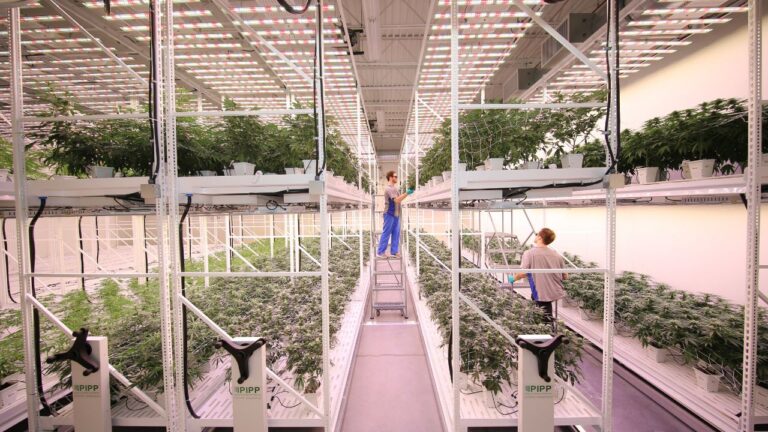
For Arizona rooms we work on Arizona cannabis facility design with HVACD (heating, ventilation, air conditioning and dehumidification), controlled environment agriculture targets built around the Aspergillus test, cannabis vertical farming layouts that add tiers inside approved premises, operational optimization of inventory and labor and, when margins slip, a cannabis turnaround diagnostic. Our Chief Operating Officer and co-founder Michael Williamson has 25,000+ hours (company-reported) in cultivation and dispensary operations and co-founded Greenhaus Industries, which patented stackable trays for growing on multiple tiers.
Our Arizona record: we have not yet had an Arizona client. Leif Olsen, our Chief Executive Officer and a co-founder, leads our licensing work, and Ian Miller, our Executive Chair and a co-founder, raised $22 million (company-reported) in private equity to build a greenfield cultivation and processing operation outside Arizona. We have no Arizona office; we deliver work on-site and remotely, and the same team runs Catalyst BC’s national cannabis consulting practice.
A word against our own interest: ADHS posts its rules, forms and portal training guides free (ADHS training resources), and a licensee can file an ownership update without a consultant. To talk through an Arizona file, contact us or call (USA) 303-305-3787.

Investing in Arizona cannabis
- Cannabis Business Strategy ConsultingDiligence on an Arizona license holder
- Cannabis Financial Planning & ModelingPro formas net of the 16% excise tax
- Cannabis Licensing & Application SupportOwnership updates and future rounds
- Cannabis Startup SupportLocal permits and approval to operate
Already licensed in Arizona
- Cannabis Facility Design & HVAC / HVACD EngineeringDehumidification against Aspergillus
- Cannabis Controlled Environment Agriculture (CEA)Climate that passes microbial tests
- Cannabis Vertical Farming ConsultingMore tiers inside approved premises
- Cannabis Operational OptimizationInventory audits, yield and labor
- Cannabis Business Turnaround & Operational RecoveryRecovery before a renewal or sale
Compliant Harvests
Square Feet of Cultivation, Production, and Retail Facilities Designed
Licenses Secured
Is ADHS Taking Marijuana License Applications in October 2026?
No. ADHS’s establishment page invites interested parties to sign up for email notice of any future allocations; no application period was posted when we read it on October 8, 2026 (ADHS establishment page). When ADHS may issue more licenses under the cap of one for every 10 pharmacies, it posts a round at least 30 calendar days ahead and draws at random if oversubscribed. At ADHS’s December 2025 pharmacy count, that cap works out to 132 licenses (our arithmetic); the county and social equity licenses were issued outside it, and the ADHS pages we read do not show how many of the 170 licenses count against it.
The medical program has a narrower opening. ADHS’s December 24, 2025 review counted 1,323 open pharmacies and 136 dispensary registration certificates, with no more available under the one-in-ten formula, but Apache and La Paz counties had no dispensary certificate, so one certificate will be allocated for each (ADHS dispensary allocation page). ADHS says that 10-working-day period will be posted in 2026, at least 30 calendar days before it opens. An Arizona cannabis license application in either program must be ready before the window opens.
ADHS filings open and closed on October 8, 2026
| Filing | Status | Detail |
|---|---|---|
| New marijuana establishment license | Closed | Only during a posted application period |
| New medical dispensary certificate | Closed | One each for Apache and La Paz counties when a period is posted |
| Approval to operate | Open to license holders | Within 18 months after the license issues |
| Move, add a site, enlarge premises or add an activity | Open to license holders | A separate application for each change |
| Add or remove a principal officer or board member | Open to license holders | Information update in the facility portal |
| Marijuana facility agent license | Open to individuals | Individual application to ADHS |
ADHS establishment and dispensary allocation pages, read October 8, 2026; 9 A.A.C. 18, R9-18-102, -302, -304, -306 and -308. Every source is listed at the bottom of this page.
How Arizona has allocated adult-use licenses so far
| Round | When | Result |
|---|---|---|
| Early applicants: dispensaries in good standing, and applicants in counties with fewer than two dispensaries | January 19 to March 9, 2021 | Licenses to qualified dispensaries; county applicants went to a drawing |
| County licenses by random selection | April 19, 2021 | 13 licenses allocated |
| Social Equity Ownership Program | Applications December 1 to 14, 2021; drawing April 8, 2022 | 26 licenses |
| Any future round | When ADHS posts one | Random drawing if oversubscribed |
A.R.S. § 36-2854(A)(1)(b) to (f); ADHS establishment page; ADHS list of licenses allocated April 19, 2021; ADHS social equity pages.
From allocation to an operating store
| Stage | Rule |
|---|---|
| After allocation | Each principal officer or board member obtains a facility agent license before the approval-to-operate application |
| Approval to operate | Apply within 18 months after the license issues; ADHS inspects before you open |
| Opening | Retail site open at least 30 hours a week between 7 a.m. and 10 p.m., within 18 months of the license |
| License term | Two years |
| Renewal | Apply at least 30 calendar days before the license expires |
A.R.S. § 36-2854(A)(1)(g); R9-18-302(C), -304(A), -307 and -308(B)(1).
Investors who will not wait for a round should jump to ownership.
One Establishment License, Three Sites, and Arizona’s Dual Licensees
Arizona’s licensing law sits in A.R.S. Title 36, Chapters 28.1 and 28.2, and two rule chapters, 9 A.A.C. 17 for the medical program (9 A.A.C. 17) and 9 A.A.C. 18 for adult use. ADHS issues the marijuana establishment license, the nonprofit medical marijuana dispensary registration certificate and laboratory credentials (a marijuana testing facility license, or a laboratory registration certificate under 9 A.A.C. 17), and an entity holding the first two is a dual licensee. There is no separate cultivation or manufacturing license; those activities ride on the establishment license or the dispensary certificate. A medical-only dispensary must also name a medical director; a dual licensee is exempt from that rule (R9-17-324(C)).
What each Arizona credential allows, and its limits
| License | What it allows | Key limit |
|---|---|---|
| Marijuana establishment | One retail site that may sell, cultivate and manufacture; one off-site cultivation site; one off-site manufacturing site | No sales to consumers from the off-site locations; one ounce per sale, no more than five grams of concentrate |
| Nonprofit medical dispensary | Dispenses to registered patients and caregivers, with one additional cultivation location | Operated on a not-for-profit basis |
| Dual licensee | Holds both and serves patients and adult consumers at a shared location | May not transfer one credential without the other |
| Marijuana testing facility | Tests potency and contaminants | No family or financial tie to an establishment |
| Marijuana facility agent | Individual license for principal officers, board members and employees | Valid two years; must be 21 or older with no excluded felony offense |
A.R.S. §§ 36-2850, 36-2804, 36-2806, 36-2855 and 36-2858; R9-18-305(A) and -309(A).
The Social Equity Ownership Program test
| Requirement | Rule |
|---|---|
| Licenses | 26, drawn April 8, 2022 from applications filed December 1 to 14, 2021 |
| Ownership | At least 51% held by principal officers or board members who each met three of four criteria |
| Criterion 1 | Household income below 400% of the poverty level in at least three of the years 2016 to 2020 |
| Criterion 2 | A personal Arizona marijuana conviction, or an expungement under A.R.S. § 36-2862 |
| Criterion 3 | A spouse, parent, child, sibling or legal guardian with such a conviction, or eligible for expungement |
| Criterion 4 | Lived at least three of the years 2016 to 2020 in an area ADHS identified as disproportionately affected |
| Ongoing duty | Policies on how the establishment benefits affected communities, such as hiring or donating part of gross profits |
ADHS how-to-qualify page; ADHS social equity allocation page; R9-18-308(B)(2)(g).
Every establishment and testing facility license runs two years (§ 36-2854), and a dual licensee renews both credentials on one date, the earlier of the two. ADHS must make at least one unannounced inspection of each licensed facility every year.
ADHS Application, Renewal and Change Fees for Arizona Licenses
The fees in the adult-use fee rule are nonrefundable (R9-18-102). ADHS currently charges $25,000 to apply for an establishment license and $5,000 to renew it, and an applicant that is not drawn in a round does not get its fee back.
Adult-use establishment and testing facility fees
| Item | Fee |
|---|---|
| Establishment license application | $25,000 |
| Establishment license renewal (every two years) | $5,000 |
| Approval to operate | $2,500 |
| Change of retail, cultivation or manufacturing site location | $2,500 |
| Adding a cultivation or manufacturing site | $2,500 |
| Adding approved activities at a site | $2,500 |
| Testing facility license, initial / renewal | $25,000 / $5,000 |
| Facility agent license, initial or renewal | $300, or $150 with a level 1 fingerprint clearance card; an initial fee is waived under a state fee waiver for individuals who meet set criteria (A.R.S. § 41-1080.01) |
9 A.A.C. 18, R9-18-102(A).
Medical dispensary and card fees
| Item | Fee |
|---|---|
| Dispensary registration | $4,000 |
| Dispensary renewal | $1,000 |
| Change of dispensary or cultivation site location, or adding a cultivation site | $2,500 each |
| Changing or adding activities | $2,500 |
| Dispensary agent card | $500 |
| Qualifying patient card | $150, or $75 with food-assistance (SNAP) participation |
Taxes and penalties
| Item | Amount |
|---|---|
| Adult-use excise tax | 16% of the retail price; not charged on medical sales to registered patients |
| Transaction privilege tax | Retail TPT on both medical and adult-use sales, at state, county and city rates |
| ADHS civil penalty | Up to $2,000 per violation; each day is a separate violation |
| Unauthorized delivery | $20,000 per violation |
A.R.S. § 42-5452; § 36-2864; § 36-2854(B)(2) and (E).
Budget accordingly: a newly allocated establishment pays ADHS $27,500 in license fees before it opens, the $25,000 application fee plus the $2,500 approval to operate, then $5,000 every two years. On $1 million of adult-use retail sales, the excise tax is $160,000, with TPT on top (our arithmetic from § 42-5452). Our cannabis startup costs breakdown covers the build-out side of the budget.
How ADHS Draws Arizona Licenses and What Comes After the Draw
ADHS allocates adult-use licenses by random drawing when a round is oversubscribed, never by scoring business plans. An applicant files, during the posted period, the entity’s details and proposed retail site address, its Arizona Corporation Commission good standing, a facility agent license and signed attestations for every principal officer or board member, and the $25,000 fee. No principal officer or board member may appear on more than two applications in a round (R9-18-303).
ADHS’s overall time-frame is 90 working days to decide a license application and 45 working days for an approval to operate, and ADHS does not treat an approval-to-operate application as complete until you notify it that the site is ready for inspection (R9-18-103; Table 1.1).
A compliant applicant that is not drawn receives a written notice saying so; ADHS states that the notice is not a denial. Licenses issued to a county under the early-applicant county allocation stay in that county: the retail site may move only within it (§ 36-2854(A)(1)(c); R9-18-305(D)).
Five steps to open an Arizona dispensary after allocation
These steps apply to an establishment that has been allocated a license (R9-18-302(C) and R9-18-304).
- Make sure every principal officer and board member holds a marijuana facility agent license.
- Confirm the city or county has not prohibited establishments, and get the occupancy document, such as a certificate of occupancy or a conditional use permit.
- Have the local jurisdiction sign the zoning compliance statement and document ownership or notarized owner permission, each dated within 60 calendar days.
- Apply for approval to operate within 18 months of the license, with site and floor plans, your TPT number and the $2,500 fee.
- Pass the ADHS inspection, then open at least 30 hours a week between 7 a.m. and 10 p.m.
In our work in other states, delays more often start with permits and ownership papers than with floor plans, so our cannabis licensing and application team checks those first.
Changing Ownership of an Arizona Establishment Through ADHS Information Updates
ADHS’s principal officer and board member handbook describes a change of ownership as an information update filed in the facility portal: you add or remove principal officers and board members, each new one needs a facility agent card linked to the facility (the 2024 handbook also accepts a dispensary agent card; the July 2026 rule asks for the facility agent license number), and you upload legal documentation such as bylaws or Arizona Corporation Commission filings (ADHS PO/BM handbook). R9-18-102 lists no fee for adding or removing a principal officer or board member.
Several rules shape a deal. No principal officer or board member may have had an ownership interest in a marijuana business, in Arizona or any other state, whose license was revoked. No establishment may have a direct or indirect family or financial tie to a testing facility. A dual licensee keeps both credentials through any change in ownership unless it gives up dual status by forfeiting one, and may transfer them only together, to the same entity (§ 36-2858(D)(3); R9-18-305(A); R9-17-324(B)). In a new license application, a publicly traded corporation need not disclose people entitled to less than 10% of its profits.
Diligence has a public starting point. ADHS’s AZCareCheck database shows inspections and enforcement for adult-use establishments and testing laboratories, but citations against medical dispensary licenses are confidential by statute, so a medical-only target’s compliance history must come from the seller’s records. Ask for every ADHS statement of deficiencies (written inspection findings) and accepted plan of correction from the last two years before you price the deal.
The 26 social equity licensees carry a duty other licensees do not: a written policy on how the establishment benefits communities disproportionately affected by past enforcement. Correction to published guidance (October 8, 2026): an Arizona consulting page we read on October 8, 2026 says social equity applicants had to prove Arizona residency for at least three years. ADHS’s test was different: owners of at least 51% each met three of four criteria, one of them living for three of the years 2016 through 2020 in an area ADHS identified, and applications closed December 14, 2021 (ADHS social equity FAQ).
Where Arizona Cities and Counties Allow Marijuana Establishments
A city, town or county may limit establishments to zones, cap their number, regulate their time, place and manner of operation, restrict signs, prohibit or restrict delivery, or ban them outright; a county acts only in unincorporated areas (§ 36-2857). A locality may not be more restrictive than its rules for medical dispensaries, may not make operation unduly burdensome where it allows establishments, and may not allow one within 500 feet of a public or private school, a child care facility or a preschool program. A similar 500-foot rule binds a medical dispensary and its cultivation site, measured from schools and child care in place before it applied.
Delivery is legal under ADHS rules, but only from your retail site, only on an order received during posted hours, never to federal, state, local government or state university property, and with no more than $10,000 in retail value in a vehicle at once (R9-18-312.01). Online and social media advertising is allowed only where at least 73.6% of the audience is expected to be 21 or older, and every ad must carry the state warning (§ 36-2859).
Before you sign a lease, confirm the zoning, the 500-foot rule and the building’s fit; our cannabis facility design work starts with that screen.
ADHS Testing, Inventory Audits and Arizona’s 16% Excise Tax
Each batch is sampled once under ANSI/ASQ Z1.4, a statistical sampling standard, unless ADHS flags a lab report as possibly inaccurate, stored apart from saleable stock until results arrive, and sold only if it meets Table 3.1. Since July 1, 2026, labs report Total THC for adult-use products as THC-A (the acid form of THC) multiplied by 0.877 plus delta-8, delta-9 and delta-10 THC, and a label whose claim is off by more than 20% of the tested value must be revised (ADHS lab information update 11). Edibles are capped at 10 mg of THC per serving and 100 mg per package.
Adult-use sales have gone flat: ADOR estimates adult-use taxable sales of $1.07 billion in fiscal year 2024, $1.05 billion in 2025 and $1.08 billion in 2026 (ADOR collections by period). In our work in other states, flat sales push prices down, so yield per square foot and first-pass tests decide margins.
Grow sites draw their share of findings: in 2025 ADHS issued 175 citations at establishment cultivation sites, to 33 licenses, and 220 at dispensary cultivation sites, to 50 licenses. ADHS accepted a plan of correction for every citation that year, and 69 citations led to enforcement.
Arizona’s 16% Excise Tax and Where the Money Goes
The excise tax applies to marijuana and marijuana products a marijuana establishment sells to consumers, at 16% of the price; it does not apply to marijuana dispensed to registered patients or caregivers by a dispensary or dual licensee, and it is kept out of the TPT base. Retailers need a TPT license and a separate marijuana excise tax registration, filed on paper (ADOR adult-use page), and the monthly excise return is due on the 20th of the following month (ADOR FAQ). Twice a year the Smart and Safe Arizona Fund, after costs, sends 33% to community colleges, 31.4% to police, fire and sheriffs’ departments, 25.4% to the highway user revenue fund, 10% to justice reinvestment and 0.2% to the attorney general (§ 36-2856). Localities may not add marijuana-specific taxes or fees.
Two Arizona Engagements Built Around the July 2026 Rules
Investors get an entity review before they sign: the owner roster and facility agent licenses, the revoked-license and laboratory-tie attestations, dual licensee, county-fixed and for-profit status and an Arizona cannabis business plan net of the 16% excise tax. Licensees get a testing and inventory review: an Arizona cannabis compliance consulting check of your sampling, retest and 30-day audit records against R9-18-311 and R9-18-314, and HVACD sized to cut Aspergillus risk in inhalable batches. Send your license type and deal or production figures, and we will tell you plainly if another firm suits you better.
What Investors and Licensed Growers Ask About ADHS Licensing
Is Arizona accepting marijuana establishment license applications right now?
No. ADHS had posted no application period as of October 8, 2026. ADHS posts any new period at least 30 calendar days ahead, accepts applications for 10 working days and draws at random if oversubscribed.
How does an investor buy into an Arizona marijuana establishment?
Usually by acquiring an interest in the entity that holds the license. The entity notifies ADHS when a principal officer or board member is to be added, each new one must hold a marijuana facility agent license (a dual licensee’s dispensary agent may serve while an application is pending) and sign attestations, and ADHS responds within 15 working days.
How much does an Arizona marijuana establishment license cost?
The application fee is $25,000 and renewal is $5,000 every two years. Approval to operate costs $2,500, each change of site location or added site or activity costs $2,500, and a facility agent license costs $300, or $150 with a fingerprint clearance card, unless waived.
Can I apply for a medical dispensary certificate in Apache or La Paz County?
Not yet. ADHS’s December 2025 review found no dispensary in either county, so one certificate will be allocated for each. ADHS says the 10-working-day period will be posted in 2026, at least 30 calendar days before it opens.
Does Arizona cap cultivation canopy for adult-use licensees?
No. The statute and rules set no canopy limit. An establishment may cultivate at its retail site and one off-site cultivation site, and since July 1, 2026 enlarging licensed premises at a current location needs ADHS approval.
What happens when an Arizona batch tests positive for Aspergillus?
Inhalable marijuana fails if any of four listed Aspergillus species is detected in 1 gram. You may request retesting by up to two other independent laboratories within seven days, and the batch is saleable only if both pass; otherwise remediate and retest, remediate for extraction, or destroy it.
Can Arizona adult-use dispensaries deliver?
Yes. Delivery must start from the retail site on an order taken during posted hours, carry no more than $10,000 in retail value per vehicle and avoid government property, and a locality may prohibit or restrict delivery.
What taxes apply to Arizona marijuana sales?
Adult-use sales carry a 16% excise tax plus retail transaction privilege tax. Medical sales to registered patients pay TPT but no excise tax, and localities may not add marijuana-specific taxes or fees.
Cultivation and Facility Projects Behind Our Arizona Advice
These projects show the cultivation, extraction and facility work we bring to Arizona licensees; each tile opens its full write-up, and all of them are on our projects page.

Hexo Corp.
Gatineau, Quebec, Canada

Bostica
Lynn, MA, United States

Leafline Labs
Cottage Grove, MN, United States

View All Projects
View all Catalyst BC Projects
Reading for Arizona Investors and Licensed Operators

Dialing In Your Vertical Cannabis Operations: The Hidden Levers of Efficiency, Yield, and ROI
Dial in your vertical cannabis operations for maximum efficiency, yield, and profitability. By focusing on mechanical systems, plant spacing, airflow strategies, and ergonomic workflows, operators

Cannabis Startup Costs: From Licensing to Profitability
Starting a legal cannabis business isn’t just about getting a license—it’s about building a profitable, compliant, and sustainable operation in one of the world’s most

Demystifying HVACD Systems for Cannabis Grow Facilities
Cannabis grow rooms require precisely controlled environments, making Heating, Ventilation, Air Conditioning, and Dehumidification (HVACD) systems essential for success. As plants progress through their growth
Arizona Sources: A.R.S. Title 36, 9 A.A.C. 17 and 18, ADHS and ADOR Records
Statutes and rules
- A.R.S. § 36-2850, definitions (Smart and Safe Arizona Act)
- A.R.S. § 36-2854, rules, licensing, fees and civil penalties
- A.R.S. § 36-2855, marijuana facility agents
- A.R.S. § 36-2856, Smart and Safe Arizona Fund
- A.R.S. § 36-2857, localities
- A.R.S. § 36-2858, lawful operation and dual licensees
- A.R.S. § 36-2859, advertising
- A.R.S. § 36-2861, contracts
- A.R.S. § 36-2864, transaction privilege tax; additional taxes prohibited
- A.R.S. § 36-2804, dispensary registration
- A.R.S. § 36-2806, dispensary requirements
- A.R.S. § 36-2821, medical marijuana testing advisory council
- A.R.S. § 42-5452, marijuana excise tax
- A.R.S. § 42-5453, excise tax returns
- 9 A.A.C. 18, Adult-Use Marijuana Program (unofficial version effective July 1, 2026)
- 9 A.A.C. 17, Medical Marijuana Program
Arizona Department of Health Services pages and records
- Statutes and rules
- Adult-use establishments
- Dispensary certificate allocation (review of December 24, 2025)
- Social equity: how to qualify
- Social equity allocation, April 8, 2022
- Social equity FAQ
- Establishment licenses allocated April 19, 2021
- Principal officer and board member handbook
- Training resources
- Arizona Marijuana Program monthly report, August 2026
- Bureau of Marijuana Licensing citation findings, 2025
- Laboratory information update 11 (March 23, 2026)
Arizona Department of Revenue
Contact Us
Enough about us. We want to hear more about you, your project, and your vision! Get in touch with a real live person today. Don’t worry, we don’t have a long, confusing phone menu, and your email isn’t going to the abyss, we promise. At Catalyst, we provide the service and support we’d want to experience ourselves!