Alaska Cannabis Consultants for AMCO Licensing, Residency and Yield
Alaska cannabis consulting starts with an open door: AMCO accepts license applications year-round with no statewide cap, but every owner must be an Alaska resident. We work with resident investors and licensed operators chasing yield; our records list 58+ licenses secured nationwide and Alaska client work from 2016 to present.
A Decade of Harvesting Success - Trusted by Cannabis Operators Worldwide
Board Dates and AMCO Deadlines
Updated: 10/7/2026. Alaska voters legalized adult-use marijuana with Ballot Measure 2 on November 4, 2014, now Alaska Statutes chapter 17.38 (AS 17.38). The five-member Marijuana Control Board votes on licenses; the Alcohol and Marijuana Control Office (AMCO) is its staff and enforcement arm and applies the board’s regulations, 3 AAC 306 (AMCO Marijuana Statutes and Regulations). The market they oversee is sizable: AMCO’s license search listed 201 retail stores, 111 standard and 79 limited cultivation facilities, 43 product and 25 concentrate manufacturers, and two testing labs as active and operating on October 7, 2026 (AMCO Marijuana License Search).
The dates ahead are board meetings, comment deadlines and renewals, not a licensing round. Written comments on two board proposals close October 20, 2026 (AMCO regulations page), and the board’s next regular meeting is November 18–19, 2026, in Anchorage (AMCO home page). Every license renews each year: the renewal is due June 30, and a license not renewed by the end of August 31 expires.
Meet Catalyst BC's Founders
-
Leif Olsen
Chief Executive Officer
-
Michael Williamson
Chief Operating Officer
-
Ian Miller
Executive Chair
Our partners bring multi-faceted expertise across business strategy, licensing, facility development, finance, and commercial operations. That breadth is complemented by subject matter experts across the wider Catalyst BC team, allowing us to bring the right combination of experience to each client and project. The result is bespoke, collaborative support shaped around your business, priorities, and goals - with the right expertise brought to the table when it matters most.
What an Alaska Cannabis Consultant Does That AMCO Examiners Can’t
AMCO tells applicants to plan for a four- to six-month process, says its examiners have no authority to approve or expedite an application, and does not give legal advice (AMCO Marijuana FAQs). An Alaska cannabis consultant handles the rest: an ownership structure the residency rule allows, local approval, the premises and an operating plan the board accepts.
Investing in Alaska Cannabis When Every Owner Must Live Here
If you are new to cannabis and have capital, start with who may own. Alaska requires every person with a direct or indirect financial interest in a licensed business to be an Alaska resident, and AMCO traces each owning company down to the individuals behind it. The rule itself names two ways to be paid without owning: rent from real estate leased to a licensee, including percentage rent (rent tied to the tenant’s sales), and a consulting fee for services the rules allow (3 AAC 306.015).
Residents have three routes in: a new license; a minority stake in a company that holds a license, which the director approves as an ownership change; or control of an operating business, which needs the board’s written consent first and, AMCO says, four to six months to process; AMCO warned in January 2026 that moving shares or membership interests to a buyer before approval violates the rules (AMCO advisory on license transfers).
Lending to a licensee is limited too. A license cannot be pledged as collateral or foreclosed on. The only security interest in a license the rules allow is a seller’s, on a sale of 100% of the license, letting the seller take it back if the buyer stops paying for property sold with it (3 AAC 306.049; 306.051). Before you lend to a licensee, get AMCO’s view in writing on whether your terms create a financial interest.
Our work for Alaska investors: purchase diligence through cannabis business strategy; the capital plan and pro forma through cannabis financial planning; residency, transfer and ownership-change filings through cannabis license application support; and site, local approval and opening work through cannabis startup support.
Already Licensed in Alaska: Per-Ounce Tax, Two Labs and Winter Rooms
Alaska taxes the cultivator by weight, not price: $50 an ounce for bud and flower sold or transferred to a store or manufacturer (AS 43.61.010), with lower rates for other plant parts. Because the tax stays fixed per ounce while prices move, cost per gram decides your margin.
Testing is the second margin risk. Each harvest package, up to 10 pounds of dried flower, must pass required tests before sale, and a failed sample means disposing of that package unless AMCO or the board approves turning it into CO2 or solvent extract (3 AAC 306.455; 3 AAC 306.660). A retest is possible on written request, at your cost. With two labs active and operating statewide, schedule samples so a retest does not stall a harvest.
Alaska sets no canopy cap: 3 AAC 306 puts no square-foot limit on a standard cultivation license, but any change to the licensed floor plan needs the director’s written approval first (3 AAC 306.705). In our experience, HVAC (heating, ventilation and air conditioning) and dehumidification sized for long, cold winters are where Alaska rooms win or lose yield.
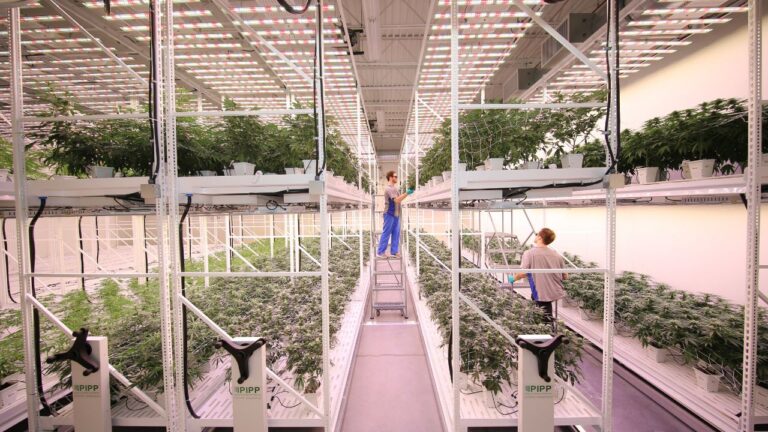
For Alaska rooms we work on cannabis facility design and HVACD (HVAC plus dehumidification) engineering, controlled environment agriculture targets for temperature, humidity and airflow, cannabis vertical farming layouts that add yield inside an approved floor plan, operational optimization and, when cost per gram climbs, a cannabis turnaround diagnostic. Michael Williamson, our Chief Operating Officer, co-founded Greenhaus Industries, where his team developed and patented stackable cultivation trays for growing on multiple tiers.
Who does the Alaska work: Leif Olsen, our Chief Executive Officer and a co-founder, leads licensing and application work, and our records list Alaska client work from 2016 to present. We have no Alaska office; we work with Alaska clients on-site and remotely, and the same team runs Catalyst BC’s national cannabis consulting practice.
A word against our own interest: AMCO publishes every form, an application flow chart and training videos free, and a resident with a lease, a clean record and a willing city or borough can file without us (AMCO Marijuana License Application). To talk through an Alaska file, contact us or call (USA) 303-305-3787.

Investing in Alaska cannabis
- Cannabis Business Strategy ConsultingPurchase diligence on operating licenses
- Cannabis Financial Planning & ModelingCapital plans without outside equity
- Cannabis Licensing & Application SupportResidency, transfer and ownership filings
- Cannabis Startup SupportLocal approval, lease and opening
Already licensed in Alaska
- Cannabis Facility Design & HVAC / HVACD EngineeringHeating and dehumidification for winter rooms
- Cannabis Controlled Environment Agriculture (CEA)Climate targets that protect test results
- Cannabis Vertical Farming ConsultingMore yield inside an approved floor plan
- Cannabis Operational OptimizationCost per gram against a per-ounce tax
- Cannabis Business Turnaround & Operational RecoveryRecovery when margins slip
Compliant Harvests
Square Feet of Cultivation, Production, and Retail Facilities Designed
Licenses Secured
Alaska License Applications Are Open Year-Round
Yes, you can apply today. Ignore any page that tells you to wait for an application window: you start an application online at any time with a myAlaska account and an Alaska business license number. The board must decide within 90 days of a complete application, though not before the local government’s 60-day protest period ends unless the local government waives it (3 AAC 306.075). A city or borough may set its own cap on the number of businesses (AS 17.38.210).
Review takes time even when nothing goes wrong. The NJ-CRC’s posted averages, dated September 9, 2025, are 4 to 5 weeks for a conditional application and 12 to 26 weeks for an annual or conversion application (NJ-CRC License Application Process).
Which Alaska licensing filings are open (October 7, 2026)
| Filing | Status (October 7, 2026) | Who files |
|---|---|---|
| New license: retail store, standard or limited cultivation, product or concentrate manufacturing, testing | Open year-round | Applicants whose every owner is an Alaska resident |
| Onsite consumption endorsement | Open | Retail marijuana store licensees |
| Transfer of a license, or of a controlling interest, to another person | Board’s written consent first | Buyer and current licensee (3 AAC 306.045) |
| Ownership change below a controlling interest | Director’s approval first | Existing licensees; every new owner a resident (3 AAC 306.040) |
| Transfer to another location | Board’s written consent first | Existing licensees (3 AAC 306.046) |
| Conversion between limited and standard cultivation, or concentrate and product manufacturing | Open | Same licensee at the same location (3 AAC 306.047) |
Statuses from 3 AAC 306 and AMCO pages read October 7, 2026; every source is listed at the bottom of this page.
AMCO and board dates through 2027
| Date | What happens |
|---|---|
| October 20, 2026, 4:30 p.m. | Written comments close on the proposed total-THC limits for edibles (3 AAC 306.560) and on notice-of-defense timing (3 AAC 306.816) |
| November 18–19, 2026 | Regular board meeting in Anchorage, also on Zoom |
| By May 1, 2027 | AMCO sends renewal notices to active and operating licensees |
| June 30, 2027 | Renewal application and fees due; a filing after this date is late |
| August 15, 2027 | AMCO sends expiration notices to licensees that have not filed |
| August 31, 2027 | Licenses not renewed expire at the end of the day |
| September 30, 2027 | Last day to apply for reinstatement of an expired license |
Dates from AMCO’s home and regulations pages and 3 AAC 306.035, read October 7, 2026.
Deadlines triggered by your filing or an AMCO notice
| Clock | Rule |
|---|---|
| Public notice | Post 10 days at the premises and one other public spot; run a newspaper notice once a week for 3 weeks, or radio twice a week for 3 weeks; all within the 90 days before you submit the last application item and fees (3 AAC 306.025) |
| Incomplete application | 90 days to finish after AMCO’s notice, or file and pay again |
| Local government protest | 60 days from AMCO’s notice of a complete application (3 AAC 306.060) |
| Public objection | 30 days (3 AAC 306.065) |
| Board decision | Within 90 days of a complete application |
| After a denial | Written reasons within 15 days; then 15 days to request an informal conference or a formal hearing (3 AAC 306.080–.090) |
| Notice of violation | 10 days to respond in writing (3 AAC 306.809) |
3 AAC 306.025–.090 and 306.809.
With no state cap or window, the real limit is local approval; see local option.
Six AMCO License Types and the Onsite Consumption Endorsement
The board issues six license types and one endorsement for retail stores. One owner group may hold a store, a cultivation facility and a manufacturing facility together, in separate rooms or board-approved shared areas, but no store, cultivator or manufacturer may have any financial interest in a testing facility (3 AAC 306.305(c); 306.405(b); 306.505(b); 306.300(b); 306.400(c); 306.500(c)).
Permissions and limits for each AMCO license
| License | What it allows | Key limit |
|---|---|---|
| Retail marijuana store | Sells to consumers; may add walk-up or drive-through window pick-up under a board-approved plan (3 AAC 306.380) | Closed 5 a.m. to 8 a.m. (3 AAC 306.310); per person per day, 1 ounce, 7 grams of concentrate and 5,600 mg of THC in all (3 AAC 306.355) |
| Standard cultivation | Grows, harvests, packages and sells to stores, manufacturers and other cultivators | No square-foot cap in 3 AAC 306; size set by the approved premises diagram |
| Limited cultivation | Same privileges as standard cultivation | Fewer than 500 square feet under cultivation (3 AAC 306.400) |
| Standard product manufacturing | Extracts concentrate and makes edibles, tinctures and topicals | Board approval for each product; edibles up to 10 mg THC a serving and 100 mg a package (3 AAC 306.560) |
| Concentrate manufacturing | Makes and sells concentrate only | No other products; infused butter, oils or fats only at wholesale to another manufacturer |
| Testing facility | Independent testing for potency and contaminants | Owners may hold no other license or financial interest (3 AAC 306.605) |
3 AAC 306.005 and 306.300–306.615.
Operating licenses on AMCO’s search, October 7, 2026
| License | Active and operating | All records listed |
|---|---|---|
| Retail marijuana store | 201 | 345 |
| Standard cultivation | 111 | 239 |
| Limited cultivation | 79 | 234 |
| Product manufacturing | 43 | 94 |
| Concentrate manufacturing | 25 | 57 |
| Testing facility | 2 | 8 |
Our count of AMCO license search results by status, October 7, 2026; “all records” includes expired, surrendered, abandoned and pending files.
Onsite consumption works in two tiers. Any store may get an endorsement for edibles only, indoors or outdoors; consumption by any method, including smoking, is allowed only at a freestanding store, one whose building holds no tenant except licenses owned by the same group. An indoor smoking area needs its own ventilation, with plans signed by a licensed mechanical engineer, and an outdoor area requires mailed notice to neighbors within 250 feet (3 AAC 306.370).
AMCO License Fees Under 3 AAC 306.100
The board’s fee schedule, as amended on May 29, 2025, charges a new and a renewed license the same annual fee (3 AAC 306.100). You pay the annual license fee with the application, and the board refunds it only if it denies the application.
Application and annual license fees by license type
| License | Application fee | Annual license fee (new or renewed) |
|---|---|---|
| Retail marijuana store | $1,000 | $5,000 |
| Standard cultivation | $1,000 | $5,000 |
| Limited cultivation | $1,000 | $1,000 |
| Standard product manufacturing | $1,000 | $5,000 |
| Concentrate manufacturing | $1,000 | $1,000 |
| Testing facility | $1,000 | $1,000 |
| Onsite consumption endorsement | $1,000 | $2,000 |
3 AAC 306.100(a) and (d). Renewals add the renewal application fee in the next table; fingerprints are extra.
Renewal, change, transfer and penalty fees
| Fee | Amount |
|---|---|
| Renewal application | $600, plus $600 more for an onsite consumption endorsement |
| Late renewal (filed after June 30) | $1,000 extra |
| Reinstatement of an expired license | 100% of the renewal license fee, plus the renewal fees |
| Transfer to another person or location | $1,000 application fee |
| License conversion | $1,000 application fee, plus any increase in the annual license fee (3 AAC 306.047) |
| Ownership change below a controlling interest | $250 if you hold one license; $500 if two or more |
| Change of business name, premises diagram or operating plan, or a new product | $250 |
| Second inspection after failing a preliminary inspection | $500 (the director may waive it) |
| Marijuana handler permit card, new or renewed (valid 3 years) | $50 |
| Late renewal after unpaid taxes | $200, $500, $5,000 or $10,000, rising with each stage of the dispute |
| Fingerprint background check | $50 per person from October 1, 2026 |
3 AAC 306.100(a)–(i) and 306.700; fingerprint fee from AMCO’s October 2026 notice.
Marijuana excise tax rates paid by cultivators
| Plant part | Rate |
|---|---|
| Mature bud and flower | $50 per ounce |
| Immature or abnormal bud | $25 per ounce |
| Trim | $15 per ounce |
| Clone | $1 each |
AS 43.61.010; rates below $50 set by the Department of Revenue, effective January 1, 2019 (Tax Division, Marijuana Tax).
Budget accordingly: a new retail store pays $6,000 in state fees to apply, the $1,000 application fee plus the $5,000 annual license fee, and $50 for each owner’s fingerprints; every June 30 after licensing it pays $5,600 more to renew (our arithmetic from 3 AAC 306.035 and .100). Check any fee list against the rule: some pages still show a $7,000 store renewal or a $48.25 fingerprint fee, and neither matches the current schedule. The larger costs are the lease you must hold before you apply, local permits and the build. Our cannabis startup costs breakdown covers the rest of the budget.
How the Marijuana Control Board Approves an Alaska License
Alaska does not score or rank applications, and there is no lottery. The board must deny a new application if it finds a ground listed in 3 AAC 306.080: an incomplete file or a false statement, a location or owner the rules bar, a local prohibition, an operating plan that does not show compliance, a finding that the license is not in the public’s best interests, or a local protest the board does not find arbitrary, capricious and unreasonable, meaning without a rational basis. Approval takes a majority of the board’s whole membership (AS 17.38.111).
How to open a dispensary in Alaska
Alaska’s term for a dispensary is a retail marijuana store.
- Confirm that your city or borough allows a retail store and that its zoning allows your site.
- Secure the premises by deed or lease in the applicant’s name, at least 500 feet from the protected uses listed under local option.
- Start the application online, then post and publish the public notice and send it to the local government and community council.
- File the operating plan, supplemental forms, fingerprints and fees; once AMCO deems the file complete, the 60-day local protest and 30-day objection periods run.
- Win the board’s vote, pass AMCO’s preliminary inspection and open only once the license is issued.
A cultivator may start at preliminary inspection with up to 12 mother plants and any number of immature plants and seeds (3 AAC 306.405). The grounds you can control are the ones to prepare for: an owner who fails the residency test, premises you cannot prove you hold, and a file AMCO finds incomplete. That is where our cannabis licensing and application team and startup support begin.
Alaska Residency, Financial Interest and License Transfers
The board will not issue, renew or transfer a license unless every owner, officer and director, down to each partner, LLC member and shareholder, is an Alaska resident. A resident is a person eligible, at the time of application, for the most recent Permanent Fund Dividend (PFD), Alaska’s annual payment to residents. PFD eligibility requires living in Alaska for the entire prior calendar year (AS 43.23.005), so a newcomer must first live in Alaska from January through December; someone who arrives in March 2026 first qualifies for the 2028 dividend. AMCO checks names with the Permanent Fund Division and warns that anyone who does not apply for the PFD should expect a longer review.
Renewals have one release valve: the board may renew for a licensee who no longer meets the PFD test if the primary residence is still in Alaska and there is good cause that is temporary (3 AAC 306.035).
Ownership changes need approval before they happen. Selling a controlling interest, meaning 50% or more of a corporation, or less where one person and family run it, is a transfer that needs the board’s written consent. Any other change in owners, percentages, officers or directors is an ownership change the director approves only if each new owner is a resident (3 AAC 306.040; 306.045; 306.990). The seller must list every debt and tax the business owes, and the board denies a transfer while those are unpaid unless they are secured (3 AAC 306.080). A transfer filed between April 30 and August 31 must come with, or after, that year’s renewal application.
Local Option, Local Protests and Alaska’s 500-Foot Rule
In our experience, local approval decides more Alaska projects than state review does. A city or borough may ban any license type, or all sales, by ordinance or vote, including just the onsite consumption endorsement or its smoking, vaping or outdoor use (3 AAC 306.200). Licenses inside a newly prohibited area are void 90 days after the vote is certified or the ordinance takes effect (3 AAC 306.250). A borough’s power generally applies only outside the cities within it (AS 17.38.210(m)), and an unincorporated village of 25 or more residents in the unorganized borough can vote its own ban within a five-mile radius (AS 17.38.300–.350). AMCO’s local option page listed no ordinances on October 7, 2026, says its records are not comprehensive and tells applicants to ask the community directly (AMCO Marijuana Local Option).
Where licenses are allowed, the local government may still protest; a conditional protest only requires you to meet local conditions first. Outside any local government you need a petition: within 50 miles of a local government’s boundary, signed by a majority of permanent residents within one mile; farther out, by two-thirds of those within five miles of the nearest post office (3 AAC 306.030).
The state buffer is 500 feet from a school ground, a recreation or youth center, a building with regular religious services, or a correctional facility, measured along the shortest pedestrian route from your public entrance; premises in use before the protected use arrived can still be renewed or sold. A licensed premises cannot sit inside a liquor-licensed premises (3 AAC 306.010). Our cannabis facility design work starts with that site screen.
Alaska Cannabis Compliance Consulting: Metrc, Testing and Excise Tax
Every plant and package is tracked from seed or cutting to sale in Metrc, the state system AMCO contracted from Franwell. Each mature or flowering plant carries a tag, and a store reconciles its sales to Metrc at the close of every day (3 AAC 306.435; 306.330).
Every licensee, employee and agent needs a marijuana handler permit, valid three years, before starting work. Cameras must cover every restricted area, entrance and point of sale, and recordings must be kept 40 days; theft or diversion must be reported to AMCO within 24 hours (3 AAC 306.720; 306.700; 306.715).
Required tests cover potency (THC, THCA, CBD, CBDA and CBN), harmful microbes and Aspergillus molds, and residual solvents in solvent-based concentrates. Pesticides are not on the routine list, but AMCO may order random samples of growing media, fertilizers, pesticides and water at the cultivator’s cost (3 AAC 306.645; 306.465). Since January 8, 2026, labs must report total THC as delta-9 THC plus 0.877 × THCA (0.877 adjusts for the weight THCA loses when heat turns it into THC) (AMCO total THC advisory). Cultivators may not treat flower with terpenes to change its color, look, weight or smell (AMCO terpene advisory), and AMCO says it will pursue products that mix marijuana with hemp converted to delta-9 THC (AMCO hemp-derived THC advisory).
Civil fines can reach three times the gain from a violation or, for serious conduct, $10,000, $30,000 and $50,000 for first, second and later violations, plus up to three years of probation (3 AAC 306.840; 306.836).
Who files and pays Alaska’s marijuana excise tax
Only cultivators file and pay, every month, by the last day of the month for the previous month’s sales and transfers (AS 43.61.020). Unpaid taxes, including local ones, can block a renewal (3 AAC 306.080; 306.100(g)).
From August 2025 through July 2026, cultivators reported 104,256 ounces of bud and flower, 348,768 ounces of immature or abnormal bud and 822,186 ounces of trim, about $26.3 million in calculated tax (our sum of the monthly figures in the Tax Division monthly marijuana report). Flower pays $50 an ounce, immature or abnormal bud $25 and trim $15, so your average tax per gram depends on how a harvest is graded, not on how much you grow; statewide, cultivators reported 3.3 times as many ounces at the $25 rate as at $50, and trim paid about $12.3 million.
Before You Sign an Alaska Lease or Add Grow Rooms
Resident investors get an ownership and site review before they commit: whether every owner passes the residency test, whether the city or borough allows the license, whether the site clears the 500-foot rule, and how a purchase must be sequenced for the board’s consent. Licensed operators get a cost-per-gram review: lab results and failed batches, tax per ounce against yield, and a floor-plan change AMCO can approve. Send your license type, community and capital or production figures; if we are not the right fit, we will say so.
Alaska Marijuana Control Board Licensing Questions
Can I apply for an Alaska marijuana license right now?
Yes. Alaska has no application window and no statewide cap, so you can start an application with AMCO at any time. The board decides within 90 days of a complete application, after the local government’s 60-day protest period; AMCO tells applicants to plan for four to six months overall.
Do I have to be an Alaska resident to own a cannabis business?
Yes. Every person with a direct or indirect financial interest must be eligible for the most recent Permanent Fund Dividend, which requires living in Alaska for a whole January-to-December year first. Non-residents may be landlords, including on percentage rent, or paid consultants, but may not hold equity (3 AAC 306.015).
What does an Alaska marijuana license cost?
Every new license has a $1,000 application fee. The annual license fee is $5,000 for a retail store, standard cultivation or standard product manufacturing facility, and $1,000 for limited cultivation, concentrate manufacturing or testing. An onsite consumption endorsement adds $1,000 to apply and $2,000 a year (3 AAC 306.100).
Can a resident buy an operating Alaska marijuana business?
Yes, if every buyer is a resident. Buying a controlling interest is a license transfer that needs the board’s written consent first, with a $1,000 application fee; smaller ownership changes need the director’s approval. AMCO’s January 2026 advisory says moving shares to the buyer before approval violates the rules and can lead to discipline.
Can a city or borough block an Alaska cannabis business?
Yes. A city or borough can ban some or all license types by ordinance or vote, and can protest any application within 60 days; the board denies an application after a protest that is not conditional unless it finds the protest arbitrary, capricious and unreasonable. Check the local ordinance before you sign a lease.
Is there a size limit on Alaska cultivation licenses?
Only for the limited license, which must have fewer than 500 square feet under cultivation, measured from the perimeter of the floor or growing space. 3 AAC 306 sets no square-foot cap for a standard cultivation license; its size is the premises diagram the board approves, and any expansion needs the director’s written approval. Ask AMCO in writing before stacking racks in a limited license.
How is marijuana taxed when it leaves an Alaska grow?
The cultivator pays a state excise tax when it sells or transfers marijuana to a store or manufacturer: $50 an ounce for mature bud and flower, $25 for immature or abnormal bud, $15 for trim and $1 per clone, filed and paid monthly with the Department of Revenue (AS 43.61).
Can an Alaska store let customers consume on site?
Yes, with an onsite consumption endorsement. Any retail store may allow edibles only; smoking or vaping is allowed only at a freestanding store, outdoors or in an indoor area with its own ventilation. Each customer may buy up to 1 gram of flower, 25 milligrams of THC in edibles and a 0.3-gram vape a day for use on site.
Catalyst BC Cultivation and Facility Projects
These projects outside Alaska show the cultivation and facility work we bring to Alaska clients; the results for each sit in our case studies.

Hexo Corp.
Gatineau, Quebec, Canada

Bostica
Lynn, MA, United States

Leafline Labs
Cottage Grove, MN, United States

View All Projects
View all Catalyst BC Projects
More Reading: Alaska Cannabis Lounges and Startup Budgets

How Much Does It Cost to Open a Cannabis Dispensary in 2026
The allure of jumping into the legalized cannabis industry often paints a picture of quick riches and burgeoning demand, yet the reality of establishing a

Cannabis Startup Costs: From Licensing to Profitability
Starting a legal cannabis business isn’t just about getting a license—it’s about building a profitable, compliant, and sustainable operation in one of the world’s most

Alaska Cannabis Lounge Licensing: A Comprehensive Guide for Operators and Investors
Alaska has emerged as a pioneer in permitting on-site cannabis consumption, authorizing licensed retail marijuana stores to add consumption lounge endorsements. As an Alaska cannabis
Alaska Regulatory Sources: AS 17.38, 3 AAC 306, AMCO and Tax Division Records
Provenance. Every regulatory figure on this page is drawn from Alaska Statutes chapters 17.38 and 43.61, AS 43.23.005, the Marijuana Control Board’s regulations at 3 AAC 306, and the pages, notices, advisories and license search of the Alcohol and Marijuana Control Office, with tax figures from the Department of Revenue, Tax Division. 3 AAC 306 was read in AMCO’s compilation effective May 29, 2025 and checked against the Legislature’s online Alaska Administrative Code on October 7, 2026; AMCO lists no amendment adopted since. Statutes were read in the Legislature’s Alaska Statutes 2025. Items described as proposed are proposed, not adopted. License counts and the 12-month tax total are our own arithmetic from AMCO and Tax Division data. Company figures come from Catalyst BC’s own records. Sources were read October 7, 2026. Where this page and the official text differ, the official text governs.
Alcohol and Marijuana Control Office pages, notices and data
- AMCO, Marijuana Statutes and Regulations (3 AAC 306 effective May 29, 2025; proposals open to October 20, 2026)
- AMCO, 3 AAC 306 compilation, Regulations for the Marijuana Control Board, updated May 29, 2025
- AMCO, Marijuana FAQs (four- to six-month process; residency; Metrc)
- AMCO, Marijuana License Application (forms, flow chart, training videos)
- AMCO, home page (November 18–19, 2026 board meeting; $50 fingerprint fee from October 1, 2026)
- AMCO, 2026–2027 Licensee Renewal Application Notice (renewal fees; June 30 and August 31 deadlines)
- AMCO, Marijuana License Search (license counts by status, October 7, 2026)
- AMCO, Marijuana Local Option (list not comprehensive)
- AMCO advisory, Marijuana License Transfer & Ownership Applications, January 8, 2026
- AMCO advisory, Laboratory Reporting Requirements for Total THC, January 8, 2026
- AMCO advisory, Marijuana Products with Hemp-Derived THC, January 8, 2026
- AMCO advisory, Treatment of Marijuana with Terpenes by Cultivation Facilities, April 16, 2025
- AMCO, Proposed Regulations FAQ, total THC in edible marijuana products (proposed, not adopted)
- AMCO, Proposed Regulations FAQ, notice of defense under 3 AAC 306.816 (proposed, not adopted)
Alaska Administrative Code, 3 AAC 306
- 3 AAC 306.010, License restrictions (500-foot buffer; liquor premises; zoning protest)
- 3 AAC 306.015, License conditions (residency; financial interest; PFD definition)
- 3 AAC 306.025, Application procedure (public notice; 90-day limits)
- 3 AAC 306.030, Petition in an area with no local government
- 3 AAC 306.035, Renewal (June 30; August 31; reinstatement; residency exception)
- 3 AAC 306.040, Ownership change
- 3 AAC 306.045, Transfer of a license to another person
- 3 AAC 306.046, Transfer of a license to another location
- 3 AAC 306.047, License conversion
- 3 AAC 306.049, Foreclosures; license not collateral
- 3 AAC 306.051, Retained security interest (100% transfers only)
- 3 AAC 306.060, Protest by local government
- 3 AAC 306.065, Public participation (30-day objection)
- 3 AAC 306.075, Procedure for action on application (90 days)
- 3 AAC 306.080, Denial of license or endorsement
- 3 AAC 306.100, Fees; refund (as amended May 29, 2025)
- 3 AAC 306.200, Local options
- 3 AAC 306.250, Effect on licenses of a local prohibition (void after 90 days)
- 3 AAC 306.300, Retail store license (no interest in a testing facility)
- 3 AAC 306.305, Retail store privileges (co-ownership with cultivation or manufacturing)
- 3 AAC 306.310, Acts prohibited at retail store (closed 5 a.m. to 8 a.m.)
- 3 AAC 306.355, Limit on quantity sold
- 3 AAC 306.370, Onsite consumption endorsement
- 3 AAC 306.380, Walk-up or drive-through window
- 3 AAC 306.400, Cultivation license types (limited: fewer than 500 sq ft)
- 3 AAC 306.405, Standard cultivation privileges (12 mother plants at preliminary inspection)
- 3 AAC 306.435, Cultivation inventory tracking (10-pound packages)
- 3 AAC 306.455, Required laboratory testing before sale
- 3 AAC 306.465, Random sampling
- 3 AAC 306.500, Product manufacturing license (no interest in a testing facility)
- 3 AAC 306.505, Product manufacturing privileges (co-ownership)
- 3 AAC 306.560, Edible potency limits
- 3 AAC 306.605, Testing facility license (no common interest)
- 3 AAC 306.645, Required laboratory testing
- 3 AAC 306.660, Failed materials; retests
- 3 AAC 306.700, Marijuana handler permit (3 years)
- 3 AAC 306.705, Licensed premises; alteration
- 3 AAC 306.715, Security; 24-hour theft report
- 3 AAC 306.720, Video surveillance (40 days)
- 3 AAC 306.809, Notice of violation (10 days)
- 3 AAC 306.836, Probation (up to 3 years)
- 3 AAC 306.840, Civil fines
- 3 AAC 306.990, Definitions (controlling interest; square feet under cultivation; total THC)
Alaska Statutes
- AS 17.38.111, Meetings; majority of whole membership
- AS 17.38.210, Local control (borough powers outside cities, subsection (m))
- AS 17.38.300, Local option election by an established village (through 17.38.350)
- AS 43.61.010, Marijuana excise tax
- AS 43.61.020, Monthly statement and payments
- AS 43.23.005, Permanent Fund Dividend eligibility
Department of Revenue, Tax Division
Contact Us
Enough about us. We want to hear more about you, your project, and your vision! Get in touch with a real live person today. Don’t worry, we don’t have a long, confusing phone menu, and your email isn’t going to the abyss, we promise. At Catalyst, we provide the service and support we’d want to experience ourselves!